Here is a video from Lindybeige featuring World of Tanks researcher Nicholas “The Chieftain” Moran looking at the Churchill tank.
Lindybeige and The Chieftain ramble over a Churchill tank (with added Sherman)
January 4, 2018 by 1 Comment
Inside the Chieftain’s Hatch: SOMUA S35 part 2
January 4, 2018 by 1 Comment
Part 2 of the Chieftain’s video on the SOMUA S35.
Tank Chats #43 Matilda I
January 4, 2018 by 1 Comment
The Tank Museum at Bovington presents another installment in their Tank Chat series.
Inside the Chieftain’s Hatch: SOMUA S35 part 1
December 18, 2017 by 1 Comment
The Chieftain has posted a video on the French WWII era Somua S 35. Enjoy.
Video: The Great War
November 28, 2017 by Leave a Comment
From The Great War youtube channel comes a couple videos on WWI British Tanks.
Translated articles from Tank Archives.com
November 27, 2017 by Leave a Comment
It’s time to go see what’s been going on over at the Tank Archives.com blog. Here is a sample of the latest Russian language articles they have translated into English for your reading pleasure. Click on the headline to read the full article.
Czechoslovakian Dead End
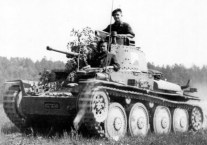 The greatest success of the Czechoslovakian tank industry was with light tanks. The LT vz. 35 and LT vz. 38 turned out to be excellent vehicles, used by several nations during WWII. Despite the fact that Skoda’s T-15 and Pz.Kpfw.38(t) n.A. did not make it past the prototype stage, the chassis of the latter was used for the Jagdpanzer 38(t) tnak destroyer. It is not surprising that, after the end of the war and start of work on the TVP medium tank, work on a new light tank began in parallel. The result of that work was several interesting prototypes, such as the TNH 57/900, Skoda T-17, and the amphibious Letak.
Frenchman in German Hands
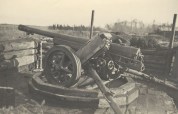 The belligerents in WWII had to improvise time and time again. Obsolete weapons, no longer suitable for their initial purpose, found surprising new applications. One of the most notable examples of such a “second life” is the German conversion of the French 75 mm Mle. 1897 field gun, as a result of which the 19th century weapon became an effective anti-tank gun.
Devourer of Tungsten
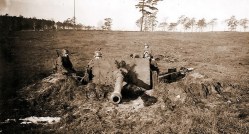 In late summer of 1942, the Red Army captured a German weapon that piqued the interest of the Red Army Main Artillery Directorate. This was the new German tapered bore 7.5 cm Pak 41. Several shells were captured along with the gun, which allowed trials to be performed and several characteristics to be determined. What was this gun, and what were the results of its trials in the USSR?
Adventures of the Centurion in Scandinavia
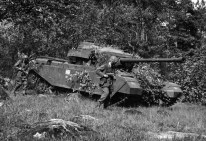 Despite Sweden’s goals to arm itself with domestic designs, foreign tanks in the Swedish army were not a rare sight. In cases when their industry was too slow or designers put out unsatisfactory results, the Swedish military made up the shortfall with foreign purchases. Recall that the Strv m/37, Sweden’s most numerous tank at the start of WWII, was actually the CKD AH-IV-Sv tankette. Later, the Swedes acquired the Strv m/41, a licensed copy of another Czechoslovak vehicle, the LT vz. 38.
The Swedish Army’s Tough Choice
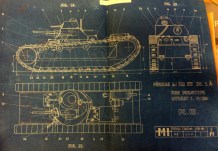 The time between the World Wars was that of rapid technical progress. Even tanks, a relatively new invention, could become obsolete quickly. Even though only several wealthy countries could afford a large number of the newest tanks for their armies, experimental vehicles and small batches cropped up in many nations. Sweden, who managed to retain neutrality during WWI, was among them. Its army was engaged in a lengthy and difficult search for a suitable tank.
British Tank for Soviet Infantry
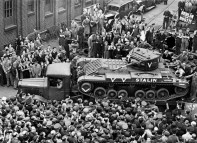 On September 29th, 1941, the first regular Arctic convoy departed from Britain to the USSR. It was indexed PQ-1. On October 11th, 11 transport ships arrived at Arkhangelsk, where they delivered 193 Hawker Hurricane fighters and other military cargo. Among it were 20 Matilda III and Valentine II tanks. So began the delivery of the Valentine tank, which became the most numerous British tank in the Red Army.
Infantry Sweet Spot
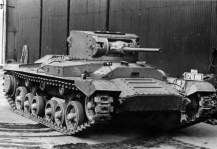 The Valentine infantry tank was the most common British tank of WWII. Like the Matilda, it didn’t last long as a front line tank in the British army, but commander versions and SPGs on the chassis made it to Germany. Its career in other countries was even more eventful. The Red Army used them until the end of the war, and they were widely used in the Pacific theater of war. In some nations, these tanks served as training tanks until the 1950s. What was the history of the creation of this extraordinary tank, and how did the first modifications of the Valentine serve?
Multiturreted Independence
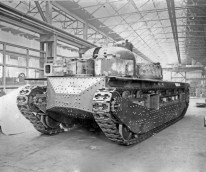 Towards the end of WWI, the French reached first place in the heavy tank development race. A little longer, and the FCM 2C would have seen combat. The French created the first breakthrough tank in the world, which combined powerful armament with armour that, at the time, could be considered shellproof. In addition, the French vehicle became the first multiturreted tank in the world, and its main turret was large enough for three men.
Heavyweight Brainstorming
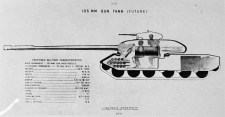 During the years of WWII, American industry made excellent light and medium tanks. SPGs built on their chassis were no less excellent. The only field where American engineers encountered misfortune was the development of heavy tanks. Although the Heavy Tank M6 was built, and even entered service, it was quickly left behind. The tank turned out to be too heavy and insufficiently mobile, without a place in American tank doctrine. Nevertheless, work on American heavy tanks never stopped, and projects like the Chrysler K kept coming.
Exhibit with a History
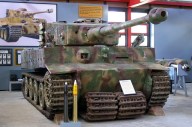 The German Tiger tank currently on display in Saumur is one of only six tanks of this type that survive to this day. Out of the six, the history of this one is the most interesting. This tank fought with two armies on both sides of the front, and had its own personal names.
Pz.Kpfw. Löwe: The German Lion
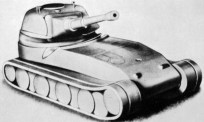 During the Third Reich, the German tank building school was defined, in part, by monsters such as the Maus and E-100. However, the German system of armament from the 1930s had no superheavy monsters like these, and no heavy tanks at all. In the second half of the 1930s, the plan was to have two types of light tanks and two types of medium tanks. How did Germany end up with monsters like the Pz.Kpfw. Löwe, and how were they developed?
From the Vault: French Super Light Tank
November 26, 2017 by 1 Comment
Here is a two page article from the Jan-Feb 1963 issue of ARMOR magazine that takes a look at the French ELC light tank project. This vehicle never entered serial production and it does not appear that much information has been published about this odd little vehicle in English (the wikipedia page for this vehicle references mostly foriegn language sources.) This vehilce is roughly comparable in time frame, role and mission to the US M56 Scorpion and M50 Ontos. Click on the images below to view the article page.


Video: Military History Visualized on Panzer Tactics
November 26, 2017 by Leave a Comment
The youtube channel Military History Visualized has released a new video on German Panzer tactics in the early years of WWII.
New Book Alert: British Tank Crewman 1939-45
November 26, 2017 by Leave a Comment
Osprey Publishing has released a new volume in their Warrior series looking at British tank crewment in the Second World War. British Tank Crewman 1939-45 (Warrior)
Publisher’s Description:
Great Britain had introduced the tank to the world during World War I, and maintained its lead in armored warfare with the “Experimental Mechanized Force” during the late 1920s, watched with interest by German advocates of Blitzkrieg. Despite these successes, the Experimental Mechanised Force was disbanded in the 1930s, making Britain relatively unprepared for World War II, both in terms of armored doctrine and equipment.
This fully illustrated new study examines the men who crewed the tanks of Britain’s armored force during World War II, which was only four battalions large in 1939. It looks at the recruitment and training of the vast numbers of men required, their equipment, appearance and combat experience in every theater of the war as the British armored division sought to catch up with the German Panzers.

Available on Amazon here.
Book Alert: M113 APC 1960–75: US, ARVN, and Australian variants in Vietnam
November 26, 2017 by Leave a Comment
A new entry in the long running New Vanguard series by Osprey is available titled M113 APC 1960–75: US, ARVN, and Australian variants in Vietnam (New Vanguard)
Publisher’s Description:
The M113 is the most widely used and versatile armored vehicle in the world. Fielded in 1960 as a simple “battlefield taxi,” over 80,000 M113s would see service with 50 nations around the world and 55 years later, many thousands are still in use. In addition to its original role of transporting troops across the battlefield, specialized versions perform a multitude of other functions including command and control, fire support, anti-tank and anti-aircraft defense, and casualty evacuation.
This new fully illustrated study examines the service record of the M113 from its initial fielding through the end of the Vietnam War. It will also describe the many US, South Vietnamese, and Australian variants of the M113 used in the Vietnam War as well as information on tactics, unit tables of organization and equipment, and a selection of engagements in which the M113 played a decisive role.

Available on Amazon here.

 Tank and AFV News