Here are an assortment of Russian language articles covering WWII era armor translated into English by Tank Archives.com. It’s been a couple months since we last checked in on them so there are quite a few. Click on the link to go to Tank Archives.com and view the full article.
Medium Tank M3 – by Yuri Pasholok
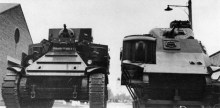 The American army had only a handful of medium tanks at the start of WWII. That does not mean that American designers ignored vehicles of this class. In the summer of 1939, the Medium Tank M2 entered production. Only 18 units were built, but it turned out to be the start of a new era for American tank building. The layout of its chassis became the foundation of American medium tanks. In 1940, the superior Medium Tank M2A1 was built, although it was already obsolete at the time.
Light Tank M5: The Peak of Evolution – by Yuri Pasholok
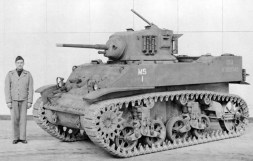 Rapid advances in armoured vehicles during WWII meant that even very good designs did not stay at the top for long. This was especially noticeable in American tank building. In 1939, the Light Tank M2 and Combat Car M1 were at the top of technical progress, but they were replaced with the Light Tank M3 by the time the USA entered the war in late 1941. In 1942, the Light Tank M3A1 entered production, but it did not last long as America’s main light tank. At the end of 1942, the Light Tank M5 was there to replace it, the last of the descendants of the Light Tank M2.
Through Adversity to the SU-122 – by Yuri Pasholok
 It was clear by the spring of 1942 that work on a medium SPG on the T-34 chassis with an 85 mm gun in a rotating turret hit a dead end. The result of this work, which started back in the summer of 1940, was the U-20, which the military considered unsatisfactory. The project didn’t leave the drawing board. Later, development of Soviet SPGs took a different path. A significant influence was the study of a captured StuG III Ausf. B. Later, factory #592 built a Soviet version on its chassis, called SG-122. It was clear, however, that converting foreign vehicles was not the end.
SU-26: Blockade Long-Liver – by Yuri Pasholok
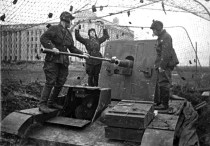 The start of the Great Patriotic War in the summer of 1941 forced many changes onto the prospective designs of Soviet SPGs. Many branches were cancelled, and work on the ZIS-30 SPG on the Komsomolets tractor platform was urgently started. Until then, it was not considered as an SPG platform at all. However, one SPG that was designed according to pre-war plans was not only built, but mass produced. This is a vehicle best known under the name SU-26. Its real name, T-26-6, was buried deep in the archives.
Light Paper SPGs (SU-31 and SU-32) – by Yuri Pasholok
 As with many other Soviet SPGs, the path to the SU-76 was not easy. Initially, the two-turreted T-26 tank would be used as the chassis for an infantry support vehicle. Later, the T-50 joined in the plans. The situation after the start of the war forced the concept of the SPG to change urgently. Instead of a light infantry support SPG, the ZIS-30 appeared, a tank destroyer on the Komsomolets tractor chassis. Designers only returned to the topic of a multipurpose SPG towards the end of 1941. The SU-12, the first production variant of the SU-76, did not come about on the first try. This article tells the story of vehicles that were dead ends, without even being produced in metal.
The Road to SU-76 – by Yuri Pasholok
 The T-50 tank was considered the highest priority platform for light SPGs in the pre-war Soviet Union. However, a proposal for an SPG chassis based on the T-40 amphibious reconnaissance tank was made at a meeting on June 9th, 1941. The idea was quickly abandoned, and, a few weeks later, the USSR was too busy for the T-50 SPG. Suddenly, the first wartime light Soviet SPG turned out to be the ZIS-30, which used the chassis of the Komsomolets artillery tractor. Due to the cancellation of artillery tractors, the idea of building an SPG using T-40 components came out of retirement. The result was a small family of experimental vehicles, such as the SU-31 SPAAG and SU-32 SPG.
Big Dreams, Small Chassis (T40) – by Yuri Pasholok
 Despite the difficulty with which the Soviet T-40 amphibious reconnaissance tank entered production, designers considered the platform quite promising. The T-40 chassis would be used to produce the GAZ-22 artillery tractor, which would eventually replace the Komsomolets. The fact that the T-40 was also seen as an SPG platform was less well known. Most of the designs remained on paper, but at least one was produced in a small batch.
Metamorphoses of an Amphibian Scout (T-37 and T-38) – by Yuri Pasholok
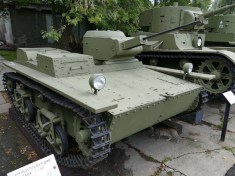 An unusual modification of the T-38 can be seen in the outdoor display of the Central Museum of the Armed Forces of the Russian Federation. This vehicle is distinct from its brothers: instead of one DT machinegun, its turret houses a 20 mm TNSh autocannon and a coaxial DT machinegun. Some Russian historians spread the myth that this tank was experimental. In reality, not only was this not an experimental tank, but these tanks had the chance to fight. This article will cover modifications of T-37 and T-38 amphibious tanks.
Israeli Sandwiches – by Yuri Pasholok
 When Israeli armoured vehicles are mentioned, one often thinks of Merkava tanks first. Without a doubt, these vehicles are a point of pride for Israel. However, the backbone of the Israel Defense Force (IDF) was composed of converted foreign vehicles for a very long time. The Israelis spent several decades fine tuning the art of adapting vehicles to suit their needs. Everything started with improvised armoured cars, which played an important role in the war for Israeli independence.
Marder II: Light Tank Destroyer -by Yuri Pasholok
 By the end of 1941, the Germans began to understand that the time of light tanks was over. This also applied to the PzII tank. By that time, it’s main enemy was medium tanks with shellproof armour, against which the 20 mm autocannon was useless. Production of light tanks ended in Germany in the summer of 1942, but that doesn’t mean that the PzII chassis was done for. Work on light SPGs on its chassis began in the spring. One of them was a tank destroyer that is best known as the Marder II.
An Aryan From Poland – by Yuri Pasholok
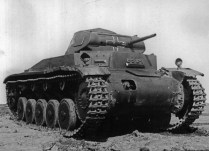 The Red Army GABTU had a very vague idea about the armoured vehicles of its potential enemy at the start of World War II. The same could be said about the other members of what would become the Allies. For obvious reasons, there was very little available information about tanks made by Germany and its allies. Mainly, it could be obtained from encyclopedias, which were full of errors. The ability to properly study the foreign tanks was only possible after combat began. In this respect, the USSR was ahead of the rest of the world. The first trophies began arriving from Spain: a captured PzI Ausf. A and an Italian L3/35. In the summer of 1939, a Japanese Ha-Go tank was captured in the Far East. The list of trophies grew with the start of WWII. The German PzII Ausf. C was among them.
Pz.Kpfw.II Ausf. F: Third Time’s the Charm – by Yuri Pasholok
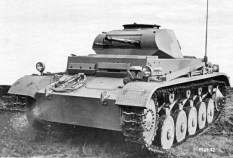 There are few cases when a tank that is accepted into service is replaced by a modification that is inferior to it. In Soviet tank building, one example of this is the KV-1S, a necessary measure. It was lighter than the KV-1, and had thinner armour, but as a result of its lower mass and improved gearbox, it was a lot more reliable and mobile. The tank itself received a large number of improvements. With the Germans, the most clear example of such a paradoxical course of action was the PzII Ausf. F. Here, the Germans returned to an older version of the PzII (Ausf. C, albeit with some improvements) than the one that was already accepted into production (Ausf. D).
Pz.Kpfw.II Ausf. D-E: Unlucky Torsion Bars – by Yuri Pasholok
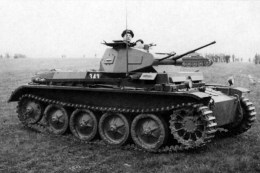 Worldwide tank building progressed rapidly in the second half of the 1930s. This can definitely be said about Germany’s tank industry, which developed tank suspensions, along with everything else. Various experiments in this area led to widespread use of torsion bars. However, there is a tank in the history of Germany’s tank design that was produced in large numbers, but it is rarely remembered. It ended up in a paradoxical situation where, instead of a technically superior tank, a tank with an old suspension returned into production. This was the PzII Ausf. D: a light tank that fought in its initial configuration for only a month.
 The story of the PzII tank was an unusual one. In many ways, it owes its “accidental” existence to the attempts of mounting a 20 mm autocannon in the Kleintraktor (future PzI). Due to issues with production of the Z.W. tank (future PzIII), the PzII was the most numerous front line tank for the first two years of WWII. Germany’s most common tank was not even originally included in the armament plans.
 The light PzII tank played an important role in the structure of the German tank forces. Despite the opinion born of German generals’ memoirs, this was not a training tank. On the contrary: at the time of its inception, the PzII was one of the best light tanks in the world. It appeared almost by accident, but occupied a significant part of the Wehrmacht’s order of battle. The PzII remained in production for five years, with some small breaks. What is the history of the PzII, and what did its first versions look like?
 The Americans considered improving the firepower of the Medium Tank M4 back in September of 1941. A year later, experiments with installing the 76 mm T1 gun into the stock turret commenced. Even though the gun fit, the military was unsatisfied with this rearmament. A decision was made to equip the M4 with the turret from the Medium Tank T23, which did not enter production. This was not hard, since the turret ring diameter was the same.
 Starting in the second half of 1943, the approach to sending British and American Lend Lease armoured vehicles to the USSR changed. Instead of immediate large scale shipments, the Western Allies sent a few samples of new vehicles. If the tank or SPG was satisfactory for the Soviet side, full scale shipments followed. The first vehicle to arrive on this trial basis was the Light Tank M5A1. By that point, production of light tanks in the USSR was wrapping up, so the American novelty never made it into service.
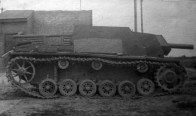 Work on SPGs, especially heavy ones, stopped in the USSR after the start of the Great Patriotic War. This was largely caused by the fact that the factories were busy with other orders. In addition, many factories were evacuated eastward. Only light SPGs were put into production at the start of the war, and these were largely improvised. Meanwhile, due to the number of factories that switched from making artillery tractors to tanks, the artillery branch was forced to revisit SPGs towards the end of 1941.
 The German superheavy Maus tank left a mark in the history of tank building. This was the heaviest tank in the world, developed as an assault tank, practically invincible to enemy fire. In many ways, its fate was the same as the fate of another giant, the French FCM 2C, which holds the title of the world’s largest tank to this day. Like the French heavyweight, the German tank never saw combat. In both cases, the tanks were blown up by their own crews. Another similarity was that the tanks became the subject of a careful study.
 One of the distinguishing characteristics of German tank building in WWII was an aim to use up obsolete vehicles, including those which used to be the backbone of the German tank force. If a German tank became obsolete, that didn’t mean that it would be scrapped. Some tanks were sent to training units, other were modernized. Obsolete tanks, especially light ones, were often converted to SPGs or engineering vehicles. This was the fate that awaited the PzI, Germany’s first mass produced tank, which was already obsolete at the start of WWII.
 Coming up with tank ratings is a hobby of many tank experts, as well as people who consider themselves as such. As a rule, the creators try to determine the best tank. While some kind of systematic approach was developed over the years, picking out the worst tanks is usually more complicated. Often, creators of lists of the worst tanks make their choices according to no set system and end up naming a number of tanks that didn’t earn such a shameful label.
 Putting the PzI Ausf. B into production was the correct decision, albeit a late one. The problem wasn’t only that the concept of a light tank with machineguns for armament was obsolete. The 6th Department of the Armament Directorate was disappointed in the chassis developed by Krupp’s engineers overall. Even though the power to weight ratio of the PzI grew from 11.1 to 17.2 hp/ton after modernization, there was no drastic improvement in mobility. 40 kph is not what was expected with such a boost.
 The creation of the PzI light tank did not come easily for German tank building. The tank was redesigned several times while still in the development stage, starting out as a 3 ton tank with a 20 mm autocannon, and ending up as a 5 ton tank, where nothing larger than a pair of MG-13 machineguns could fit into the turret. Even though the PzI entered production and became a mass produced tank, easily numbering over 1000 units, the German tank forces were not completely satisfied with its characteristics even before production began. Modernization was only a matter of time. What results did it bring?
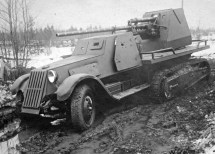 Ever since their appearance in the mid-1910s, halftracks have been considered as a chassis for armoured vehicles, especially SPGs. Better off-road performance than wheeled vehicles and stability made these vehicles an attractive chassis for artillery. Halftrack SPGs were popular in Germany and the United States. The heroes of this article, Soviet ZIS-41 and ZIS-43 halftracks, are not as well known.
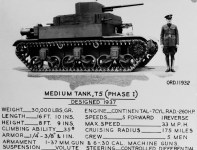 The late 1930s were a time when armoured vehicles were developing rapidly. The start of WWII in September of 1939 gave an even bigger push to the flywheel of progress. Designs that were considered revolutionary suddenly fell behind. There were cases where tanks became obsolete soon after coming out of the factory. The American Medium Tank M2 is among those unlucky ones. You can read a lot of mockery of the combat abilities of this tank, but they are unreasonable. American engineers made a decent medium tank, but by the time it entered mass production there were already other tanks with more armour and better armament.
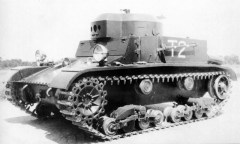 The idea of a light tank with a front engine that the American Ordnance Department insisted on was at a dead end by 1932. Trials of the Light Tank T1 family and later the Medium Tank T2 showed that the idea was unacceptable. Poor visibility, excessive mass, bad crew conditions, and, most importantly, the limits of further development, put an end to such tanks. Designers moved on to working on other tanks with different layouts. Harry Knox, the father of the front engine American tanks, did not abandon his idea, and kept looking for a place for his idea. Stooping down to plagiarism, he crossed his Light Tank T1E1 with the Vickers Mk.E, its overseas competitor. The resulting “hybrid” Light Tank T2E1 was not that bad.
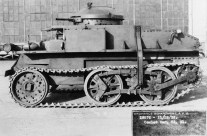 Traditionally, cavalry occupied a very strong position in the American army. As soon as there was an opportunity to obtain its own tanks, the cavalry took it. Since, officially, the cavalry was not allowed to have tanks, the name “combat car” was used, even though these vehicles were actually tanks. The Combat Car M1 and several similar vehicles on its chassis are typical representatives of the small family of interbellum cavalry tanks.
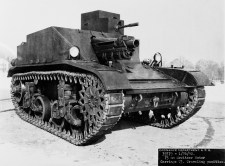 The American army began thinking of motorizing their artillery back in WWI. For a long time, attempts were made to build an SPG on the chassis of the light tracked Holt tractor. In parallel, John Walter Christie was working on a similar vehicle. Neither project satisfied the US Army for various reasons. A second attempt at an SPG was made in 1930, but the Howitzer Motor Carriage T1 remained an experiment. The next opportunity to obtain self propelled artillery came a decade later in the form of the Howitzer Motor Carriage T18.
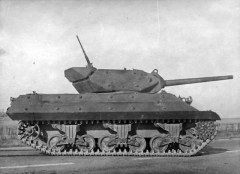 Unlike many tanks, few tank destroyers arrived in the USSR within the Lend Lease program. The Gun Motor Carriage T48, or SU-57, built on the chassis of the M3 halftrack, was the only exception. Initially, they were built by the Americans for a British order, but the British barely used them. The USSR gave them a completely different reception: they were used actively and showed themselves as an effective anti-tank measure. As for tank destroyers on a tank chassis, the only Western vehicle that was accepted into the army was the Gun Motor Carriage M10, known widely under the British nickname “Wolverine”.
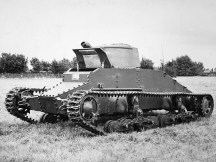 There are many tanks in the history of armoured warfare that were simply unlucky. The British Infantry Tank Mk.I is one of them. Even its name was lost when it became the Matilda due to some historian’s error, even though that name applies to a completely different vehicle. As Britain’s first infantry tank, it was hopelessly obsolete by the start of the war. Even its thick armour was not enough to survive in a war that it was simply not suitable for.
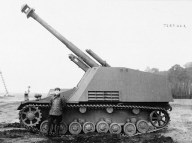 German engineers invented the “self propelled gun mount” class of artillery. The first work in this area was done during WWI, but it truly became a mass event 25 years after it ended. The recipe was simple: take a light or medium tank and use its parts to to build a chassis with bulletproof armour. A slightly modified version of a towed gun was installed on that chassis. Thanks to this phenomenon, the mobility of German artillery grew significantly. The Hummel became the post powerful of German “self propelled gun mounts”. This SPG earned its position as one of the symbols of German self propelled artillery.
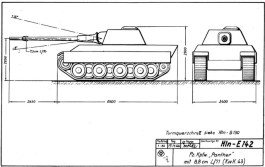 Tanks that could have been built are often discussed within certain circles. Aside from the superheavy Maus and E-100, there are the light and medium E-10 and E-25 tank destroyers. Despite very incomplete data about these vehicles, the overall characteristics are known, including the armament. Meanwhile, the core of “Panzerwaffe-46” was going to be composed of the medium E-50 tank and heavy E-75 tank, at least in the minds of fans of alternative history. The story with these tanks is a lot more complicated, since work stopped at an early stage, and a good half of the information available on these tanks is divination at best. Let’s try to figure out what about the E-50 and E-75 is true and what is blatant misrepresentation.
 Tank and AFV News