Another installment of AFV articles from various news sources. Click on the headline to go to the full article.
The Motley Fool – After the M1A2 Abrams, the Army Wants a New Tank for 2030
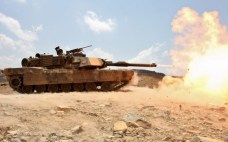 The U.S. Army boasts a motorpool stacked to the rafters with 6,000 M1 Abrams main battle tanks — more tanks than some countries have soldiers. Yet for some crazy reason, Congress keeps buying more. Actually, the reason isn’t totally crazy. The U.S. only has one factory left that’s totally dedicated to the production of main battle tanks — General Dynamics’ (NYSE:GD) factory in Lima, Ohio. Sporadic demand from tank-buyers, however, keeps this factory always on the edge of having to shut down operations — at which point the U.S. wouldn’t be able to build tanks if it suddenly needed to. (A shutdown would also cost jobs in an important Congressional district.)
Washington Examiner – General: US no longer has a ‘world class’ tank
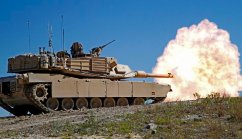 U.S. tanks are now roughly on par with Russian tanks, according to a top general, and the American military doesn’t have the technology to recover its former advantage. “I would not say that we have the world class tank that we had for many, many years,” Lieutenant General John Murray said during a Senate Armed Services subcommittee hearing on modernizing the Army. “I’ll be the optimist and say that we’re at parity with a lot of different nations.”
Newsweek – Moscow Man Convicted of Trying to Smuggle Soviet Tank into Kazakhstan
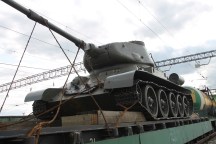 Russian authorities have slapped a three-year suspended sentence on a Moscow man for trying to smuggle a World War II-era tank into neighboring Kazakhstan, state news agency Itar-Tass reports. The man—whose name federal authorities did not divulge—obtained a Soviet Т-34-85 circa from 1945, from a Latvian citizen at the bargain price of €20,000, but planned to sell it off to a buyer in Kazakhstan for more than 10 times that amount.
War is Boring – The Biggest Tank Battle in History Wasn’t at Kursk
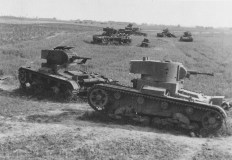 A thousand coffee table books and countless hours of popular history programs have described the Battle of Prokhorovka, part of the Third Reich’s 1943 Operation Citadel, as the largest tank battle in history. Near the city of Kursk on the Eastern Front, hundreds of Soviet tanks slammed into the 2nd SS Panzer Corps in an enormous conflagration of flesh and metal. Prokhorovka was certainly an important clash and one of the largest tank battles ever, but it might be time to retire its description as the biggest — a claim which has been seriously questioned in recent years by historians with access to Soviet archives opened since the end of the Cold War.
Warrior – Why Allies’ Secret DD Tank Failed on D-Day
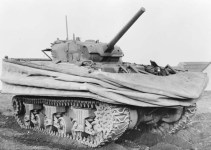 If you’ve seen the blockbuster movies The Longest Day (currently on Netflix) or Saving Private Ryan, a big part of the story is how infantry fought through the obstacles on Omaha Beach (the wisdom of sending two divisions into that meat-grinder can be debated at another time). But the lack of tank support wasn’t part of the plan. In fact, it was one hell of an instance where that notorious and unwelcome Murphy’s Law put in an appearance, costing the infantry some much-needed support. It would have been their secret weapon: the Dual-Drive, or DD, tank.
The National Interest – The PT-76: The Russian Tank That Can ‘Swim’
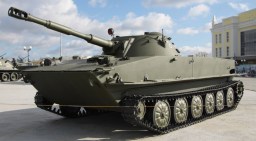 The PT-76 seems like a minor oddity of the Cold War — a Soviet amphibious light tank with thin armor and an unimpressive gun. Certainly it seemed bound for rough treatment on modern battlefields full of heavy weapons and heavier tanks. But the floating PT-76 chalked up a remarkable record, carrying knife-wielding Himalayan soldiers into battle, sinking gunboats on the Ganges Delta, dueling powerful U.S. Patton tanks in Vietnam, and launching amphibious surprise attacks on both sides of the same Middle Eastern war. The first article in this two-part series will look at the origin and characteristics of the PT-76, the nasty shock it gave U.S. forces in Vietnam, and the historic countermeasure used against it.
 GRAFENWOEHR TRAINING AREA, Germany, March 7, 2017 — Tank and maintenance crews from the 1st Battalion, 66th Armor Regiment assigned here are giving their M1A2 Abrams main battle tanks a buffed-up look that improves the tanks’ overall defensive capabilities. The crews, with the 3rd Armored Brigade Combat Team, 4th Infantry Division, which is serving as the initial ABCT rotational force in support of Atlantic Resolve, began installing the Abrams Reactive Armor Tile system Feb. 28 to tank hulls and turrets.
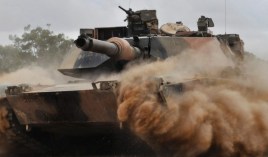 As the Defence Department gears into “new and enhanced capability”, spending around $195 billion over the next 10 years, most people are aware of the large-scale builds: the Air Warfare Destroyers, the 12 future submarines, the future frigates and Australia’s step into the aviation future with 72 F-35 stealth fighters. Less well known is the resurgence of a defence technology which has not made many headlines for the past 45 years: the main battle tank.
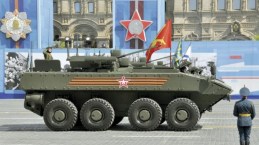 Russia has released additional details of its latest Bumerang (Boomerang) family of wheeled 8×8 armoured fighting vehicles (AFVs) that are the long-term replacement for the currently deployed BTR-80 8×8 amphibious armoured personnel carrier (APC). The Bumerang chassis has the designation VPK-7829, with the infantry fighting vehicle (IFV) variant designated the K-17 and the APC model is designated the K-16 (while under development the vehicle was referred to as the Gilza, which is Russian for ‘cartridge’).
 Israel’s first women seeking to become tank-crew members started the process this week as Israel strives to join countries like Norway, Canada and Australia on the short list of states with women in tanks. At the end of their basic training in mixed-gender battalions, 15 of the women will be selected for a pilot program to see if they are fit to serve in tanks. Selection will be based in large part on motivation and physical fitness. In light of certain rabbis’ and reserve officers’ wariness about women serving in the military and/or the Armored Corps, the army’s pushing of the process seems to be sending a message in support of women in combat.
 Yugoimport’s Lazar 3 8×8 MultiRole Armoured Combat Vehicle has entered service with Serbia in the armoured personnel carrier (APC) configuration. The vehicle has a welded steel chassis to which its monocoque steel hull – which features spall liners – is bolted. In its baseline form the vehicle has all round ballistic protection to Standardization Agreement (STANAG) 4569 Level 3, and over the frontal arc this is increased to Level 3+. Mine protection is to STANAG 4569 Level 3a and 3b, and the floor has two levels of protection.
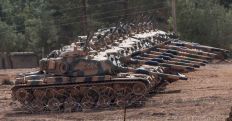 ANKARA—The Turkish government has officially launched a competition for the upgrade of a batch of 200 German- and US-made battle tanks in the army’s inventory, a contract that analysts estimate to be worth roughly $500 million. Five Turkish companies placed their upgrade bids on Jan. 23. The local bidders are: military electronics specialist Aselsan, Turkey’s biggest defense company; missile-maker Roketsan; and armored vehicles manufacturers BMC, Otokar and FNSS. Aselsan and Roketsan are state-controlled companies; BMC, Otokar and FNSS are privately owned.
 Military cooperation between China and Thailand, the oldest U.S. Asian ally, has deepened somewhat in the past few years amid a downturn in U.S.-Thai relations over rights concerns following the May 2014 coup. Since then, there have been some notable developments, including a first-ever joint air force exercise, planned purchases of equipment from tanks to submarines, as well as discussions about a joint military production facility to advance defense industry cooperation.
 ANKARA, Turkey — Growing political tensions between Ankara and Vienna in recent months have resulted in the termination of an otherwise prospective deal between a Turkish and an Austrian company, both engine specialists. In October 2015, TUMOSAN, a privately owned Turkish engine maker, signed a deal with AVL List, an Austrian firm, for technical support for the engine that the Turkish company had been commissioned to develop. Under the deal, TUMOSAN would get technical support from AVL for the power unit of the Altay, Turkey’s first indigenous, new-generation main battle tank in the making. AVL also would provide know-how for the integration of the engine to the tank.
 The Royal Netherlands Army (RNLA) has outlined plans to upgrade a number of its armoured fighting vehicles (AFVs) in order to extend their operational lives and enhance capabilities. Details were given by Colonel Eric Molenaar, Head of Material, Army Staff of the RNLA, at the IQPC International Armoured Vehicles 2017 conference held in London from 23 to 26 January. The RNLA is set to upgrade at least part of its CV9035NL fleet in two phases. Under Phase 1, 44 vehicles will be fitted with a hard-kill defensive-aid suite (DAS) under the leadership of BAE Systems Hägglunds.
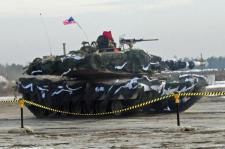 Jan. 31 The U.S. Army will send M1A2 Abrams main battle tanks to the Baltic states of Latvia, Estonia and Lithuania along Russia’s borders ahead of a NATO operation in the spring. The tanks participated in joint drills between U.S. and Polish forces but some are being moved to the Baltic states to await a deterrence operation set to reassure the United States’ European allies that Washington, D.C., is committed to their defense, The Wall Street Journal reported. German troops are also arriving in Lithuania, British troops are reinforcing positions in Estonia and Canadian troops are being sent to Latvia.
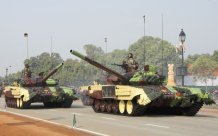 Further details have emerged about India’s plans for the main battle tank (MBT) element of the Future Ready Combat Vehicle (FRCV) programme. Requirements for the main armament, powerpack, and mission systems have been revealed by the Defence Research and Development Organisation (DRDO). Speaking at the International Armoured Vehicles 2017 conference in London, Dr U. Solomon of the DRDO’s Combat Vehicles Research and Development Establishment (CVRDE) highlighted some of the new requirements for the MBT design, which is intended to replace the Indian Army’s fleet of T-72M1 ‘Ajeya’ MBTs and is scheduled to enter service from the early 2020s.
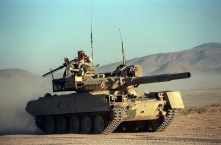 The Sheridan’s service in Vietnam ended with the withdrawal of the last Armored Cavalry Regiments in 1972, and the Army began phasing the complicated vehicles out of the cavalry units by the late 1970s. However, they remained in airborne formations for lack of a replacement, and were upgraded the M551A1 TTS model with an effective thermal sight for night combat. In 1989, eight to ten Sheridans of the Third Battalion of the Seventy-Third Armored were used in the first and only parachute drop of U.S. tanks into combat by C-130 transports onto Torrijos/Tocumen Airfield.
 As the mild-mannered Private Godfrey in the hit TV show and film Dad’s Army, actor William Arnold Ridley won a place in the nation’s hearts. He actually served in the Home Guard for real in the Second World War after being evacuated from Dunkirk as the Germans pushed the British back across the Channel in May 1940. But even before that time, Ridley has seen action in the trenches during the First World War with the Somerset Light Infantry.
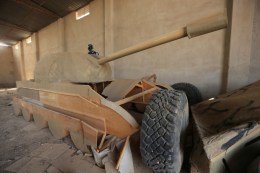 IRBIL, Iraq — As they battle to hold on to the northern Iraqi city of Mosul, Islamic State militants have added a new weapon to their arsenal: tanks made of wood. The life-size replicas are intended to confuse air support from the U.S.-led coalition backing the Iraqi ground offensive for the city, commanders said. Although they may look far from realistic when viewed from close quarters, it’s harder to tell what they are made of from the sky. Iraqi forces discovered a building used to manufacture the decoys when they retook the village of Sada, north of Mosul, last week. In addition to three fake tanks, they found five wooden Humvees.
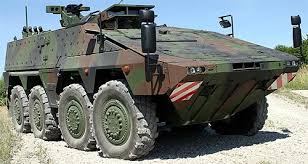 WARSAW, Poland — Romanian Prime Minister Dacian Ciolos has announced that the country’s Defence Ministry is planning to award a contract for the delivery of armored personnel carriers (APC) to Germany’s Rheinmetall Defence. The company is to team up with a state-run Romanian manufacturer and launch a plant in Romania that will produce the APCs. “There will be a partnership, a Romanian-German joint venture, which will allow Rheinmetall to obtain the contract from the Ministry of Defence and build an armored personnel carrier that will be first supplied to the Romanian military,” Ciolos told local broadcaster Europa FM in an Nov. 17 interview.
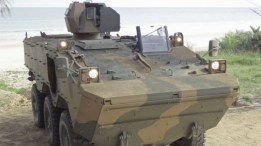 The Brazilian Army’s Logistics Command (CoLog) will award Iveco Latin America a contract for 1,580 serial production VBTP-MR Guarani 6×6 amphibious armored vehicles on 22 November, the service’s Projects Management Office told IHS Jane’s . The fleet, to be delivered from 2016-35, will comprise troop transport, communications, command post, ambulance, and 120 mm mortar vehicles. CoLog is buying the platforms in batches of 723, 547, 275, and 35 vehicles, as well as associated equipment and services totalling BRL5.9 billion (USD1.76 billion). Several will be armed with manned protected weapon mounts and ARES Aeroespacial & Defesa’s REMAX and UT-30BR remote weapon stations.
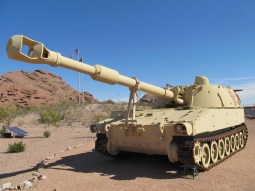 Morocco has taken delivery of a consignment of 155 mm M109A5 self-propelled howitzers, local media reported on 21 November. The reports were accompanied by photographs showing at least 12 M109s that had been unloaded at Casablanca’s port. The US Excess Defense Articles database shows that Morocco has requested 70 surplus M109A5 howitzers. Morocco is already an M109 user, having imported 42 M109A2 howitzers from Germany in 2008, as well as three M109A3s and a single M109A4 from the United States in 2013, according to the UN Register of Conventional Arms (UNROCA) information.
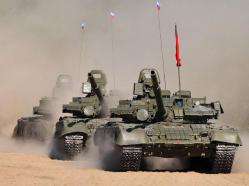 Russia is reportedly preparing to upgrade its Soviet-era T-80 battle tanks in order to bring them back into service. Up to 3,000 of the tanks, which entered service in 1976, will be updated to bring their combat power closer to the current T-90 model. “At present, the preparative works to start the modernisation of the first T-80BV MBTs are at a final stage,” a defence industry source told military magazine Jane’s Defence Weekly. The “overhaul and modernisation” of the tanks “will be launched next year” the source added. They said the number of tanks to be upgraded will be determined by the military.
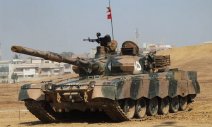 The Pakistani government has signed an agreement with Ukraine for the supply of 200 engines to equip the country’s highly anticipated next-generation main battle tank (MBT), which is commonly referred to as the Al Khalid-Improved (I) MBT, according to Pakistani defence officials. The deal was signed on 23 November during the International Defence Exhibition and Seminar (IDEAS), which is held every two years in the southern Pakistani city of Karachi. While the exact type of engine was not revealed, a senior official of Pakistan’s Ministry of Defence (MoD) told IHS Jane’s that it will be larger than the Ukrainian 6TD-2 engine generating a maximum 1,200 bhp that powers the 420 Al Khalid MBTs operated by the Pakistan Army’s Armoured Corps.
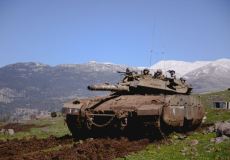 A 20-year old IDF soldier was killed when his tank overturned during an exercise on the Golan Heights shortly after midnight Wednesday, the IDF announced on Thursday morning. The accident victim was Sgt. Ido Ben- Ari from Ramat Sharon, a tank commander in the 9th Battalion of the Armored Corps’ 401 Brigade. He was posthumously promoted to staff-sergeant. Three other soldiers suffered minor injuries in the incident and were discharged from Rambam Medical Center in Haifa after receiving medical treatment. Ben-Ari’s tank brigade was taking part in a wide-scale training exercise along with the Givati Brigade and its engineering forces when the accident occurred at around 1 a.m. on Mount Shifon on the northern Golan Heights.
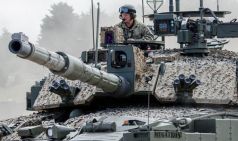 CUTS being planned by army chiefs would see the country’s defence force lose a third of its frontline tanks, leaving it with fewer than Serbia. The plan, expected to be revealed in the coming months, would see one of the army’s three tank regiments have all of its 56 Challenger 2s replaced with Ajax fighting vehicles. If the plan was sanctioned it would leave the country with just 40 more tanks than neutral Switzerland. The move would see the UK’s tanks drop from 227 to 170, with 112 on frontline duty while the rest would be used for training in the UK and Canada.
 Several former IDF commander have come out against a bill proposal that would result in the IDF integrating women in combat roles that are currently not open to them. MK Merav Michaeli, a member of the Knesset Foreign Affairs and Defense Committee, introduced the legislation that would require the IDF to design a model to fill personnel needs regardless of gender. “What the American armed forces are doing now is what the IDF was recommended to do ten years ago,” said Michaeli. “Every day that goes by without exhausting human resources is a waste of quality manpower and motivation. Instead of giving female soldiers with high motivation every opportunity, the IDF is dragging its feet because of prejudice and pressure from rabbis.”
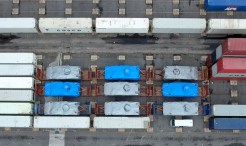 Mainland agents tipped off Hong Kong customs about nine Singaporean military vehicles after the boat carrying them docked in the mainland port of Xiamen, prompting their seizure and impounding in the city last Wednesday, a report has claimed. Before the latest twist in the diplomatic row, Singapore stepped up efforts to recover the armoured vehicles, with a delegation arriving in Hong Kong on Friday night to expedite their release and quell the potential political fallout. Sources said Singapore would need to contact the Chinese Ministry of Foreign Affairs to get the vehicles back, adding that the discovery had been reported to Beijing already and the decision on whether to release them was no longer in Hong Kong hands.
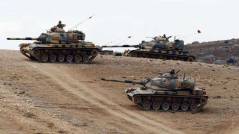 MANBIJ, Syria (Kurdistan24) – The Kurdish-led military command in the northern Syrian town of Manbij on Thursday announced they destroyed four Turkish army tanks in the western countryside of the township. In a statement, the Manbij Military Council (MMC), a Syrian Arab-Kurdish coalition allied to the Kurdish-led Syrian Democratic Forces (SDF), said the Turkish army airstrikes and shelling had changed the course of their battle against the Islamic State (IS) since last week. The MMC statement said the Turkish airstrikes were supposed to be against IS in al-Bab town in northern Syria, but the Turkish warplanes and artillery were targeting the liberated areas around Manbij. “Our forces [MMC] blew up four Turkish tanks around the village of Sheikh Naser, west of Manbij,” the statement said.
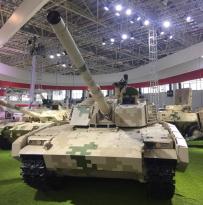 At the Airshow China event, a few new details on the Chinese tank VT-5 were released. The combat weight of the tank is claimed to be between 33 and 36 metric tons, depending on fitted armor package. Two different armor configurations for the VT-5 are currently being offered by Norinco, one optimized for conventional combat and one fitted with enhanced side armor protection. The armament is confirmed to be a conventional 105 mm rifled gun, which is fitted with a thermal sleeve, a fume extractor and a bustle-mounted autoloader. Together with the computerized fire control system, the effective combat range is claimed to be 3,000 metres or more. The stabilized gun can be used stationary or fired from the move without affecting the accuracy of the VT-5. A remotely controlled weapon station (RWS) serves as secondary armament.
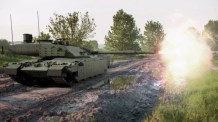 BAE Systems Land (UK), teamed with General Dynamics Land Systems UK and Rheinmetall Defence, have been downselected for the Challenger 2 Life Extension Programme (LEP) Assessment Phase (AP) with contract award due in December 2016. The aim of the Challenger 2 LEP is to replace obsolete sub-systems in the turret area including the commander’s and gunner’s stabilised sighting systems and control handles, gun control equipment, and fire-control computer, and then to fit new commander’s, gunner’s and loader’s displays. Also bidding for the LEP were CMI Defence (Belgium), teamed with Ricardo (UK); Krauss-Maffei Wegmann (Germany), teamed with Pearson Engineering (UK); Lockheed Martin UK, teamed with Elbit UK; and RUAG Defence (Switzerland), with all of these having additional team members.
 The Army is now engineering a far-superior M1A2 SEP v4 Abrams tank variant for the 2020s and beyond –designed to be more lethal, faster, lighter weight, better protected, equipped with new sensors and armed with upgraded, more effective weapons, service officials said. Advanced networking technology with next-generation sights, sensors, targeting systems and digital networking technology — are all key elements of an ongoing upgrade to position the platform to successfully engage in combat against rapidly emerging threats, such as the prospect of confronting a Russian T-14 Armata or Chinese 3rd generation Type 99 tank.
 The Israel Defense Forces is reviewing the possibility of female soldiers serving in tank brigades, a brigadier general told a Knesset committee, though the head of the army’s Armored Corps has voiced hesitation, if not outright opposition, to the notion. Speaking before the Knesset’s powerful Foreign Affairs and Defense Committee on Monday about the prospect of shortening the required service time for male soldiers, Brig. Gen. Eran Shani mentioned the army was also conducting research to see if positions for women could be expanded, including in the Armored Corps and elite 669 rescue unit.
 When someone mentions a list of the best tanks in history, the names are always the same: Tiger, T-34, M-1 Abrams. And always from the same nations: Germany, Russia, America. But great tanks from Great Britain? Though the British were the ones to develop armored fighting vehicles in World War I, British tanks of the Second World War can generally be described in one word: awful. There were tanks that could barely move without breaking down. Tanks that were fast but too thinly armored, or heavily armored but too slow. Tanks with radios that didn’t work. Tanks with guns that could shoot armor-piercing shells at other tanks, but not high-explosive rounds at infantry and antitank guns.
 As of recently, I’ve gone through the Japanese National Archive files, looking through to find documents that relate to my studies. While I was there, I stumbled across something that caught my interest. Of said documents, the one of most importance was a file called “Military Secrets No.1”. The reports were held by the Ministry of Defense, Army records section, Munitions Mobilization district. Contained in these files were a 3-page production chart of late war tracked vehicles of the Japanese army. Located within the chart I found a number besides the Type 5 Ho-Ri tank destroyer. A vehicle that until recently was only known to have made it to wooden mockup stages. In this lengthy article I will cover my findings on the tank project. Unfortunately visual representations of the tank are still being looked at. So I will use existing found sources for this.
 ANKARA—Turkey’s military and procurement officials are mulling the options of upgrading hundreds of German-made Leopard 2 and U.S.-made M60 main battle tanks.
 ROME — Italy’s new tank, the Centauro II, was shown off at a military test range Wednesday, as the country’s Parliament continued to decide whether to fund the vehicle. Deputy Chief of the Defence Staff Lt. Gen. Danilo Errico and Leonardo CEO Mauro Moretti were among guests who gathered Oct. 19 at the Cecchignola Army range on the fringes of Rome to watch a prototype of the wheeled tank being put through its paces. The Army hopes to buy 150 of the vehicles, which is built by a joint venture between Leonardo and Italian truck-maker Iveco.
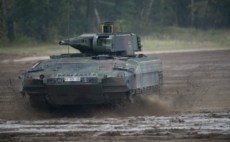 The 31-year-old was airlifted to hospital in Munich in a helicopter after the crash, police reported on Thursday. The 24-year-old driver of the tank was also lightly injured. The crash happened in the mountainous Tyrol region of Austria, where the soldiers were on exercise on Wednesday evening. The driver reportedly lost his way in thick fog and the tank rolled over several times as it fell down the hill. A recovery crane was brought in to the crash site, and only after it had recovered the tank could the two men be freed.
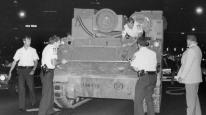 SHOOT the deranged man driving the stolen tank or risk mass Sydney casualties. That was the strange dilemma facing police officer Ron Mason 30 years ago as he climbed on top of a stolen Army tank parked on the Sydney Harbour Bridge. “There is going to be substantial death — either to motorists or train passengers or even in the harbour — if I didn’t shoot him,” retired detective superintendent Ron Mason told The Daily Telegraph on the incident’s anniversary.
 CLINTON Forty-two tons of steel flew through the air Saturday as the Ohio Veterans’ Memorial Park took possession of its newest relic — an M60A1 tank. A crane gently placed the hulking tank onto a decorative rock garden a few paces from the park’s display of a 1963 Cobra AH-1F helicopter. A VFW post in Defiance donated the M60A1 “Patton” tank to the park. “It actually was going to be melted down for scrap because they had no place to put it,” said Ken Noon, president of the not-for-profit Ohio Veterans’ Memorial Park.
 ROME — The Italian army is a step closer to acquiring new tanks and assault helicopters after plans for the purchases were submitted for parliamentary approval. On Oct. 11 the defense commission of the lower house of the Italian parliament began debating plans by the Italian military to buy the Centauro II tank and an updated version of its A-129 Mangusta helicopter. The Centauro II is a wheeled tank which boasts improvements on the Centauro tank already in service with the Italian army. The commission, which has until November 8 to offer an opinion on the purchases, was once just a rubber-stamping operation for military investments, but under 2012 legislation was given more influence over acquisition.
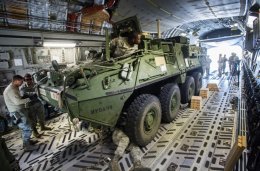 Declining defense budgets along with 15 years of battling terrorists and insurgents have left a more lightly armed Army with the prospect of facing columns of Russian tanks if war erupts in Europe. And even as Fort Carson troops train to be the first to fight if the nation heads to war overseas, politicians and pundits are debating whether the formations we’ll send are strong enough to be more than a speed bump for America’s potential enemies. “The short answer is, no, they are not a replacement for heavy forces for a fight in Europe,” said Steve Bucci, a defense expert for the right-leaning Heritage Foundation in Washington, D.C.
 As a nation that produced exceptionally poor tanks during World War II, Japan during the postwar period had quite a reputation to overcome. Wartime tanks such as the Type 97 “Chi-Ha” were a decade or more behind the rest of the world during a period of exceptionally quick tank development. As Japan rebuilt industry and specialized in cars and trucks, it also built up a cottage tank industry to replace American M4A3E8 and M24 tanks donated to the Ground Self-Defense Force. The Type 61, Type 74, Type 90 and now the Type 10 tanks have all been credible designs more than capable of turning the tanks of Japan’s potential adversaries into smoldering scrap. Remarkably, each design bears little in common with previous versions.
 TALLINN, Estonia, Oct. 11 (UPI) — An initial batch of CV9035 infantry fighting vehicles purchased by Estonia from the Netherlands have arrived in the Baltic nation. The 12 vehicles, together with an armored recovery vehicle, arrived by boat and were being transported to the 1st Infantry Brigade at Estonia’s Tapa Army Base. Estonia signed a contract with the Netherlands for the purchase of 44 used CV9035NL IFVs and six Leopard 1 tank-based support vehicles in late 2014 for 113 million euros. All the vehicles, which will be delivered by 2018, are to undergo maintenance and repairs before arriving in Estonia, the Estonian Ministry of Defense said.
 The Army is fast-tracking an emerging technology for Abrams tanks designed to give combat vehicles an opportunity identify, track and destroy approaching enemy rocket-propelled grenades in a matter of milliseconds, service officials said. Called Active Protection Systems, or APS, the technology uses sensors and radar, computer processing, fire control technology and interceptors to find, target and knock down or intercept incoming enemy fire such as RPGs and Anti-Tank Guided Missiles, or ATGMs. Systems of this kind have been in development for many years, however the rapid technological progress of enemy tank rounds, missiles and RPGs is leading the Army to more rapidly test and develop APS for its fleet of Abrams tanks.
 BAE Systems will be handing over the first of 29 Armored Multi-Purpose Vehicles (AMPV) to the US Army in December. As of early October, one vehicle has been completed with nine vehicles on the production line, the company announced Friday. These vehicles will be put through some 7,500 miles of contractor trials and 21,000 miles of US Army trials.
 The US Army is working to formulate specific requirements for a Mobile Protected Firepower (MPF) platform that so far appears akin to a light or medium tank. Army planners want to “speak definitively about requirements” and then have industry respond with design ideas before the programme begins, Major General David Bassett, programme executive officer for ground combat systems, told reporters on 4 October at the Association of the US Army (AUSA) annual conference. “We’re not willing to wait for a lengthy bottom-up design process”, he said. The army would like to get more than one vendor for a competitive programme, but is not yet sure if there will be sufficient resources for that, Maj Gen Bassett added.
 Army Abrams tanks are being outfitted with high-tech, vehicle-mounted systems which can detect, track and destroy approaching enemy RPG fire within milliseconds. The Army is fast-tracking an emerging technology for Abrams tanks designed to give combat vehicles an opportunity identify, track and destroy approaching enemy rocket-propelled grenades in a matter of milliseconds, service officials said. Called Active Protection Systems, or APS, the technology uses sensors and radar, computer processing, fire control technology and interceptors to find, target and knock down or intercept incoming enemy fire such as RPGs and Anti-Tank Guided Missiles, or ATGMs.
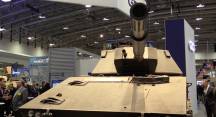 The Army’s long search for a small tank that packs a big punch seems to never end. Now, General Dynamics is looking to do something about that with their new Griffin tank technology demonstrator. Unveiled at this year’s Association of the United States Army (AUSA) convention in Washington DC, this little tank is meant to be a jumping off point for finally fulfilling the Army’s mobile protected firepower requirement. The 27 ton Griffin is a franken-tank of sorts, which is not a bad thing. It uses pieces of existing technology to lower costs and development time–and also return some investment to the Army for projects abandoned years ago.
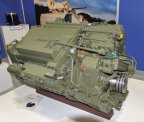 Spain’s SAPA Transmission has developed a new family of automatic transmissions for wheeled and tracked vehicle applications. The SW series of wheeled transmissions is being marketed for use with engines with outputs from 600 hp to 800 hp. The SW 516 and SW 616 have eight forward and two reverse gears while the SW 524 and SW624 have 12 forward and four reverse. For tracked combat vehicles, the company has developed the SG family of automatic transmissions, claimed to deliver more power to the sprocket than conventional automatic transmissions.
 The British Challenger 2 tank is becoming obsolete in the face of new threats such as the Russian T-14 Armata. But the United Kingdom is preparing to embark on an upgrade program to keep up with advances in armored warfare. Britain doesn’t have many other options. For one, the Challenger 2 will remain in service until at least 2035 because it’s too expensive to replace. “We have got issues with the tanks we’ve got and if we don’t do something about it we will have issues,” Gen. Nick Carter, the chief of the British Army General Staff, said last year.
 What’s the fastest way to acquire unmanned ground vehicles? Rig your manned vehicles for remote control. At least that’s the pitch from General Dynamics Land Systems. The maker of the Abrams tank and the Stryker armored fighting vehicle is teaming up with Kairos Autonomi, a company whose kits can turn virtually anything with wheels or tracks into a remote-controlled car. It’s part of a strategic play to meet the U.S. Army’s expanding demand for unmanned ground vehicles.
 The U.S. Army would develop next-generation replacements for its armored vehicles such as the M1A2 Abrams main battle tank and the Bradley fighting vehicle, but the service simply does not have the money for such projects. Instead, the Army is incrementally improving its venerable armored combat vehicles to keep them relevant against a rapidly modernizing threat—the Russian Armata family of combat vehicles for example. The Army does have some concepts that it is developing for next generation combat vehicles—and the service might build prototypes—but there are no plans to bring any such machines into production.
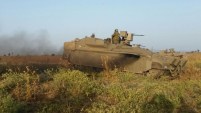 Israel’s new Engineering Namer armoured vehicles have completed their first combat drill, the Israeli Ministry of Defense announced on 2 June. Held in the Golan Heights, the drill was the first time the engineering variant of the Namer armoured personnel carrier (APC) has taken part in a platoon-level Combat Engineering Battalion exercise. The vehicles crossed steep anti-tank ditches and assembled a bridge for other vehicles to cross after them.
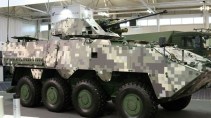 Slovakia’s MSM Group has unveiled a new air-transportable 8×8 wheeled infantry fighting vehicle (IFV) prototype called the Corsac, which is based on the General Dynamics European Land System (GDELS) Steyr Pandur II armoured personnel carrier. Developed by a team lead by MSM Group with partners including EVPU, Konstrukta Defence, and GDELS-Steyr, the Corsac is designed to meet the requirements of the Slovak Armed Forces and is fitted with the Turra 30 remotely-operated turret.
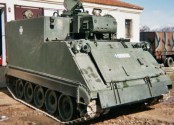 The Brazilian Army has formally received 50 tracked armoured vehicles from the US Department of Defense through the Excess Defense Articles (EDA) programme. The fleet includes 12 M113A2 armoured personnel carriers (APCs), 34 M577A2 command post vehicles, and four M88A1 recovery vehicles. These vehicles, all formerly fielded by the US Army, are to soon be moved from Anniston Army Depot in Alabama and Sierra Army Depot in California to New York, and then shipped by sea to Paranaguá in Brazil by US firm Tigers Global Logistics, the Brazilian Army told IHS Jane’s on 2 June
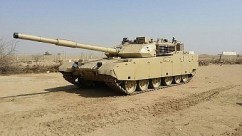 Two years since it took office, the military regime has continued to strengthen ties with China, especially through closer military cooperation. The push for closer ties as guided by the regime’s “big brother”, Deputy Prime Minister and Defence Minister Gen Prawit Wongsuwon, is signified via the arms purchase that covers 28 main battle tanks, the Model VT4, worth US$4.9 million (178 million baht). There is a plan to buy more for three battalions.
 General Dynamics Land Systems (GDLS) will start to deliver the first production M1A2 SEP v.3 Abrams to the U.S. Army starting in 2017. Out of a total of nine prototypes built, the company has delivered seven prototype tanks for field-testing at the Yuma Proving Ground in Arizona and the Aberdeen Proving Ground in Maryland. “Testing commenced in Jan. 2015 and ends in Mar. FY2020,” said Donald Kotchman, General Dynamics Land Systems’ vice president for tracked combat vehicles in a statement to The National Interest. “Prototypes are currently in reliability test and performing well.”
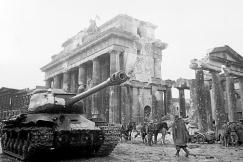 Following the German invasion of June 1941 it took a long time for the USSR to recover from the miscalculations made in the pre-war years, and it cost the country vast losses in infantry and materiel. But by the third year of the war many of the errors had been fixed, and the Red Army had got rid of its massive unwieldy machines, leaving it with a 100-percent modern mechanized force. But while the tank divisions could now boast better motorization and better-trained crews, problems still remained, the most important of which concerned tactics for using the armored forces. Here the Soviet generals still had a lot to learn.
 The family of a man crushed to death by a World War II-era tank is suing the Jelly Belly chairman and the tank driver over the accident last summer on the candy maker’s California estate. The lawsuit, filed last week in California Superior Court, claims negligence and wrongful death after Kevin Wright, a 54-year-old contractor, was run over on Aug. 22. Wright, who was hired to help maintain the family’s tank collection, was asked to hop on the vintage 1944 M5 tank owned by Jelly Belly chairman Herman Rowland Sr., the complaint says.
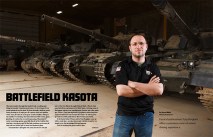 Kasota businessman Tony Borglum offers customers a one-of-a-kind driving experience.
 Turkey’s first indigenously-designed, third generation+ main battle tank (MBT), designated Altay, is ready for serial production, the Hurriyet Daily reports. Hurriyet cites Turkish military vehicles manufacturer Otokar, a branch of the Koç Group, the country’s top industrial conglomerate.
 The U.S. Army and Marine Corps will jointly test a so-called “active protection” system. These tanks and other armored vehicles will be fitted with an Israeli-developed system that shoots down and jams enemy anti-tank weapons. According to U.S. Naval Institute News, this will be the first test of Trophy on American equipment.
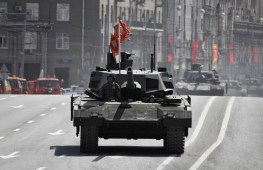 Uralvagonzavod is set to deliver the first batch of 100 operational T-14 Armata main battle tanks to the Russian Ground Forces between 2017 and 2018.
 “Whip” antennas—those long metal rods that used to extend from our cars—look pretty cool in a Smokey and the Bandit kind of way. But for military vehicles, they’re not such a great solution.
 Tank and AFV News