Book Alert: A30 Challenger Tank A Technical History

A new book by British researcher P.M. Knight is now available from Lulu.com.  This new volume looks at the history and development of the WW2 era British A30 Challenger tank (not to be confused with the modern Challenger MBT).  This is the third book that Mr. Knight has written on British WW2 armor, having also published volumes on the Covenanter and Crusader Cruiser tanks.  The book is available at Lulu.com and should be available through Amazon in a few weeks.

Publishers Description:

product_thumbnailThe A30 Challenger was devised during 1942 as a means of mounting the powerful 17 pounder anti-tank gun on the chassis of what was intended to be the British Army’s next Cruiser tank, the Cromwell. The subsequent development programme was subject to a degree of controversy as to the role and efficacy of such a vehicle, and, in the event, only 200 machines were ordered. The first examples did not see action until August 1944, and even then they were often viewed only as “stop-gaps” until the arrival of the A34 Comet. However, there were those, especially among its design team at Rolls-Royce in Belper, Derbyshire, who came to believe that the Challenger represented a missed opportunity to provide the Army with an unprecedented combination of firepower and mobility. This book examines the story of what would be an innovative and successful, if somewhat rarefied, tank and its subsequent development as a self-propelled anti-tank gun.

Italy’s Big Guns: Semovente M.41M Development, Deployment and Derivatives

Over at the Status Report blog they have posted an article by “Vollketten” on the development and history of the Italian Semovente M.41M.  People curious about WW2 Italian armor may find the article of interest.

Excerpt:

‘Primo Studio’ 90/53

rpQ9X2BThe earliest concept for this vehicle appears to be have been this one; the ‘Primo Studio’ with a small gunshield and very small profile. The hull is very square with 3 unequally spaced return rollers and 4 pairs of twin bogied wheels each side. The hull is laid out with the transmission at the front as was the norm for Italy, then the crew compartment with the engine behind and then the gun mounted at the rear on a pedestal. In my opinion this ‘Primo Studio’ M.41M would just make an ideal premium tank destroyer in WoT; small and well armed, but slow with weak armour. This would be a tank destroyer for the patient player.
It had originally been proposed to fit this 90mm L.53 calibre weapon into the chassis on the P.26/40 heavy tank which was under development at the time by Ansaldo but due to construction and development issues a modified and lengthened M.14/41 tank chassis was utilised instead, fitted with improved suspension to take the additional weight of this cannon (hence M.41-M, with ‘M’ being ‘Modificata’). The prototype was undergoing trials by the 5th of March 1942; from a November 1941 mockup to functional prototype in only four months was a remarkable achievement.

Read the full article at the Status Report.

From the Vault: Road Test the M48

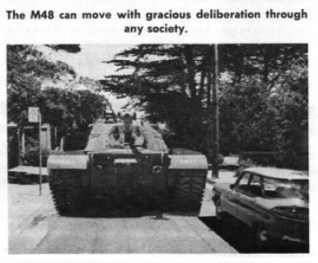
Today we present a rather humorous piece from the Jan-Feb 1967 issue of ARMOR title “Road Test the M48” by Ron Klein and Eric Erickson.  This piece takes a look at the US M48 in the style of an automotive magazine road test style article.  We have provided a transcription of the article, along with scans of the original.

header

After years of testing sports cars, sedans, personal cars, racing cars, limousines, station wagons, phaetons, broughams, classics, convertibles, both foreign and domestic, we believe we have found the ultimate mode of travel for the all-around, all-American sportsman who has a highly refined taste for powerful and truly distinctive transportation and no qualms about paying for it. This exceptional vehicle is the M-48 Town and Country Sports Saloon. Conservative in design and functional in appointments, the M-48 possesses a classic elegance. As with other vehicles there have been design changes over the years; today’s M-48 is lower and longer than its 1920 counterpart and performance is up, but its basic utilitarian configuration is virtually unchanged.

As we examined this model closely on the show-room floor, we noticed a few disadvantages to this particular body style. The engine components are not readily accessible. and the four cupola-type entrances require some healthy gymnastics to negotiate. In keeping with its basic conservatism, the exterior shows little embellishment. In fact, the manufacturer provides a rather unimaginative color scheme: everything is painted olive green. Custom paint jobs are available on special request, but these are limited to polar white and two-tone jungle green.

The only possible description 01 tne interior design is functional. There are two types of seats in the M-48. The driver is provided a deep, comfortable bucket seat (bottom only) similar to those found on early vintage farm tractors. The passengers have somewhat more austere accommodations: a seat similar to a small, flat bar stool. We have found that this stool is capable of supporting approximately one-half of the average derriere at a time making it necessary to alternate rather frequently. The absence of ashtrays and a glove compartment further demonstrates the parsimonious attitude of the designer when it comes to providing the niceties of passenger comfort. Curious cylindrical tubes and sheet metal boxes serve as footrests and backrests if semi-reclining positions are desired. Roof insulation and upholstery were of fine quality steel plating several inches in thickness.

Luggage space is plentiful if one happens to own distinctive luggage. There is no trunk per se, but there are four score or more tubular containers about two feet long and four inches in diameter which are handy for storage. Elsewhere throughout the interior one can find places for suitcases of various sizes although loading and unloading is rather awkward since everything must go in through the sun roof, or hatch, as it is called in this model.

We tested the riding qualities of the M-48 on various road surfaces, and noted a minimum of squeaks and rattles. This is obviously due to the vehicle’s solid construction and the fact that the manufacturer has been free with sound-deadening materials, such as six-inch steel plate. The suspension system, consisting of 12 torsion bars and shock absorbers, merits the highest praise. The resulting ride is not unlike that in an overstuffed rocking chair. On a cross-town run, sidewalk curbs, traffic islands, and an itinerant Volkswagen or two passed virtually unnoticed under the massive treads of the M-48. We can state without qualification that this vehicle has no equal on or off the road today when it comes to riding qualities. Further, traction and control are not a problem on rough roads. It is felt that the weight (50 tons) of the M-48 goes a long way in providing a positive relationship between the ground and the treads.

pic 1The model we tested was equipped with power steering, a feature that should be a must on every buyer’s list of options. Turning was effortless, and from lock to lock the steering wheel required only 1/2 turn. The M-48 comers with extreme agility, and there was literally no lean or sway. The only drawback in cornering at high speeds was a ten- dencv to plow rather deep furrows in the asphalt paving. Because of this we hope that the public- spirited individual who is fortunate enough to own this machine will limit his hot-rodding to unimproved roads or the dirt track. Another highly desirable maneuvering characteristic of the M-48 is its neutral steer capability. That is, while the vehicle is stationary and the transmission is in neutral, the M-48 can be made to turn within its own length by turning the steering wheel either right or left and depressing the accelerator. This maneuver is very effective for parking but has an unfortunate tendency to level anything alongside, such as parking meters and telephone poles.

The noise level inside the M-48 was high, as we had anticipated, and of course the single-cast steel hull produced considerable resonance. But then the M-48 has never claimed to be a car in which the loudest noise is the ticking of the clock.

With the driver’s hatch, or sun-roof, open, the driver has truly amazing forward visibility; he is provided with a 180 degree panorama without as much as a windshield to obstruct the view. Since the driver’s seat is located in the center of the vehicle, maneuvering through heavy traffic becomes child’s play. Rearward visibility, on the other hand, is not so good, as the passenger compartment limits all aft vision, and no rear-view mirror is present. However, the average driver will not find this to be a particular disadvantage. He would soon adopt a completely indifferent attitude with respect to what is behind him, realizing that it makes very little difference in the end.

We felt that the two-speed automatic transmission offered on this model was more appropriate for ladies’ day at the supermarket than for rugged town and country driving. A four-speed box would be more to our liking and offer the kind of performance a man would expect from this type of machine. We found it impossible to break the track loose while digging out from a standing start. However, on one occasion we were able to detect slippage while accelerating from a standing position, and that was in trying to pick up speed for an up-hill climb from a bridge crossing. Even then the tracks did not lose their grip; the bridge was pulled from its supports.

The M-48 is powered by a Continental V-12 air- cooled engine of about 825 horsepower. The cylinders are individually replaceable units. Overhead valves with rocker arm assemblies are actuated by a camshaft along each bank. Two mechanical fans provide cooling air around cylinders and oil coolers. Power is transmitted to the final drives through a cross-drive transmission, which is a combined transmission, steering, and braking unit. The brakes are of the wet, multiple disk type.

The engine lies beneath a six-foot square grating which makes up part of the rear deck. Care must be taken in walking on this deck while the engine is running, since during rapid deceleration, three or four-foot sheets of flame sometimes sweep across the deck from the exhaust which is located just behind the passenger compartment.

This model may present some maintenance problems to the do-it-yourself enthusiast. Although major assemblies such as engine and transmission can be uncoupled and removed in an amazingly short time, one may have some difficulty in accomplishing their actual removal. For the engine, a hoist of at least 8000 pounds capacity is desired. The transmission is comparatively light, equal to the curb weight of a couple of Volkswagens, at most.

Fuel consumption in the M-48 is, as we expected, high-approximately one-third of a mile to the gallon under ordinary driving conditions. Also, general preventive maintenance is somewhat more expensive than average; an oil change in both the engine and transmission runs about a hundred dollars. But the M-48 is not, after all, designed for the man who was to watch his pennies.

pic 2Finally, we cannot ignore the fact that the M-48 is made to order for the sportsman. This is one of the very few Detroit production models that comes equipped with a built-in big-game rifle. Whether hunting moose in British Columbia or rhinos in Africa, the sporting enthusiast has at his fingertips at all times the wherewithal to keep the family larder stocked with delicacies. Furthermore, Detroit could take a major step forward in solving the problem of congested highways by making this standard equipment on all production models.

Allow us to re-emphasize the fact that the M-48 is not the vehicle for everyone. The mother with young children will find its indestructability praise-worthy, but she will also find that disembarking presents an embarrassing problem, especially while wearing a tight skirt. The young man whose goal is security and social status will hardly find this vehicle conducive to his best interests career-wise, social-wise, and girl-wise.

But for the all-around hearty male type who can afford it-for the man who lets nothing stand in his way-the man with outdoor interests and lots of enemies-we say this is IT!

Inside the Chieftain’s Hatch: Achilles Part 1

A new installment in the “Inside the Hatch” series of videos featuring Nick Moran of World of Tanks.  This episode looks at the British Achilles tank destroyer, also known as “Gun, Quick-firing, 17 pounder on Self Propelled Mount M10 Mk1C.”  This particular example is the one formerly owned by Jacques Littlefield.