When the Germans realized what a threat tanks could be, they made their trenches wider to trap them; one answer to this was to build longer tanks and the Mark V was stretched by six feet to create the Mark V*. As an interim solution this was adequate but a further improved version, the Mark V** was designed for 1919.
Find out more about the First World War on the Tank Museum’s Centenary blog, Tank 100 http://www.tank100.com
 David Willey, the curator at Britain’s Tank Museum at Bovington, says Hobart quickly became a leading light in this kind of warfare. In 1934, Hobart became the inspector of the Royal Tank Corps, and in charge of tank tactics. He was such an influential figure that Heinz Guderian, one of the leading commanders in Germany’s early victories of World War Two, had his reports translated and studied them intently, Willey says.
 VK 45.03. Tiger III. Tiger II. Tiger Ausf B. And they’re all the same tank. Even after reading and re-reading the books on King Tiger’s development (Notably the Jentz/Doyle one), I’m still a little confused, though perhaps a little less than some. You’d think that a country with a reputation of organization such as Germany would have had a system which was easier to decipher, but as Hilary Doyle intimated in Operation Think Tank, the various companies all competing for contracts tended to be as much interested in the money as they were their patriotic duty to see the war won. Doubtless the winds of fortune changed as the company leadership leaned upon their patrons in the political hierarchy which had no small role in the development of vehicles by the middle of the war. Anyway, since the VK 45.03 premium tank is now on sale, let’s have a look at the background.
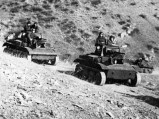 The British light Tetrarch tank is most often remembered in connection with the landing in Normandy. While it was the first tank used for this purpose, initially the Tetrarch was designed for something else. The adventures of the Tetrarch in the British army are well known, unlike the use of the tank in the Red Army. That story is still full of omissions.
 The results of the French competition for a new light tank in the mid 1930s were unclear. On one hand, the army made a deal with Renault to produce 300 light Renault ZM tanks. The tank entered service with the name Char léger Modele 1935 R,or Renault R35. A year later, the FCM 36 was accepted into service, which was more promising according to the infantry commanders. Doubt was cast on the production of the R35, but it was never cancelled, and it became the infantry’s most numerous tank. Right before WWII began, the AMX 38 appeared, another tank that could have been accepted into service with the French army.
 The summer of 1944 was coming to an end, but the Sandomierz foothold was still hot. The sun was beaming from above and battled raged on the ground. A German attack at dawn of August 13th failed, but the enemy started anew during the day, hoping that the long guns of the King Tigers will do their job. Their path was blocked by IS tanks from the 71st Guards Heavy Tank Regiment. Among them was a company commanded by Senior Lieutenant V. A. Udalov.
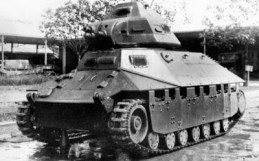 The FCM 36 was the least lucky French tank created in the interbellum period. Its design was progressive: it was the first tank with sloped armour to be put into production. While other French tanks were put together with bolts or rivets, FCM made its hull welded. In addition, the FCM 36 had a diesel engine. Alas, the fate of this interesting tank was a difficult one.
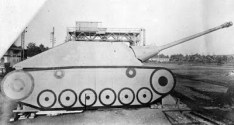 Of all German E-Series (Entwicklung, development) only the E-100 ever reached the stage where it was ready to be built in metal. This did not stop other vehicles in the series from becoming very popular. These vehicles included not only tanks, but also tank destroyers, including the medium E-25 tank destroyer. Let us look deeper into its history and familiarize ourselves with other “paper” vehicles of its class.
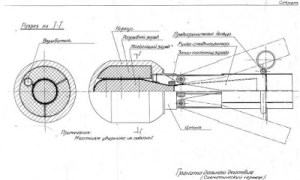 A grenade and a bottle with incendiary fluid: this was the most widespread armament of a Red Army infantryman in late 1941. It was most effective where it was used with another powerful weapon: heroism. A well trained soldier could throw a bottle 20-30 meters, a heavy grenade bundle would fly even less. The bravest men closed in to this distance or even less, often paying with their life for a disabled or burned tank. On paper, this looks like a good trade, but in real life this is a tragedy.
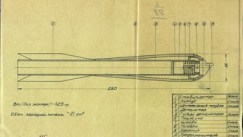 The range of a hand grenade is very short. In WWI, many methods were tried to solve this problem. One of those was a special rifle grenade. A cup was attached to the muzzle of a rifle, which fired a grenade with the aid of a blank cartridge. This method was not very effective: the range was barely a few hundred meters, the fragmentation effect of the grenade was weak, and there was no accuracy to speak of. Due to a low muzzle velocity, the shots had to be fired at a large upward angle. Despite poor reliability and questionable effectiveness, the idea of rifle grenades not only survived until the Great Patriotic War, but continued to evolve.
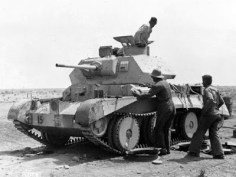 The adoption of the Cruiser Tank Mk.III in 1938 didn’t mean that the British were fully satisfied with it. Armour that was only 14 mm thick made the tank vulnerable to anything bigger than a rifle. High caliber machineguns that were one of the most popular anti-tank weapons during the Spanish Civil War made the military seriously think about improving protection. It was impossible to do anything radical with the Cruiser Tank Mk.III, since a whole new tank would be needed. It was decided to go down the road of minor modernization. The resulting tank became one of the best and longest lasting pre-war British tanks.
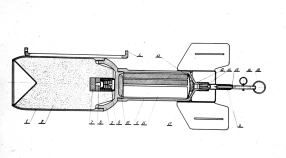 Using a rocket against a tank is very tempting. Rockets can carry a powerful warhead and can be launched without an expensive barrel: all you need is a rail. In the 1930s, Soviet pilots were already using rockets to fire at enemy planes.
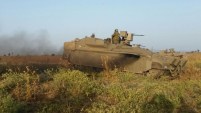 Israel’s new Engineering Namer armoured vehicles have completed their first combat drill, the Israeli Ministry of Defense announced on 2 June. Held in the Golan Heights, the drill was the first time the engineering variant of the Namer armoured personnel carrier (APC) has taken part in a platoon-level Combat Engineering Battalion exercise. The vehicles crossed steep anti-tank ditches and assembled a bridge for other vehicles to cross after them.
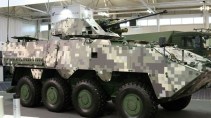 Slovakia’s MSM Group has unveiled a new air-transportable 8×8 wheeled infantry fighting vehicle (IFV) prototype called the Corsac, which is based on the General Dynamics European Land System (GDELS) Steyr Pandur II armoured personnel carrier. Developed by a team lead by MSM Group with partners including EVPU, Konstrukta Defence, and GDELS-Steyr, the Corsac is designed to meet the requirements of the Slovak Armed Forces and is fitted with the Turra 30 remotely-operated turret.
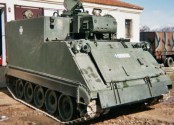 The Brazilian Army has formally received 50 tracked armoured vehicles from the US Department of Defense through the Excess Defense Articles (EDA) programme. The fleet includes 12 M113A2 armoured personnel carriers (APCs), 34 M577A2 command post vehicles, and four M88A1 recovery vehicles. These vehicles, all formerly fielded by the US Army, are to soon be moved from Anniston Army Depot in Alabama and Sierra Army Depot in California to New York, and then shipped by sea to Paranaguá in Brazil by US firm Tigers Global Logistics, the Brazilian Army told IHS Jane’s on 2 June
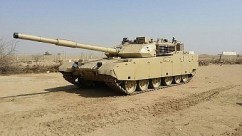 Two years since it took office, the military regime has continued to strengthen ties with China, especially through closer military cooperation. The push for closer ties as guided by the regime’s “big brother”, Deputy Prime Minister and Defence Minister Gen Prawit Wongsuwon, is signified via the arms purchase that covers 28 main battle tanks, the Model VT4, worth US$4.9 million (178 million baht). There is a plan to buy more for three battalions.
 General Dynamics Land Systems (GDLS) will start to deliver the first production M1A2 SEP v.3 Abrams to the U.S. Army starting in 2017. Out of a total of nine prototypes built, the company has delivered seven prototype tanks for field-testing at the Yuma Proving Ground in Arizona and the Aberdeen Proving Ground in Maryland. “Testing commenced in Jan. 2015 and ends in Mar. FY2020,” said Donald Kotchman, General Dynamics Land Systems’ vice president for tracked combat vehicles in a statement to The National Interest. “Prototypes are currently in reliability test and performing well.”
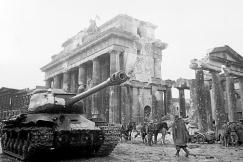 Following the German invasion of June 1941 it took a long time for the USSR to recover from the miscalculations made in the pre-war years, and it cost the country vast losses in infantry and materiel. But by the third year of the war many of the errors had been fixed, and the Red Army had got rid of its massive unwieldy machines, leaving it with a 100-percent modern mechanized force. But while the tank divisions could now boast better motorization and better-trained crews, problems still remained, the most important of which concerned tactics for using the armored forces. Here the Soviet generals still had a lot to learn.
 The family of a man crushed to death by a World War II-era tank is suing the Jelly Belly chairman and the tank driver over the accident last summer on the candy maker’s California estate. The lawsuit, filed last week in California Superior Court, claims negligence and wrongful death after Kevin Wright, a 54-year-old contractor, was run over on Aug. 22. Wright, who was hired to help maintain the family’s tank collection, was asked to hop on the vintage 1944 M5 tank owned by Jelly Belly chairman Herman Rowland Sr., the complaint says.
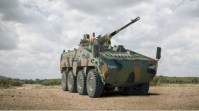 Jane’s IHS is reporting
 Tank and AFV News