As a follow-up to our Photo of the Day from yesterday about the T28 heavy tank that slide off a HET during transit, here is a statement from the facebook page of the National Armor and Cavalry Museum regarding the event.
Friends of the National Armor and Cavalry Museum,
Last Thursday we were very excited to show off the T28 leaving the yard. It was on its way to begin the first part of a clean-up, re-paint, and partial restoration. Unfortunately things do not always go as planned. During the journey across post to where it was to be painted, the contracted Heavy Equipment Transporter (HET) was traveling down a hill when it suffered an unexpected and massive brake failure. In order to keep the HET on the road, the contractor crew was forced to make an extremely sharp turn. This forcefully shifted the T28 (currently weighing about the same as an M1A2 Abrams as it is without its outer track set or engine installed) around the trailer. Despite the large amounts of chain used, the T28 broke completely free. In hindsight, this probably prevented a worse accident since the T28 was not left partially chained, which could have caused the tank to roll over and off. Instead the T28 slid off the trailer and hit the ground with both tracks. It then rolled rear first, into a ditch before stopping.
First and foremost, we are extremely thankful no one was injured in the incident. As for the accident itself, the appropriate departments are conducting their investigations. As for the T28, we are very lucky that it was built very tough! Considering the U.S. Super Heavy was definitely not designed to fly short distances, it landed in the best manner imaginable. The impact of the landing and subsequent stop in the ditch did cause some damage to the suspension, specifically two bogie stations. The good news is everything is repairable and will be incorporated into the painting and cleanup. While she spent a night in the ditch, she was recovered the next day with no issues by two M88A1 Hercules Recovery Vehicles. During this time, we did not put out information until all chains of command could be informed and a proper damage assessment could be completed. While this is an unfortunate setback, it is minor in the long run and the T28 will be back. In closing we’d like to thank everyone for their support during this process and hope you continue to follow our work in preserving and restoring the U.S. Army’s armor collection. Thank you!
Sincerly,
The NACM Staff and Volunteers


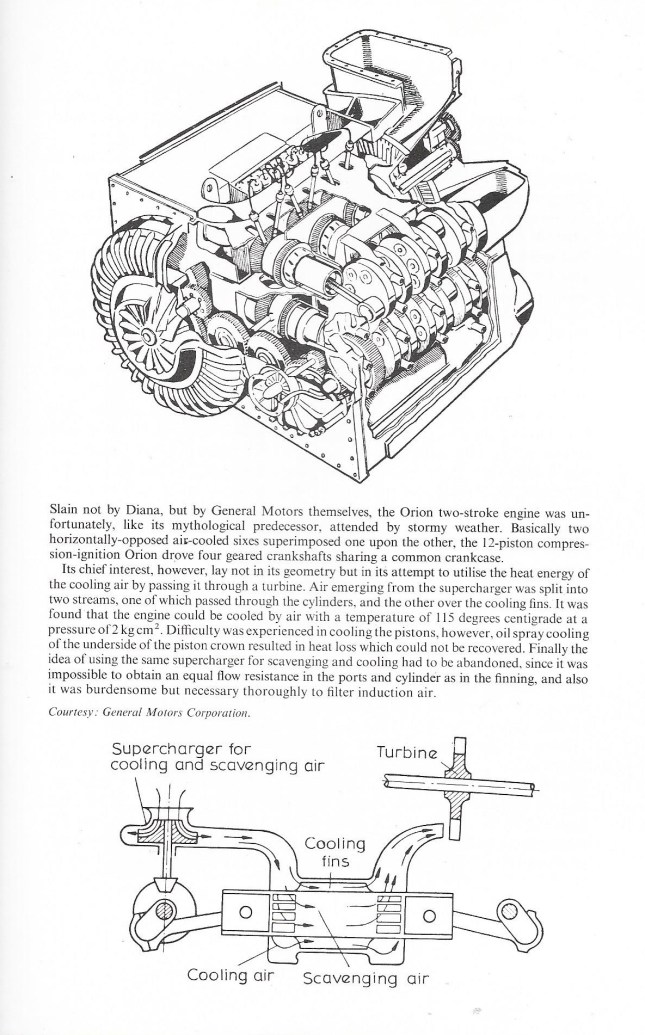



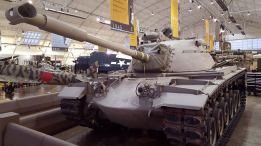 The Flying Heritage Collection’s new M48A1 Patton tank has taken the long way around to its final destination. The tank was built in the United States and then sold to the Kingdom of Jordan in Western Asia. Jordan, an ally of the US, UK, and France, received 197 M48 and 200 M48A1 tanks beginning in the mid-1960s. Many Jordanian tanks saw combat during the Six Day War with Israel in 1967. It is unknown where this particular tank was assigned at the time. When newer tanks like the M60 became available, Jordan retired many of its M48s. This tank was a gift to the Flying Heritage Collection from the Royal Tank Museum in Aqaba, Jordan.
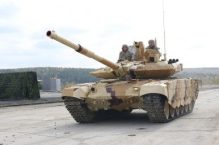 The Indian Army is set to deploy over 460 new T-90SM main battle tanks (MBTs) along India’s border with Pakistan, senior Indian defense officials told IHS Jane’s Defense Weekly on January 19. The new T-90SM MBT (other designations T-90AM or T-90MS) is the latest and most modern version of the T-90 (which in turn is a modernized variant of the T-72 MBT), and has specifically been designed for export by Russia. According to IHS Jane’s Defense Weekly, the newly ordered MBTs will supplement 850-900 license-built T-90S Bhishma tanks, divided into 18 regiments, and currently deployed in the Indian states of Rajasthan and Punjab.
 The Army has sent a tank and armoured vehicles through the Channel Tunnel for the first time as it looks at ways to dispatch heavy armour quickly to eastern Europe in the event of a crisis with Russia. Five armoured vehicles loaded on wagons were sent through to France soon after midnight on Wednesday as part of the logistics exercise. They completed the 40 minute return journey a few hours later. The drill came as the Army looks for new ways to deploy armour from the UK once it closes its bases in Germany. When the bases are closed at the end of the decade, the Army will have to deploy armoured vehicles from the UK if they are needed by Nato’s rapid reaction force to bolster defences in eastern Europe.
 Turkey’s plans to build its Altay main battle tank (MBT) have hit a snag after Tümosan, the planned engine provider, cancelled a key technical support contract with Austria’s AVL List GmbH. The cancellation comes after Austria’s parliament unanimously adopted a non-binding motion that imposed an arms embargo against Turkey in November 2016. As a result conditions were placed on the transfer of technology to Turkey. Austria made the move in response to Turkey’s increasing violation of human rights since the failed military coup attempt in July 2016.
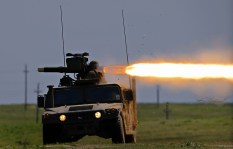 MOSCOW, January 19. /TASS/. Russia’s new active protection system Arena-M for T-72 and T-90 tanks is capable of protecting armored vehicles from US Tube-launched Optically-tracked Wire-guided (TOW) missiles, Chief Designer of the Machine-Building Design Bureau Valery Kashin told TASS. “According to the information we have on these missiles, the Arena-M will undoubtedly be able to protect a tank from a TOW,” the chief designer said.
 “It was in the early 2000s that I had the honor of meeting Mr Hunnicutt at a gathering of tank enthusiasts at the then-Littlefield Collection. Had I known then what I know now, I would have paid much more attention to the genial old chap who seemed to have near-celebrity status amongst my companions, and less to the tanks. Over time, as my interest in the history of armoured vehicles developed, I began to understand why he was the focus of such attention. “Hunnicutt” has become synonymous with being the last word of recorded US armored vehicle development, and until now his works have commanded very high prices on the used-book market, with good reason.
 Tank and AFV News