 The Winter 2017 issue of ARMOR is available for download. Features in this issue include:
Making Reconnaissance Guidance Say What You Think by CPT Luke Bowers
The Role of Reconnaissance Forces in the Counterattack by LTC Scott Pence
Looking Toward the Future: the U.S. Cavalry’s Role in Multi-Domain Battle by MAJ Amos C. Fox
Trends in Defensive Operations by COL Esli Pitts
Tough Vehicles Require Tougher Crews: Why We Must Re-establish a ‘Gunnery Culture’ … and How to Do It by SSG David D. Lunebach and SSG Sean M. Leytham
The Battle of Debal’tseve: the Conventional Line of Effort In Russia’s Hybrid War in Ukraine by MAJ Amos C. Fox
TRADOC Big 6+1 Capabilities by LTC Corey B. Chasse
Enhancing Shared Understanding within the Brigade’s Operations Process by MAJ Rich Groen
Applied Combined-Arms Maneuver at Company Level by 1LT James Casey
Saving Future Gallons: Overview of New Field Manual 7-0 by James L. Young Jr.
 In the late 1940’s, Argentina bought nearly 450 M4 Sherman’s from Belgium in many British variants, over 250 of them were the Firefly version, with the long barrelled 17pdr gun that could take on the Tiger 1.
 It’s been a few months since we visited the Tank Museums
  has been listed on Amazon by Amber Books. As far as we can tell, this is a reprint of the 2002 book
 An image posted on online forums in early February shows what appears to be a next-generation Chinese infantry fighting vehicle (IFV) featuring a new front-engined hull and a possible unmanned turret. If it is a new prototype IFV, it could be a successor to the China North Industries Corporation’s (NORINCO’s) ZBD-04 or later ZDB-04A, which are in service with the Ground Forces of China’s People’s Liberation Army (PLA). Like the ZBD-04/ZDB-04A, the new IFV hull features six running wheels and an apparent forward mounted engine, but differs in a number of ways, including a less sloped forward glacis.
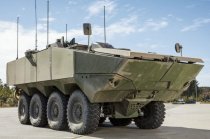 Science Applications International Corp (SAIC) has unveiled the first of 16 prototypes for the US Marine Corps’ (USMC’s) competitive Amphibious Combat Vehicle (ACV) 1.1 programme during a 21 February ceremony at the company’s facility in Charleston, South Carolina. SAIC partnered with Singapore Technologies Kinetics (STK) to submit STK’s Terrex 2, which includes a V-shaped hull and space to carry 11 marines with a crew of three (to add additional room to carry two more marines would have required a redesign and added weight that the company deemed unnecessary).
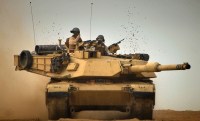 WASHINGTON — A years-long period of reduced modernization budgets has caused a major lag — potentially up to 30 years for some rides — in upgrading the Army’s combat vehicles, the Army general in charge of the fleet said. “I can tell you right now the level of investment in my portfolio is unacceptably low,” Maj. Gen. David Bassett said Monday at a Lexington Institute forum on Army rapid acquisition. The current investment has only allowed the service to make very capable upgrades to its fleet — which would require “decades to touch all of our armored brigade combat team formations,” Bassett said.
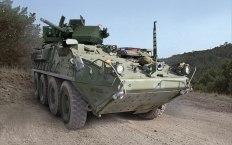 The Army is trying to rapidly field Strykers with a bigger gun to the 2nd Cavalry Regiment in Europe amid concerns the service is outgunned by Russian counterparts, and so far the program is on track, according to Col. Glenn Dean, the project manager for Stryker. Congress provided the Stryker program office funding in 2015 and 2016 to field Stryker infantry carrier vehicles with a 30 mm cannon to the regiment in Europe by 2018. A little more than $300 million is allocated for eight prototypes and upgrades to 83 production vehicles, plus spares. General Dynamics Land Systems — the Stryker’s prime contractor — was authorized by the Army to hold a competition to select a gun and turret for the vehicle.
 The South Korean army has peculiar needs. For one, just across the Demilitarized Zone, North Korea possesses one of the largest tank armies in the world. In this cauldron of densely packed military forces, both sides share a peninsula that is also very mountainous. During the Korean War, many battles were fought in places such as the Punchbowl, Pork Chop Hill, Old Baldy, Bloody Ridge and Heartbreak Ridge, just to name a few. Any weapon built specifically to exploit the peninsula’s terrain would have an edge. So, when South Korea produced its first domestically designed tank, Seoul took the mountainous terrain into full account.
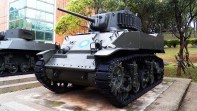 When the Allies launched the amphibious landing in Normandy in 1944, one of their chief fears was that German Panzers would roll down to the beach within twenty-four hours and crush sodden Allied infantry under their tracks. To protect against such an outcome, the Allied airpower ruthlessly scourged road and rail links leading to Normandy, and airborne operations preceding the landing had as a chief objective impeding a German armored counterattack.
 With the promise of increased defense spending, U.S. Army officials are planning a major upgrade for the M1 Abrams tank as the start of a sweeping effort to modernize the armored vehicles in the service’s heavy brigades. The initial package of upgrades currently in test will enable to M1 to fire the Advanced Multipurpose, or AMP, round, which can be programmed to deliver devastating effects such as airburst on enemy targets, said Maj. Gen. David Bassett, program executive officer, Ground Combat Systems.
 examines the history of the bizarre and ill-considered German super-heavy tank. This is a 240 hardcover edition and is described as being a continuation of the Spielberger series on German tanks.
 , this book is authored by Dick Taylor and Michael Hayton. This book follows the same format as previous books in this series, being a 160 page hard cover volume with plenty of photos and full color illustrations and charts.

 Tank and AFV News