 This British Armour Branch report was recently linked to over at the Tanknet forum. We thought it was worth posting here. The document is from 1945 and details British comprehensive firing trials against a German Pz V Panther tank. A variety of weapons were tested against the Panther, including small arms, mines, the PIAT, and the common tank and anti-tank guns in service with the UK at that time (6pdr, 75mm, 17pdr, 25pdr.) The results are not particularly surprising, but may be of value for those looking for specific information about vulnerabilities of the Panther.
We have transcribed the conclusions of the report below:
- The vehicle is virtually immune to small arms fire from ground level.
- Small arms attack directed downward at about 30 degrees into the inlet louvres of the engine compartment causes severe damage to radiators.
- Even more severe damage to the radiators may result from 20mm attack from the air from from fragments of HE shell bursting in the air above the vehicle or against the turret above the engine compartment roof.
- Projectiles of calibre 6 pdr and upwards, whether AP or HE, which strike below the horizontal centre line of the gun mantlet, are likely to penetrate or blow in the roof of the driving compartment and may jam the turret traverse.
- Penetration through the sides of the vehicle will very probably cause cordite or petrol fires.
- The rolled armour proved brittle and flaky.
- The use of interlocked joints provides a structure which has considerable stability even when the main welds are fractured.
- The brittle nature of the roof plates makes these vulnerable to attack from HE grenades or shell which burst in contact with or within a few inches of the plate.
- Frontal attack with PIAT is unprofitable, flank attack against pannier (or turret) sides is effective.
- Mine with explosive charges between 4 and 15 lbs are likely to break the track if detonated at the centre of its width, but may not do so if detonated by its edge. Detonations under any part of the track are unlikely to affect the floor plates or their joints with the hull side.
- It is probable that a combination of three No.75 grenade mines will have an effect on the track similar to that produced by a single Mk.V H.C. (standard) A.T. mine. Either will break the track when detonated below the middle third of the track.
Further discussion of the above conclusion will be found in the various parts of this report.
The Trial has confirmed in general the assessment of vulnerability given in D.T.D. Report No. M.6815A/3 No.1, differences between certain predicted vulnerable ranges and actual results being due to the brittle nature of the armour. Though evidence is available that many other Panther tanks damaged in battle have had armour which has shown similar defects, it should not be assumed that this form of weakness will always exist.
The design of the vehicle is such that its structural stability is considerable, the effective use of interlocking joints being chiefly responsible.
The Panther tank, judged on the results of this trail alone, remains a most formidable weapon with few weaknesses; and its value if used with adequate flank protection should not be underrated.
The full report can be viewed in this photo gallery.
 Typically when one sees statements from WW2 veterans concerning the M4 Sherman tank on TV shows or in books, they often are critical of the armor or firepower of the vehicle. These quotes typically come from the final year of the war when the Sherman was being compared to the much heavier German adversaries it faced in Western Europe. While this narrative seems to have defined the Sherman in popular culture, it’s worth pointing out that when the vehicle was introduced in 1942, it was received with much praise by British forces in North Africa. An example of this was recently provided to us by a friend of the site over in the UK who forwarded this letter that was found in the appendix of 7th Half-Yearly Progress Report of the Royal Armored Corps (1st January to 30th June 1943.)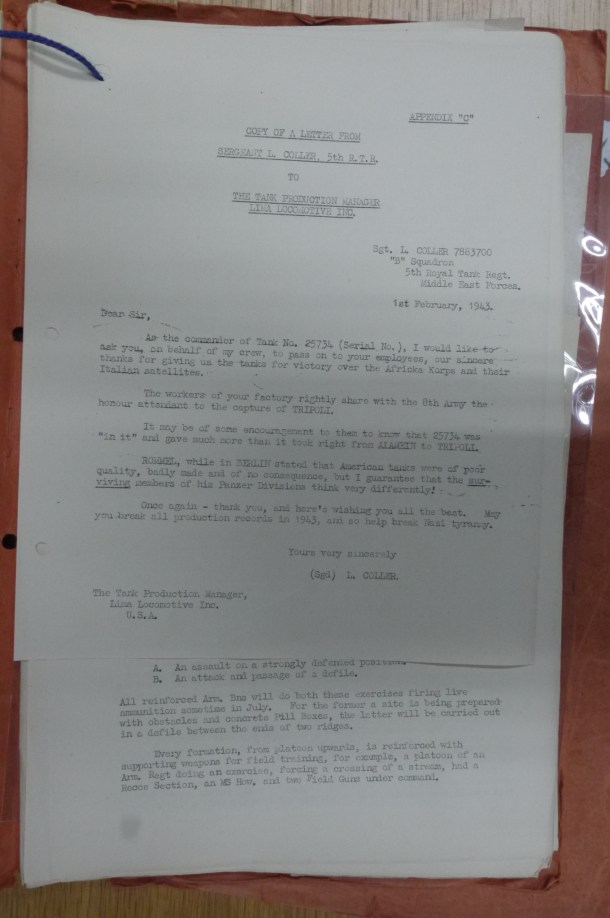
 Today we present a report from the British Archives dating back to 1970 concerning the Soviet T-55 tank. This particular report was conducted jointly by the British and the Israelis and documents “trials to assess the weapon system and fightability characteristics of the Soviet T-55 tank.” We have uploaded the entire report onto a separate page which can be
  Today we present a British study from December of 1947 on ‘Motion Studies of German Tanks.” This report examines the ergonomics of late WW2 German tanks Tiger, Tiger II an Panther. The report focuses on crew comfort and efficiency, looking at each crew position and providing analysis. Detailed charts of gun loading times are included in the report, as are diagrams of the ammo storage layout. This report was photographed at a archive by a

 Tank and AFV News