Nicholas Moran, North American researcher for World of Tanks has posted a new article sharing some discoveries from the archives regarding US WWII era tank destroyers.
Excerpt:
Every now and then I come across things in the Tank Destroyer Board archives which are interesting, but not necessarily suitable for a post by themselves. Sometimes I’ll put up the picture or comment on my Facebook page, but I think this collection of writings is worth sharing.
We start with some comments reported to the board in February 1945, from the ETO.
Searchlight Illumination
Searchlights employed so that the beams shine just above the height of a man will cause individuals and vehicles to cast shadows which are easily seen. This reduces the probability of surprise by the enemy in snow covered terrain. - Commanding General, 35th AAA Brigade.[Chieftain’s Note: Those of you who make scale or Lego models may be familiar with this technique. When you drop a part, the use of a torch (flashlight) at floor level casts long shadows, making it easy to find it.]
Photo from the Korean War. Truck and Jeep-mounted searchlights were used as late as VietnamRumors
Much excitement was caused in our command post when a line captain reported 25 Tiger tanks headed our way. Questioned, he admitted he had seen one tank and "assumed there were at least 25 since they usually attacked in mass." Investigation showed there was just one tank, and that between us and it was a road block covered by a minefield, bazooka teams, and three tank destroyers. 1106th Engineer Group.[Chieftain’s Note: Well, this demonstrates the difference between information and intelligence.]

Read the full article at The Chieftain’s Hatch.
 Difficult battles of the Soviet-German front in 1941-1942 negated the advantages of light tanks. Equipped with relatively weak weapons and mostly bulletproof armour, light tanks as a class were becoming obsolete. The Germans were the first to see the end of the pre-war concept of a light tank, ceasing production in 1942. In the USSR, engineers were still trying to boost the combat performance of the T-70. The result of this work was the T-80 tank, but it came too late. Meanwhile, proposals for radically new light tanks arrived. A proposal for the MT-25 tank was sent by Chelyabinsk engineers to Stalin on February 24th, 1943. Unlike many proposals, this one contained interesting ideas and was well thought out, and piqued the interest of the Main Armoured Directorate. What were these ideas, and why was the tank never built?
 In the late summer and early fall of 1944, F. Leclerc’s 2nd Armoured Division was confidently leading the Allied offensive in Lorraine. Colonel Paul de Langlade was the leader among leaders. His decisive actions threatened German units south of Nancy with encirclement. The Germans decided to deliver a counterattack to correct matters. Now de Langlade, having scorned his enemy, had to deal with the consequences of his success.
 Sometimes fairly good designs of military hardware don’t reach their true potential because they appeared in the wrong time or in the wrong place. Light tanks, widely in use on all theaters of WWII, disappeared rather quickly from the Eastern Front, freeing up the space for their heavier brothers. The Hungarian Toldi tank, the first mass produced tank for the country, was one of them. The consequences of the First World War were disastrous for Hungary. The Treaty of Trianon of 1920 which cost Hungary 72% of its territory, 64% of its population, and its access to the sea was seen as a national disgrace. The state of mourning declared after the treaty was signed was one of the longest in world history: state flags remained at half mast until 1938 when Hungary returned some of its lost territory after the First Vienna Award. Some schoolchildren begin the day with singing the national anthem, while Hungarian students began with reading a prayer for the reunification of their country.
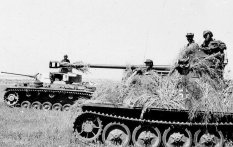 The Wehrmacht offensive towards the Caucasus in 1942 had two goals. The secondary was to cut the line of Lend-Lease supplies, but the primary goal was to reach the local oil supply. At the time, Caucasian wells accounted for 70% of the USSR’s oil. It’s not hard to imagine what a loss of these wells would mean for the USSR, which was already doing poorly in 1942, or what a godsend it would be for the fuel-starved German army.
 Having fought its last war in 1814, Sweden ended up one of the few European countries that avoided participating in either World War. Nevertheless, the Swedes always paid careful attention to their army’s weapons. Despite its neutrality, Sweden often preferred weapons of German origin. This applied to tanks as well. Even the Strv fm/21, the first Swedish tanks, were really German LK.IIs. Ten of these tanks were built at AB Landsverk in Landskrona, which became the Swedish tank development center for decades to come. The Landsverk L-60 was born here, some elements of which were a real revolution for tank development in the 1930s. Sweden’s neutral status, its developed industry, and well maintained connections were very useful for the Germans. The Treaty of Versailles prohibited Germany from developing new types of weapons and military vehicles. However, this prohibition did not stop the Germans from secretly re-launching tank development programs in 1925. They also did not miss out on the opportunity to develop tanks in other countries.
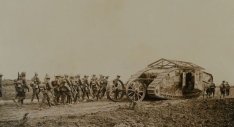 No one could have guessed on September 15th, 1916 that many military theory books would become obsolete in an instant. The first tank entered its baptism by fire, and an unnamed German’s cry “The devil is coming!” announced the coming of the new god of war.
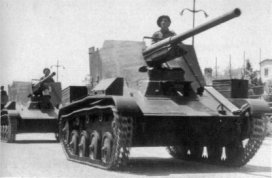 Romania joined WWII with a very marginal tank force, both in numbers and capability. The first battles on the Eastern front showed that their tanks were incapable of engaging Soviet medium tanks, let along heavy ones. The Romanian army was in desperate need of new more powerful anti-tank means. In a very short amount of time, they could only be built on captured platforms.
 The main purpose of new IS-2 heavy tanks that appeared in the Red Army in 1944 was the destruction of German pillboxes with their 122 mm guns. Fighting enemy tanks was not a priority. However, plans and forecasts rarely work in war. The IS tanks got a chance to test themselves against enemy armour soon after they arrived on the battlefield.
 In the days of the Second World War, heavy self propelled guns played an important part on the battlefield. It is not surprising that after the end of the war, heavy SPGs, including tank destroyers, remained a priority for designers from all nations. It’s surprising that only a handful of these vehicles were ever built in metal, and none were mass produced. The Soviet Union and its Object 268 was no exception.
 The Germans understood that the summer offensive against the Kursk salient will not be an easy one. German commanders took their time planning Operation Citadel, moving the start date several times. Meanwhile, the Red Army was digging in, wrapping the terrain in barbed wire and sowing mines. The Germans were also preparing, knowing that their units will be warmly received. Their hopes rested on new types of tanks: Tigers and Panthers, Ferdinand tank destroyers and Brummbar assault tanks.
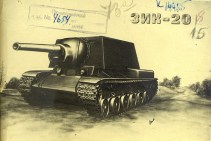 On April 15th, 1942, the plenary assembly of the Artillery Committee of the GAU met to discuss further development of self propelled artillery. The decisions worked out in this meeting became key in wartime development of Soviet SPGs. Among others, requirements were confirmed for a heavy SPG that would replace the 212 bunker buster. Work began on this SPG on the KV-7 chassis at UZTM, headed by L.I. Gorlitskiy. By the fall of 1942, the U-18 project was ready, but by that point, a competitor was developed at Sverdlovsk.
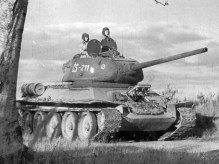 By the end of the Second World War, T-34-85 tanks became one of the most common type of tank in the Czechoslovakian army. The first tanks of this type were received by the Czechoslovakian corps in early 1945, and up to 130 tanks of this type were received in total. They took part in the liberation of Prague and later became the backbone of the post-war Czechoslovakian army. Shipments continued after the war. Photos show tanks that were clearly made after May 9th, 1945. T-34-85 tanks became the first to receive the famous tricolour insignia.
 On March 19, 1945, just outside the German village of Dörrmoschel, an American tank, already ablaze from a rocket strike, rounded a corner and and surprised an enemy anti-tank gun crew in the road.
 Tank and AFV News