In this episode, Len Dyer of the National Armor and Cavalry Restoration Center discusses the Mark VIII American Liberty Tank.
Those interested in the Mark VIII may enjoy this 1920 Ordnance magazine article on the construction of the vehicle.
News for all things related to Tanks and Armored Fighting Vehicles
In this episode, Len Dyer of the National Armor and Cavalry Restoration Center discusses the Mark VIII American Liberty Tank.
Those interested in the Mark VIII may enjoy this 1920 Ordnance magazine article on the construction of the vehicle.
It’s time again to do a round up of the Russian language articles translated to English at the Archive Awareness blog.
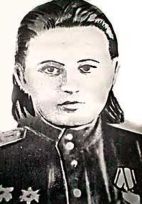 Flying was all the rage among Soviet youth in the few years preceding the Great Patriotic War. “Komsomol, to the skies!” the slogans called. Among the many young men and women who answered the call was a citizen of the city of Biysk named Nina Ilyinichna Bondar. In the late 1930s, while still in school, she joined and aero club and learned to fly the light U-2 biplane.
A month after the start of the Great Patriotic War, Nina came to the Biysk military commissariat and volunteered to join the Red Army. It was hard to refuse an officer’s daughter, and one who could fly a plane at that. The young woman was directed to the Moscow Anti-Air Defense, where her familiar U-2 became a weapon of war. However, history clipped her wings.
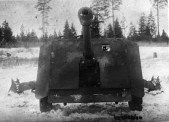 The development of anti-tank artillery followed more or less the same process in many countries. This resulted in the USSR creating a 100 mm BS-3 gun in 1944 and the Germans with the 88 mm Pak 43 gun, a weapon with excellent characteristics that forced Soviet tank designers to rethink their requirements for armour protection. However, the British arrived at the best solution, creating the Ordnance Quick-Firing 17-pounder, which had the most balanced characteristics. You can familiarize yourself with the gun in detail by viewing these photos and read about its creation and trials in the Soviet Union here.
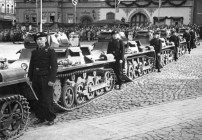 German generals often call PzKpfw I and PzKpfw II tanks “training” tanks in their memoirs. This is true in some way, as many converted PzKpfw I tanks were used to train crews. However, during the development of these tanks, there wasn’t a word uttered about training as their main function. The Wehrmacht’s first tanks were created as typical light tanks of the early 1930s, which mostly had machinegun armament. With this design, the Germans aimed towards the ideal concept of a German tank, setting the foundation for all subsequent vehicles of the Third Reich. The first member in the family that would become the weapons of blitzkrieg was the PzKpfw I Ausf. A.
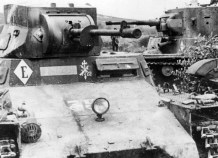 The Spanish Civil War began on July 17th, 1936. By the end of the month, the rebels gained the support of Italy and Germany, who promised, among other things, supplies of military hardware. In mid-August, Italian L3/35 tankettes arrived in Spain. German tanks arrived much later: 32 PzKpfw I Ausf. A tanks and one command vehicle were received in October of 1936. At approximately the same time, the first Soviet T-26es arrived in Spain and became the main opponents of the rebel tanks. As for the “Spanish” PzKpfw I Ausf. A, one of them became a Soviet trophy and was run through a whole spectrum of trials. What did the Soviet testers discover and what conclusions did they make?
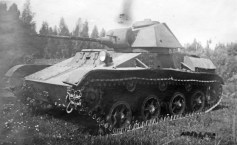 GABTU had to reach a compromise on many issues when it accepted the T-60 tank for service. It was obvious that this tank is inferior to the T-50 in nearly all characteristics, but its production could be set up very quickly and it could be produced by the thousands. However, GABTU was seriously worried about the tank’s armament. Trials of the 20 mm TNSh gun showed that its penetration was equal to the DShK high caliber machinegun. It is not surprising that the issue of improving its armament was raised even before the first prototype was built. This modernization went in several directions, one of which resulted in the T-45 tank.
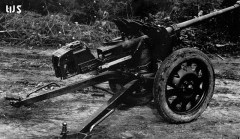 In 1942, the Allies captured an interesting anti-tank weapon designed for the German army and actively used on all fronts of WWII since 1914. Its distinguishing feature from other anti-tank rifles and cannons was its conical barrel, the caliber of which was larger at the breech than at the muzzle.Officially, the gun was called 2,8 cm schwere Panzerbüchse 41 (2,8 cm s.Pz.B. 41). German nomenclature placed it into the small arms category, but both the Red Army GAU and the military ministries of Great Britain and the United States classified it as artillery. The difference in classification comes from the fact that this weapon has all the characteristics of a cannon: carriage (upper and lower), shield, mount with a recoil brake, but the aiming was done by hand, by moving the gunner’s body and moving the barrel up and down.
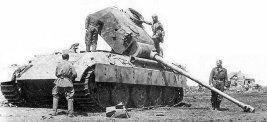 The Voronezh Front, protector of the south flank of the Kursk salient, found itself in the way of a powerful German offensive. However, this scenario played out quite unlike what German commanders expected. Most problems were faced by the 48th Tank Corps, which got stuck at the first Soviet line of defense on July 5th, 1943. Even 200 Panthers, thrown into battle near Cherkasskoye where Grossdeutschland division was spinning its wheels did not improve the situation.
Only late in the evening, having joined forces with the 3rd Tank Division, the German unit managed to enter Cherkasskoye. Soviet forces were fully expelled only by the next morning. The offensive had to be developed further, along the Belgorod-Oboyan highway, right through Lukhanino.
Part 2 of the Chieftain’s look at the British Centurion tank.
Sputnik news has posted a short video showing the restoration of a T-34 tank. This vehicle currently resides at the Museum of Military Equipment of the UMMC.
The National Museum of Americans in Wartime along with The Virginia Museum of Military Vehicles will be holding their semi-regular Open House on Sept 24 and 25 2016 at The “Tank Farm” in Nokesville, Virginia. This even features a number of historic AFV demonstrations. To view images of past events, click here. These images should give a pretty good idea of what to expect at this open house. Also, check out this video from the 2012 Open House.
To register for the event, go to the website for the American in Wartime Museum.
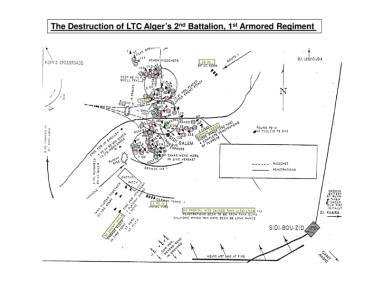 Mystics & Statistics recently made a very interesting post about a diagram showing the location of US tanks destroyed during the counterattack carried out by Combat Command C of the US 1st Armored Division near the village of Sidi Bau Zid on February 15, 1943. According to the post, the attack was a disaster, with 46 of 52 M4 Sherman tanks knocked out and over 300 men killed, captured or missing. What makes the diagram so interesting is that it shows not only the location of each knocked out tank, but also what type of enemy weapon knocked it out. Interestingly, not a single one of the Sherman tanks were penetrated through their frontal armor and only one tank was knocked out by an 88mm gun, most tanks having been knocked out by 50mm guns.
The Mystics and Statistics post notes that in this battle the M4 Sherman clearly had a technical advantage in those stats that people like to focus on so much, frontal armor and firepower. The most common German weapon in this battle was the 50mm gun, either found on the Panzer III tank or the towed PaK 38. The Sherman frontal armor was generally effective at protecting against this weapon while the 75mm gun of the Sherman was capable of handling the Pz III and Pz IV tanks opposing it. And yet despite this advantage on paper, the American force got trounced quite thoroughly. The deciding factor was the greater experience and tactical skill of their German opponent.
It’s worth contrasting this example to the battle of Arracourt a year and a half later. In this instance, the German Panzers had the the technical advantage in the form of the Panther tank with its formidable cannon and thick sloped frontal armor. However, by this point it was the German tank force that was lacking the qualities necessary for battlefield success. In 1943, it was the American 1st Armored division CCC that charged in without adequate reconnaissance or air superiority and paid the price, despite have the “better” tank. Eighteen months later, it would be the 111th Panzer Brigade’s turn to learn the same lessons. (For more on the battle of Arracourt, be sure to check out the new book Patton Vs the Panzers.)
Excerpt from Mystics and Statistics:
A few years ago, I came across a student battle analysis exercise prepared by the U.S. Army Combat Studies Institute on the Battle of Kasserine Pass in Tunisia in February 1943. At the time, I noted the diagram below (click for larger version), which showed the locations of U.S. tanks knocked out during a counterattack conducted by Combat Command C (CCC) of the U.S. 1st Armored Division against elements of the German 10th and 21st Panzer Divisions near the village of Sidi Bou Zid on 15 February 1943. Without reconnaissance and in the teeth of enemy air superiority, the inexperienced CCC attacked directly into a classic German tank ambush. CCC’s drive on Sidi Bou Zid was halted by a screen of German anti-tank guns, while elements of the two panzer divisions attacked the Americans on both flanks. By the time CCC withdrew several hours later, it had lost 46 of 52 M4 Sherman medium tanks, along with 15 officers and 298 men killed, captured, or missing.
Read the full Mystics and Statistics post here. There is also a larger format version of the chart available there.
A recent video by World of Tanks on Swedish tank history makes the claim that the Swedish Stridsvagn 103, also referred to as the S-Tank, was intended to function as a tank destroyer. The blog Swedish Tank Archives has taken issue with that assessment in a well researched rebuttal titled Stridsvagn 103 Was Not A Tank Destroyer.
We have taken the liberty of reprinting the first couple paragraphs of the article followed by a link to the Swedish Tank Archives where the entire piece can be viewed.
Stridsvagn 103 Was Not A Tank Destroyer
In internet arguments and popular culture, it is frequently claimed that the stridsvagn 103 (strv 103, “S-tank”) was a defensive tank, or basically a modern tank destroyer. It was, claims the common wisdom (perpetrated and repeated in media such as History Channel), meant to dig down in a forest, take a few shots at attacking Soviet tanks and then retreat, using its rear driver to its advantage. In the recently revealed Swedish tree for World of Tanks, it is indeed classified as a tank destroyer (although mainly for game mechanics reasons). Even in the Swedish army, some officers (although mainly ones who had no experience on the tank) thought it was worthless for traditional tank work – that is, offensive tasks. In this essay, I will show that this is simply not true: the Swedish army set out to figure out how to build a good tank, came up with the S-tank idea, developed and built that idea as a tank, which it then proceeded to use operationally as a tank.
The origins of the strv 103, or “alternative S”
In 1957, the Swedish army initiated a study of the future of warfare, in order to determine what weapons technology it should pursue during the 1960’s – as well as many other things. One of the sub-committees of this study was tasked with studying direct-fire infantry support weapon systems, such as tanks, anti-tank weapons, direct-fire crew-served weapons, etc. The central question that the sub-committee was tasked with answering was: “How should our system for direct fire (both anti-tank and anti-personnel fire) work around 1970 and in the time immediately thereafter?”
From Military History Visualized comes this video explaining the basics of armor technology from 1920-1980. At just a little under 20 minutes long, this clip provides a decent introduction to the topic.
Nicholas Moran of World of Tanks takes a look at the British Centurion.
Here is a video from World of Tanks North American on the history of Swedish tanks.
Video Description (from youtube):
Swedish tanks were built with Scandinavian precision. They were expensive, high-quality, and produced in limited quantities. It may seem strange that a country that never fought in the 20th century managed to create their own tank building legacy. That is why we’re shining a spotlight on the story of how the most famous Swedish vehicles, from Landsverk to Strv 103, were created.

 Tank and AFV News