The Armor for the Ages website has been updated with a new page on the two German WWII era Marder II tank destroyers at Fort Benning. The page includes a description and history of the vehicles as well as two photo galleries. The photos show quite a bit of interior detail of the vehicles and should prove rather useful to anyone working on a model of a Marder II.
Excerpt:
The subject of this article is one of two Marder IIs shipped to the United States after having been surrendered in Austria to the U.S. forces as the war ended. One was sent to the Aberdeen Proving Grounds (APG) while the other was sent to the Armor School Museum at Fort Knox which eventually became the Patton Museum of Cavalry and Armor. Both Marders were part of the 1. Panzer Division in its Panzer Aufklärungs Abteilung (reconnaissance battalion). The 1. Panzer Division was listed as still having 12 Marder IIs as of March 1945.
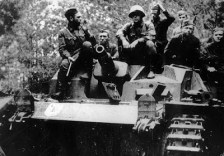 At the start of the Great Patriotic War, Soviet military intelligence and the GAU had a very approximate idea about the types and characteristics of German tanks. This deficiency led to an overestimation of the possibilities of German armour and the launch of the KV-3, 4, and 5 programs in March of 1941. Even information on real German tanks was sparse. Intelligence missed the increase of the front armour of PzIII and PzIV tanks to 50 mm and use of 50 mm guns. This lack of information had to be made up for in the most reliable way during the war: studying trophies. Among the vehicles that were glossed over by Soviet intelligence was the StuG assault gun.
 By noon of the first day of the Sandomierz-Silesian Offensive Operation, Soviet infantry penetrated the first line of German defenses and hit the second. Quickly realizing the situation, Marshall Konev, the commander of the 1st Ukrainian Front, played the ace up his sleeve: several hundred tanks and SPGs. Thanks to them, Soviet forces were ready to assault the second line by the second half of January 12th, 1945.
 The history of the Pz.Kpfw. Maus is still full of blank spots, despite the popularity of the subject. The beginning of the tank’s development from March of 1942 to 1943 is the least studied area. During this time, the project indexed Typ 205 radically changed. Essentially, the only constants were the index and the idea of using an electric transmission. Thanks to new publications and archive research, it is now possible to remove the veil of mystery from many parts of the project.
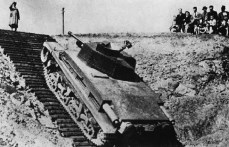 The Turán started with an acknowledgement that the Toldi light tanks (which were basically Swedish Landsverk L-60s) weren’t really suited for a general tank role on the modern battlefield. After a bit of hunting, the Hungarians ended up talking with Škoda.
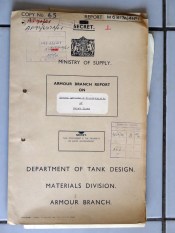 Three British reports on the quality of German armor plate on the Panther, Tiger and Tiger II tanks have been making the rounds in the internet forums lately. The reports are available on Google photos where they can be viewed and downloaded. Due to the length of these reports and work responsibilities, we have not had a chance to go through these reports in great detail or provide any typed transcripts. However, from reading the conclusions it seems the British were generally more impressed with the armor quality on the Tiger than the Panther, which they found to be brittle.

 Tank and AFV News