Tank Chats #12 TOG II*

The Tank Museum has released another installment in the “Tank Chats” video series featuring David Fletcher.  This episode takes a look at the TOG II tank housed at Bovington Tank Museum.

Description:

This enormous tank was designed on the premise that World War II would evolve in the same way as the First World War. Some believed that existing tanks would not be able to deal with such conditions, and one of the most influential was Sir Albert Stern, who had been secretary to the Landships Committee in the First World War. In company with many others involved in tank design in 1916, including Sir William Tritton, Sir Eustace Tennyson D’Eyncourt, Sir Ernest Swinton and Walter Wilson, Stern was authorised by the War Office to design a heavy tank on First World War principles.

Two prototypes were built, both known as TOG for The Old Gang and they were even manufactured by the company that built Little Willie and the first tanks in 1916, William Foster & Co. of Lincoln.
Armor for the Ages Tiger II article and gallery

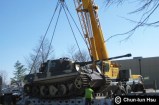
TigerIItext05The Armor for the Ages website has posted a new article on the history of the Tiger II tank that was stored at Aberdeen Proving Grounds for many years until it was restored at the Patton Museum in 1992.  This vehicle currently resides at Fort Benning.  The article includes links to four photo galleries which show the vehicle at various stages of the restoration process.  German armor fans are sure to find these galleries of interest.
Link to Armor for the Ages Tiger II page here.

Inside the Chieftain’s Hatch: Achilles Part 2

Here is part 2 of the “Inside the Hatch” video series look at the British Achilles variant of the M10 tank destroyer.

Nicholas Moran continues his tour of the Achilles tank destroyer, built on the basis of the American M10. Today, he’s talking about the tank interior and crew member positions. Why can this vehicle be considered the best of its type for its time? What difficulties did the gunner face? What’s the simplest way for the driver to get to his position? You can find answers to these questions and more in the new episode of “Inside the Chieftain’s Hatch.” Happy viewing!

German Superheavy Paper Tank Destroyers

jagdpanzere100s1-cd4370df9b9b6b0a81069a495202b39cThe Archive Awareness blog has posted an English language translation of an article by Russian tank researcher Yuri Pasholok on the subject of WW2 German “paper” superheavy tank destroyers.  In this piece he takes aim as some of the fantasy tanks and tank destroyers that have circulated in magazines and around the net such at the E-100 “Krokodil.”

Excerpt:

Fantasies regarding WWII era armour in the areas of technical capabilities and application in combat, both of tanks that existed and those that never made it off paper (or were never even planned at all), are very widespread. An popular category of these fantasies concerns tank destroyers on the chassis of German superheavy tanks. Do any of them actually have a basis in reality?

The Atlantis of German tank design: E-100 Krokodil

The E-100 and Maus superheavy tanks are some of the most worshipped idols among German armour. The fact that the development of both was stopped by a personal order from Hitler in July of 1944 does not stop many from believing that both monsters could make it to mass production. In reality, the fate of the Maus was sealed when the Allies bombed Krupp’s factories and there was nowhere left to produce the tank. The E-100 was never fully assembled and never moved under its own power, nor was a contractor determined for its production.

Tank destroyers on the chassis of the E-100 and Maus tanks are another topic. Information on these vehicles is quite incomplete which gives fertile soil to wild fantasies. One of the most hyped up examples at present is the imaginary E-100 Krokodil.

The entire article can be read at the Archive Awareness blog.  For the original Russian language version, click here.   The Russian version includes images not found in the Archive Awareness translation.

The Chieftain’s Hatch: Equipping the Force Part 2

chieftains hatchNicholas “The Chieftain” Moran has posted part two of an article based on his archive digger regarding US armor in WW2.  In particular, this article looks at Army Ground Forces and how they determined with vehicles and tanks should be developed and fielded during the war.

Excerpt:

Situation in March 1942

When Army Ground Forces was established, many of the basic decisions for the tank program had already been made by other agencies of the War Department and the Ordnance Department. At this time, the Armored Force was a semi-autonomous command which played an important part in developing its equipment. Although it came nominally under the control of Army Ground Forces, it continued to exercise many of its powers by direct contact with the Tank Automotive Center in Detroit.

The M3 medium tank was in current use, the M4 medium tank was in production but had yet to see a battlefield. Development of the Medium Tank M7 was also well under way. This had been conceived in 1941 as a 16-ton vehicle, mounting a 37mm gun, and was classified as a light tank. Successive changes requested by the Armored Force had resulted in a tank of 25 tons, mounting a 75mm gun, which thus approached the weight class of the M4 (33 tons) and was reclassified as a medium tank. During 1942 Armored Force enthusiasm for the M7 tank was quite pronounced.

All of these tanks had been developed primarily for the purpose of exploiting break-throughs and conducting operations in the traditional cavalry manner. First of all, their sponsors wanted speed and mobility, with mechanical reliability a necessary corollary. Sufficient fire power was only needed to subdue enemy infantry and minor strong points, and armor was required only to withstand enemy small arms. These tanks had narrow, high-speed treads. Unit ground pressure was not a serious factor because it was contemplated that slashing tank tactics then advocated would not be possible through soft, marshy terrain. [Chieftain’s Note: As you will recall, Armored Force, not AGF, are the folks who created tank doctrine and tank manuals, we’ve gone over in the past the position of Devers and AF on the matter of what they expected medium tanks to do against tanks. That AGF had this interpretation need not be an accurate reflection of what AF thought]

Read the full article here.


Italy’s Big Guns: Semovente M.41M Development, Deployment and Derivatives

Over at the Status Report blog they have posted an article by “Vollketten” on the development and history of the Italian Semovente M.41M.  People curious about WW2 Italian armor may find the article of interest.

Excerpt:

‘Primo Studio’ 90/53

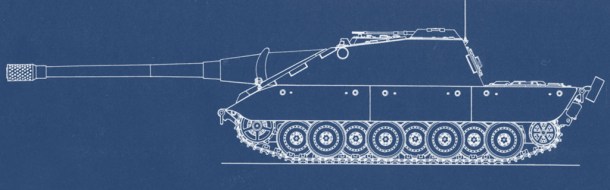
rpQ9X2BThe earliest concept for this vehicle appears to be have been this one; the ‘Primo Studio’ with a small gunshield and very small profile. The hull is very square with 3 unequally spaced return rollers and 4 pairs of twin bogied wheels each side. The hull is laid out with the transmission at the front as was the norm for Italy, then the crew compartment with the engine behind and then the gun mounted at the rear on a pedestal. In my opinion this ‘Primo Studio’ M.41M would just make an ideal premium tank destroyer in WoT; small and well armed, but slow with weak armour. This would be a tank destroyer for the patient player.
It had originally been proposed to fit this 90mm L.53 calibre weapon into the chassis on the P.26/40 heavy tank which was under development at the time by Ansaldo but due to construction and development issues a modified and lengthened M.14/41 tank chassis was utilised instead, fitted with improved suspension to take the additional weight of this cannon (hence M.41-M, with ‘M’ being ‘Modificata’). The prototype was undergoing trials by the 5th of March 1942; from a November 1941 mockup to functional prototype in only four months was a remarkable achievement.

Read the full article at the Status Report.

Inside the Chieftain’s Hatch: Achilles Part 1

A new installment in the “Inside the Hatch” series of videos featuring Nick Moran of World of Tanks.  This episode looks at the British Achilles tank destroyer, also known as “Gun, Quick-firing, 17 pounder on Self Propelled Mount M10 Mk1C.”  This particular example is the one formerly owned by Jacques Littlefield.

Yuri Pasholok on the T-10 “The Last Soviet Heavyweight”

last soviet heavyweightRussian tank researcher Yuri Pasholok has written an article chronicling the development of the Soviet T-10 heavy tank for a Russian language blog.  Peter Samsonov at Archive Awareness blog has provided an English language translation of the article.  It can be read here.

Excerpt:

The Last Soviet Heavyweight

 The last fighting machine named after Stalin would be the last Soviet heavy tank. It appeared at a time when the trend of constant increase in the weight of tanks came to a stop. Without the ability to grow protection and armament of tanks at the expense of weight, the designers of the IS-8 (T-10) used a number of creative solutions.

The end of an era of giants

Starting from late 1943, Soviet tank designers steadily increased the mass of their heavy tanks. Eventually, the initial stages of tank projects stepped over the psychological limit of 50 tons. The IS-3 was an exception, but it was essentially a deep modernization of the IS-2. Interestingly enough, there were doubts at the very top of the Main Armour Directorate (GBTU) about the suitability of the IS-3 for service. The Object 701, which hit a mass of 55 tons during the prototype phase, seemed much more desirable. Development of the future IS-4 was moving slowly: the first prototypes were ready for the summer of 1944, but the tank was constantly changed, and, despite being designed as an answer to the Ferdinand, only reached mass production in 1947. By that time, production of the IS-3 not only started, but also ended, netting a total of 1555 tanks.

Nicholas Moran on WoT tank research

While we don’t usually present items on tank themed video gaming, this presentation by Nick “The Chieftain” Moran may be of interest to those interested in how World of Tanks conducts their vehicle research.

Tank Chats #11 Valentine

The eleventh in a series of short films about some of the vehicles in the Bovington Tank Museum collection presented by historian David Fletcher MBE.

.