Two years ago we had a chance to interview author and historian Steven Zaloga. That interview became the first feature of this website when it launched in January of 2015. We recently had the chance to do a follow-up interview with Mr. Zaloga in late August, 2016. We were able to get his thoughts concerning his two latest hardcover books, Patton Versus the Panzers: The Battle of Arracourt, September 1944

 Steven Zaloga is an author and defense analyst known worldwide for his articles and publications on military technology. He has written over a hundred books on military technology and military history, including “Armored Thunderbolt: The US Army Sherman in World War II”, one of the most highly regarded histories of the Sherman Tank. His books have been translated into Japanese, German, Polish, Czech, Romanian, and Russian. He was a special correspondent for Jane’s Intelligence Review and is on the executive board of the Journal of Slavic Military Studies and the New York Military Affairs Symposium. From 1987 through 1992, he was the writer/producer for Video Ordnance Inc., preparing their TV series Firepower. He holds a BA in history from Union College and an MA in history from Columbia University.
Why did you decide to choose the battle of Arracourt, September 1944 as the topic for this book?


In the course of researching this book, did you find anything that surprised you or was it more a case of fleshing out the framework you had established in earlier works? [Read more…]
 According to an
 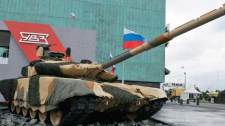 UralVagonZavod (Hangar 2, Stand CE26) has confirmed to the AAD Show Daily that development of its latest T-90MS main battle tank (MBT) is complete and production can commence as soon as orders are placed. The T-90MS is a step change compared with the earlier T-90 MBT and has already been demonstrated in the Middle East, as well as being shown at the recent Army 2016 show in Moscow. Some of the elements of the T-90MS could be back-fitted to earlier T-90 series to enhance their capability, especially in the key areas of armour and firepower.
 A fleet of 59 M1A1 Abrams tanks arrived in Australia in 2007 and until now their engines were sent to the United States to be fixed at a cost of about $500,000 per engine. Aerospace company TAE, which has a depot at the Royal Australian Air Force base at Amberley, south-west of Brisbane, has secured a contract with the army to repair the engines on site at a tenth of the price. TAE CEO Andrew Sanderson said the rebuild program had created 20 local jobs.
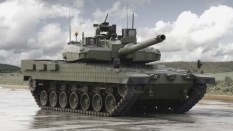 Otokar has submitted its best and final offer (BAFO) to the Turkish Undersecretariat for Defence Industries (SSM) for the first production batch of 250 Altay main battle tanks (MBTs) and associated integrated logistic support (ILS) for the Turkish Land Forces Command (TLFC). The initial Altay MBT production offer was submitted by Otokar in January 2016 and the SSM subsequently requested a BAFO. SSM will decide whether to accept Otokar’s offer or to open up a full-scale competition for the production phase of the Altay programme.
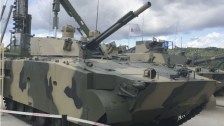 Kurganmashzavod unveiled an upgraded version of its BMP-3 Dragun infantry fighting vehicle (IFV) with additional armour protection at the Army 2016 defence show outside Moscow. “Kurganmashzavod has up-armoured the BMP-3 Dragun IFV. The vehicle has received side skirts made of composite armour and an upgraded electro-optical suite. The company is planning to assemble the Dragun demonstrator for state trials and operational test and evaluation in 2017,” a company representative told IHS Jane`s at the exhibition. He added that Dragun will be the new basis for a whole family of combat vehicles.
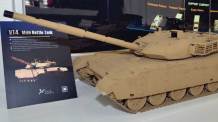 China North Industries Corporation (NORINCO, Hangar 2, Stand CW14) is aiming for a slice of the still significant main battle tank (MBT) market with its latest VT4 MBT, which is being shown here only in model form. It is understood that the first export customer for the VT4 MBT – which was previously called the MBT-3000 – is Thailand, which has placed a contract for 28 vehicles. The VT4 is armed with a 125mm smoothbore gun that is fed by an automatic loader located below the turret that first loads the projectile and then the charge. A total of 38 rounds of separate loading of 125mm ammunition are carried, of which 22 are for ready use in the automatic loader.
 The July-September 2016 issue of
  In September 1967, the Soviet military launched Exercise Dnepr, one of the largest exercises in Soviet military history. Most observers and military analysts focused both on the size of the exercise and the large-scale use of airborne forces. The Soviet army actually dropped two complete airborne divisions with all their equipment in support of a front-level offensive during the exercise.
 JSC UralVagonZavod, manufacturer of the new Russian tanks T-14 based on the multipurpose platform Armata kicked off supplies of the combat vehicles to the Russian Army, reported the company’s director general Oleg Sienko on Sept 8 at the Army-2016 military exhibition. “Indeed, we do confirm that supplies have started. Totally, we are to produce 2,300 tanks of this kind for the Russian army”, Sienko told to RIA Novosti. “Speaking of the new contract, everything is up to the customer, the defense ministry. We just prepare manufacturing facilities”, he added.
 Hyundai Rotem is expecting to commence production of 600 6×6 KW1 and 8×8 wheeled armoured vehicles (WAVs) for the Republic of Korea Army (RoKA) from 2018 at a rate of about 100 vehicles each year, the company said. These will be designated K806 and K808 in RoKA service, respectively. Speaking to IHS Jane’sat the DX Korea 2016 exhibition in Goyang city, South Korea, principal research engineer at Hyundai Rotem’s research and development centre Shin Yong-Cheol said the company expects a firm order from the South Korean government by October, which will call for a batch of 16 low-rate initial production vehicles to be delivered to the RoKA for field trials scheduled to last till the end of 2017.
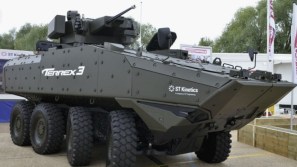 Contenders for the British Army’s Mechanised Infantry Vehicle (MIV) requirement were out in force at Defence Vehicle Dynamics (DVD) 2016 at Millbrook Proving Ground on 7 and 8 September. MIV will be an 8×8 procured off-the-shelf and fitted with a minimum number of UK sourced sub-systems such as remote weapon station, communications, battle management system and seating. According to David Russell, MIV Team Leader “MIV is now in the concept phase” and with “the team building up rapidly”.
 General Dynamics Land Systems UK (GDLS UK) has confirmed that it will commence manned firing trials of the Scout – Specialist Vehicle Ajax in early 2017. This follows a series of unmanned firing trials at a range in Wales that were carried out between July and August this year. Lockheed Martin UK developed the Ajax’s turret under subcontract. Three prototype turrets were completed and will be followed by 245 production turrets. The turret is armed with a CTAI 40 mm Case Telescoped Armament System, a 7.62 mm co-axial machine gun (MG), a Kongsberg Protector remote weapon station (RWS) that can be armed with a 7.62 or 12.7 mm MG or a 40 mm automatic grenade launcher, and banks of electrically operated grenade launchers.
 The Russian Federation may regain T-80U main battle tanks (MBT) and BMP-3 infantry fighting vehicles (IFV) supplied to the Republic of Korea (ROK) in the 1990s and in the 2000s towards state debt payments. “Moscow is planning to regain the T-80U MBTs and BMP-3 IFVs delivered to Seoul in the 1990s towards state debt payments. The taking of the relevant decision dates back to 2005.” An official from Russian defense industry was quoted as saying by Tass Defence Friday. We have recently conducted the technical assessment of the vehicles and drafted a proposal to the authorities of the ROK. The proposal was delivered to the South Korean side on September three.
 Tank and AFV News