 Jane’s is reporting that the US DoD has approved a sale of engine and transmission upgrade kits to Israel for the purpose of upgrading 100 Achzarit armored personnel carriers. Reported to be worth 16 million dollars, the New Jersey-based company Diesel Engineering Inc will be providing the kits with an order completion date of October 2017. The actual installation will be carried out by the Israeli company Nimda. The article notes that when completed, these APCs will be equipped with 710 hp Detroit Diesel Corporation 8V-92TA turbocharged diesel engines and Allison XTG-411-5A fully automatic transmissions, providing approximately 20% more power than the current engines in the Achzarit. Oddly enough, descriptions of the Achzarit on several different internet sites have posted several different horsepower ratings for this vehicle. The Achzarit is a heavily armored APC converted from the hull of T54/55 tanks which Israel captured in large numbers during the Arab-Israeli wars.
Israel to upgrade Achzarit APCs
India’s Arjun MBT face serious technical issues
 The Economic Times is reporting that the Indian Army is facing major technical issues with it’s home-grown Arjun MBT. According to the article, a significant proportion of its fleet has become inoperable in recent months and are non-sericeable due to maintenance issues. The Indian Army reluctantly accepted 124 Arjun tanks into service from 2009 to 2013 after the UPA government insisted that a token number be ordered to keep the tank development program viable. Sources said that the Army’s opinion is that while a large number of tanks are not operational due to technical defects, the fleet as such is not combat worthy due to reliability issues. “A number of tanks are not operational currently as transfer of technology (ToT) of several imported systems fitted onboard has not been done,” an Army official said. The Army has identified 96 problems, including 18 major ones.
The Arjun has had a longer development cycle than any other tank in history. The program to design the tank started in 1974 and has gone through several versions. Attempts to develop homegrown components have met with limited success and have forced the Arjun designers to rely on foreign components. It is estimated that 60% of the tank is foreign produced and many of these foreign components must be repaired abroad, a significant factor in the vehicles low readiness and reliability rates.
Other articles on long, sad story of the Arjun program:
Arjun MK 1 – India’s MBT-70 or White Elephant? (Nov 1998)
Sabotage suspected in Arjun tank engine (July 2008)
Strykers possibly to be upgunned to 30mm
 Breaking Defense has posted an article stating that the 2nd Cavalry Regiment in Europe wants 81 of its eight-wheel-drive Stryker infantry carrier vehicles fitted with 30 millimeter automatic cannons. The article notes that the 2nd Cavalry wants the weapons because it’s the Army’s frontline force in Europe. There are only two US combat brigades still based on the continent, the 2nd Cav in Vilseck, Germany and the 173rd Airborne in Vicenza, Italy, a light infantry formation with very few vehicles of any kind and nothing as heavy as a Stryker. Since Russia seized Crimea, both the 2nd Cavalry and the 173rd Airborne have deployed to the Baltic States. Currently the Stryker is armed with a .50 caliber heavy machine gun. The Defense Department has been reportedly testing the 30mm “medium caliber remote weapons station” developed by Kongsberg Protech Systems and General Dynamics Land Systems since 2013.
BAE integrates “active damping” system to CV90 suspension
 Army-technology.com is reporting that defense contractor BAE has incorporated “Formula One” suspension technology into the CV90 infantry fighting vehicle. Referred to as an “active damping suspension”, these systems have been used in Formula One race cars since the early 90’s. The system functions by sensing the speed of the vehicle and lay-out of the terrain ahead and responding by adjusting the suspension to keep the CV90 level, which reduces the wear and tear on the vehicle. Originally operational on carbon-fibre racing cars weighing no more than 700kg, the suspension system has been modified for the first time, to work on heavy tracked vehicles weighing up to 35 tons. Reportedly, the suspension enables the vehicle to travel up to 40% faster than existing armored vehicles.
German Newspaper challenges German policy of no DU tank ammo
 A recent article in German newspaper Die Welt makes the claim that German tungsten based APFSDS 120mm ammunition is ineffective against the armor of Russian T90 MBTs. The author of the article, Han Ruhle, was the Chief of Policy Planning Staff in the German Department of Defense 1982-1988. He lays the blame for the lack of effective depleted uranium APFSDS round in the German inventory at the feet of German environmentalists and anti-nuclear activists. The article states that:
Currently, the Bundeswehr has a limited effective means of anti-tank ammunition with the DM63, an arrow-tungsten-based ammunition. Their penetrating power is indeed improved significantly over the old munitions and corresponds with the enhanced 120-millimeter cannon to just the level of the old uranium core ammunition of the US from the 80s. However, this is not enough to penetrate the newer versions of the T80- and T90 tanks.
The full article can be viewed here (in German). This article comes at a time when the German military has suffered a number of embarrassments regarding equipment effectiveness, procurement and readiness. The G36 rifle has come under criticism for inaccuracy at high temperatures, the Puma IFV has suffered a series of delays and cost overruns and earlier this year a German unit on exercises was shown with broomsticks substituted for missing gun barrels.
Not surprisingly, the decidedly pro-Russian news site Sputnik International pounced on this article, declaring “German Army has no Chance against Russian Tanks“
Jane’s IHS on New Russian Heavy Armor
Jane’s IHS has released an article
 showing the various pictures recently released by the Russian Ministry of Defense showcasing their new suite of armored vehicles. Included in the article are Armata MBT, the Coalition-SV self-propelled gun, Kurganets-25 IFV, Boomarang 8×8 IFV and several other wheeled vehicles. The vehicles were revealed ahead of their formal debut at the May9 Moscow Victory Day Parade. In all the pictures the weapons systems of the vehicles are covered by tarps. The release of these official pictures follows the unofficial leaking of images and footage that happened earlier this month in the lead up to the parade.
Lockheed Martin demos improved Warrior IFV
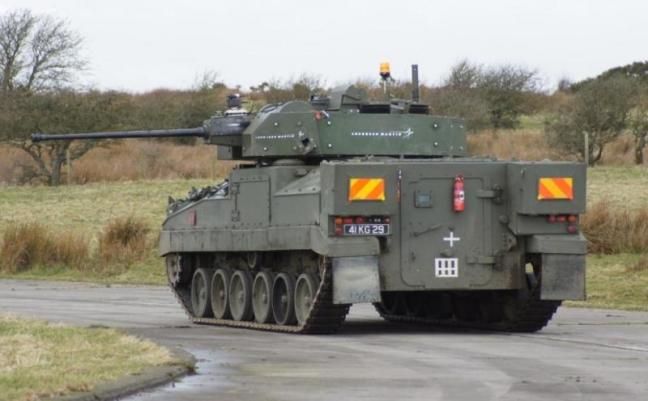 UPI is reporting that a modernized Warrior infantry fighting vehicle of the British Army successfully demonstrated a new turret and cannon system against moving targets. The demonstration was part of the country’s Warrior Capability Sustainment Program, in which Lockheed Martin UK is upgrading the Army’s fleet of 380 Warrior vehicles. In addition to a new turret and the CT40 weapon system, the modernized vehicle features an updated environmental control system, improved all-round awareness cameras and driver’s night vision systems and a modular protection system fitted to the chassis.
Russian Defense Ministry reveals photos of T-14 Armata
The International Business Times is reporting that Russia’s defense ministry has released it’s first official image of the new Armata T-14 tank. The image was released via the “Russia Beyond the Headlines” news source. The article notes that:
The heavily armored T-14 is the main battle version of the Russian Armata tank and features a 125mm gun that is remotely controlled, with an unmanned turett. The photo of the tank was first posted on the ministry’s site in a section about Victory Day, Russia’s celebration of the 70-year anniversary of the end of World War II. Images first leaked of the highly anticipated tanks in late March.
The tanks are a part of Russia’s plan to update its military, and it has proven costly with the country attempting to maintain its plan to spend 23 trillion rubles ($433 billion) despite economic contraction, Bloomberg reported.
The picture itself it not particularly exciting. As with the other leaked pictures of Armata that have appeared, the details of the turret are obscured by a tarp. Also, it would appear that the picture (below) referred to in the article is not of the tank version of the vehicle as it has no cannon.

Prime Portal AFV photo collection
 We recently stumbled across the Prime Portal website while looking for AFV photos. The site itself is a bit dated looking but the number of galleries is truly impressive. A rough count indicates at least a thousand individual galleries on this page. AFV enthusiasts will find much to look at here.
Below is a list of all the galleries found on the Prime Portal site. Please go to their website to view the galleries.
Lithuania may purchase PzH 2000 SPG
 Defense News is reporting that on Wednesday Germany said it wants to sell howitzer-type mobile artillery vehicles to Lithuania as the Baltic NATO nation boosts its defenses amid concerns over neighboring Russia. The news emerged during a visit by Lithuanian Defence Minister Juozas Olekas to his German counterpart Ursula von der Leyen. Lithuania is also interested in potentially purchasing Boxer infantry fighting vehicles from Germany as well. The German Ministry of Defense stated that the program was for 12 PzH 2000 howitzers. Any Boxer purchase would include the Organisation for Joint Armament Co-operation (OCCAR), which oversees the programme for Germany and the Netherlands.

 Tank and AFV News