Crain’s Business article on M1 Abrams tank

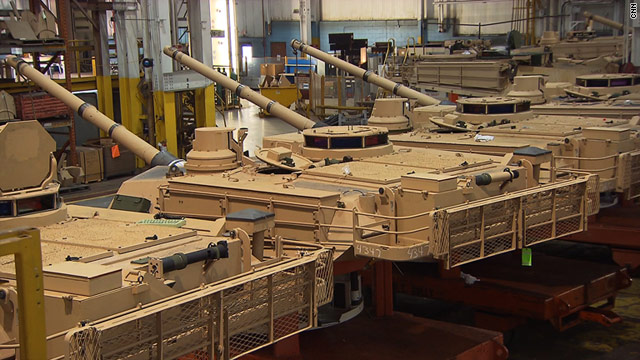
t1larg.tank.plant.cnnCrain’s Detroit Business recently posted an article about the past and future of the M1 Abrams tank.  As can be expected, the article focuses primarily on the business end of things, giving a brief history of M1 production and discussing challenges faced by the Lima Army Tank Plant in the era of sequestration.  Also mentioned are the M1 tanks sold or given as aid to foreign countries.

Article excerpt:

The former Detroit Arsenal Tank Plant in Warren, which had produced the M1 Abrams since its early days, discontinued new tank assembly in late 1991 and closed down completely in late 1996. Since then, General Dynamics Land Systems has housed all Abrams production and equipment upgrades for the Abrams at the government-owned Lima Army Tank Plant.

That plant, which was refurbishing about 2 1/2 tanks per day in early 2009, is handling a small fraction of that volume today. At issue at least since sequestration began affecting defense budgets in 2012 is whether the Lima plant can remain operational on a mix of foreign military sales and some limited production orders until M1A3 production begins in two years.

“The Army’s notion was they could mothball the plant and reopen in three years, but as GDLS can attest, you can mothball equipment but not people,” said Loren Thompson, a defense industry analyst and COO of the Arlington, Va.-based Lexington Institute.

Full article here.

From the Vault: Thoughts on Future Tank Design 1968

Today we present an article from the 1968 July-August issue of ARMOR by Richard Ogorkiewicz titled “Thoughts on Future Tank Designs.”  This article gives a pretty good summary of the state of the art in tank design in the late 60’s, illustrating the issues and thoughts that would go into the designs produced in the 1970’s.  Also of interest is the picture on the first page, an artist’s interpretation of an overhead gun system.  Page 2 states that the picture is courtesy of Continental Motors, who would later go on to develop the overhead gun system for the Teledyne Armored Gun System in the 1980’s.

US tanks go back to green

2BE961CA00000578-3219907-image-a-29_1441215460957Stars and Stripes is reporting that as focus shifts away from the middle east and toward Russia, US tanks in Europe are being repainted to woodland green rather than desert tan. According to the article, US vehicles in Europe are being repainted in forest colors to more closely match the European terrain and NATO allies. The article also mentions other issues concerning US AFV logistics in Europe, noting that:

The fighting vehicles stored here are a key part of USAREUR’s rotation of troops and vehicles into the Baltics and eastern Europe.

At Coleman, military officials discussed ways to improve the flow of equipment to the region, much of which moves by rail. For the Army, large-scale gear and troop movements around Europe have demanded that the Army relearn old logistical skills not exercised during the war years in Iraq and Afghanistan, officials said.

“We need to rebuild competency on several levels,” said Maj. Gen. Duane A. Gamble, commander of the 21st Theater Sustainment Command.

Full Article here.

From the Vault: PhotosNormandie Youtube Channel

Today we present the PhotoNormandie Youtube Channel.  This French language channel consists of a large number of video clips taken by US film crews during the Normandy campaign.  We have picked out a few that feature interesting AFV footage.


US troops driving around a captured Panther tank


US troops examining knocked out Panther


Hedgerow cutters being welded onto US Sherman tanks


German anti-tank gun with allied tank ID pictures chalked on the interior of gun shield, captured Pz IV tanks and other vehicles.


US tanks and infantry working together
 

Morocco to purchase Abrams Tanks

According to local TV news in the Lima OH area, Morocco has agreed to purchase 222 M1A1 Abrams tanks. This purchase was announced at the Joint Systems Manufacturing Center in Lima by Senator Rob Portman. According to the article, Morocco has committed to the purchase of 222 M1A1 Abrams Tanks from the JSMC under the foreign military sales program. Portman also announced that the initial contract for upgrading turrets has been awarded. The Moroccan ambassador to the U.S. and the Royal Moroccan Armed Forces were recently urged by Portman to move forward with the foreign military sales program.

Tank Chats #9 Whippet – Medium A

The ninth in a series of short films about some of the vehicles in our collection presented by The Tank Museum’s historian David Fletcher MBE.
While the heavy tanks were designed for direct attacks against enemy trenches the Tank Corps also wanted a lighter, faster tank to work with the cavalry over open country. Designed by Sir William Tritton and built by Fosters of Lincoln the Medium A, or Whippet, was the only such tank to see service with the Tank Corps, starting in 1918.


Also, here is a video of the Whippet in use.

From the Vault: College Fraternity buys Sherman Tank circa 1957

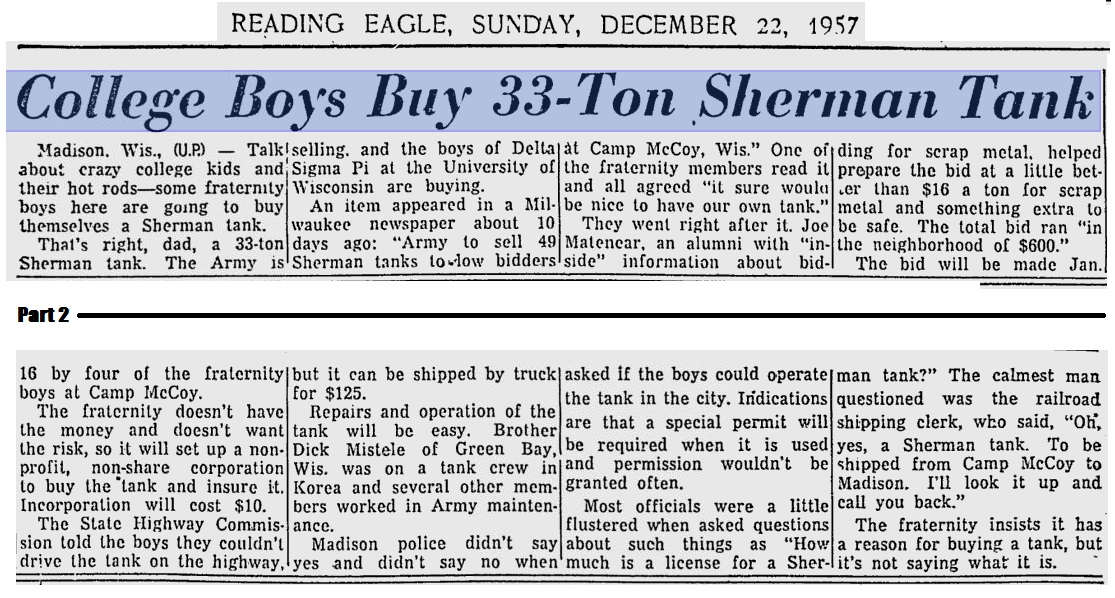
While browsing through some old newspaper articles, we stumbled across this amusing headline from the Reading Eagle, Dec 22, 1957, “College boys Buy 33-Ton Sherman Tank.”  The article states that a fraternity in Madison WI, some of whom were Korean War veterans, bought the tank for approximately $600 in a scrap auction.  Considering what an operational Sherman tank is worth these days (well into six figures), $600 seems like quite a good investment.

College boys buy Sherman Tank

T-72 cracked up after hitting brick wall

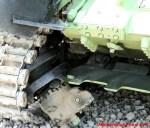
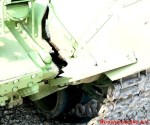
At some point during the recent Tank Biathlon event in Russia a T-72B3 tank hit a concrete wall while travelling at high speed. The tank suffered serious damage, including cracks to the front hull armor plates.

The Graveyard of Patton Tanks

The Times of India has posted an article commemorating the 50th anniversary of the 1965 war between India and Pakistan with a focus on the defeat of Pakistani M48 Patton tanks by Indian forces.

Excerpt:

1-The brave men who had demolished Pakistan’s feared Patton tanks in 1965 are a part of village lore in Asal Uttar, Punjab.

The landscape surrounding the memorial of Abdul Hamid is pretty as a picture postcard. Paddy fields sway in the easy breeze and ashen clouds play hide and seek with the sun. It’s impossible to imagine that 50 years ago the region was the theatre of one of the most intense and decisive tank battles in history.

Asal Uttar and neighbouring villages — Bhura Kuhna, Chima, Amar Kot, Valtoha and Bhura Karimpur — had turned into a battleground for four days. The desperate, do-or-die battle between Pakistan and India began on September 7, 1965.

By the time it was over, Pakistan’s General Ayub Khan’s dream of capturing Amritsar had turned into a nightmare. The combat zone had also become a graveyard for the feared Patton tanks. Pakistan lost 97 tanks in all, including 72 Pattons. Enough to create, for a brief while, an open-air showroom called Patton Nagar in nearby Bhikkiwind.

Read the full article here.

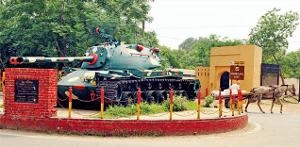
Video of this particular Pakistani M48 on display can be seen in this youtube clip (warning, this clip features some rather poor grammar as well as some inaccurate tank ID)


For those interested in the armored clashes between Indian and Pakistan in the 1965 war, be sure to check out the upcoming book “M48 Patton vs Centurion: INdo-Pakistani War 1965 (Duel)” by David Higgins scheduled for a January 2016 release.

Book Alert: Tip of the Spear

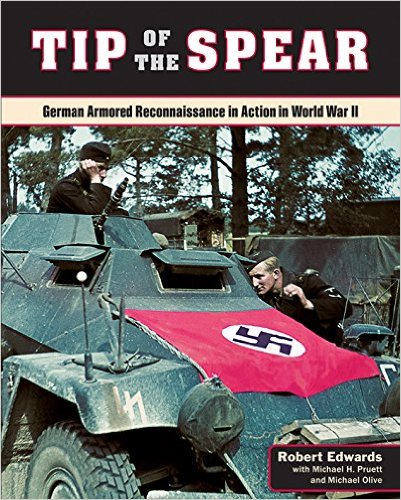
61jdF4bn6aL._SX399_BO1,204,203,200_Stackpole Publishing has announced a November 1, 2015 release for the upcoming book ‘Tip of the Spear: German Armored Reconnaissance in Action in World War II” by Robert Edwards.    This is a 528 page hardcover volume with 500 black and white photos as well as a 32-page color insert.  This book follows Edward’s “Scouts Out: A History of German Armored Reconnaissance Units in World War II” published in 2014.  Robert Edwards is a retired U. S. Army armor officer who has translated numerous books from German to English.  Most notably for armor fans, he translated Otto Carius biography “Tigers in the Mud.”

Publishers Description:

During World War II, German armored reconnaissance laid the groundwork–often through small-unit actions–for the stunning tank and infantry operations that made the German military famous. Robert Edwards’s follow-up to Scouts Out, the first extensive treatment of the subject in English, focuses on the battles and personalities found in ranks of the Waffen-SS, Luftwaffe, and other divisions.

– Covers armored reconnaissance in Poland, France in 1940, the Balkans, North Africa, the Eastern Front, Italy, and the Western Front

– Numerous firsthand accounts and after-action reports

– Analysis of recon operations, from tactics and doctrine to vehicles and commanders