UK 1940: Cranes into Self Propelled Guns?

Over at the Status Report blog, researcher “Volketten” has created a post about an ill conceived plan to convert a grab crane into a gun carrier in the UK in 1940.

Excerpt:

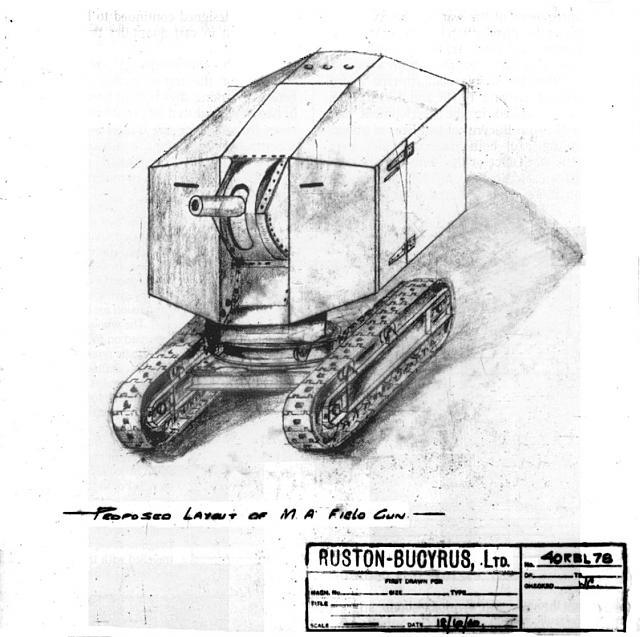
h2pMTSDIn 1940 Britain was fighting for its life and a multitude of good and not so good ideas were put forward to develop new armored vehicles to meet the needs of home defense and the British Army overseas. Lincolnshire was a hub of development at the time from a variety of companies and one of them was the firm of Ruston-Bucyrus. Founded in 1930 the firm was a merger of the Lincolnshire firm of Ruston and Hornby (who had already had some experience with track laying vehicles in WW1 during the development of early British tanks) and the American firm of Bucyrus-Erie of Bucyrus, Ohio.

They specialized in vehicles for earth-moving and excavation mainly track based although there were a couple of walking machines. By 1940 they were already placed under contract to build some British Cruiser tanks but they also tried to develop their own expertise in cranes for a more military use and the vehicle chosen to prototype the design was an old rusting RB-10 grab crane.
Read the full post here.

Video: Tankfest 2015

The Mighty Jingles has released a video about the recent Tank Fest event at the Tank Museum in Bovington England.

From the Vault: STRV 104 (S Tank) users manual comic book

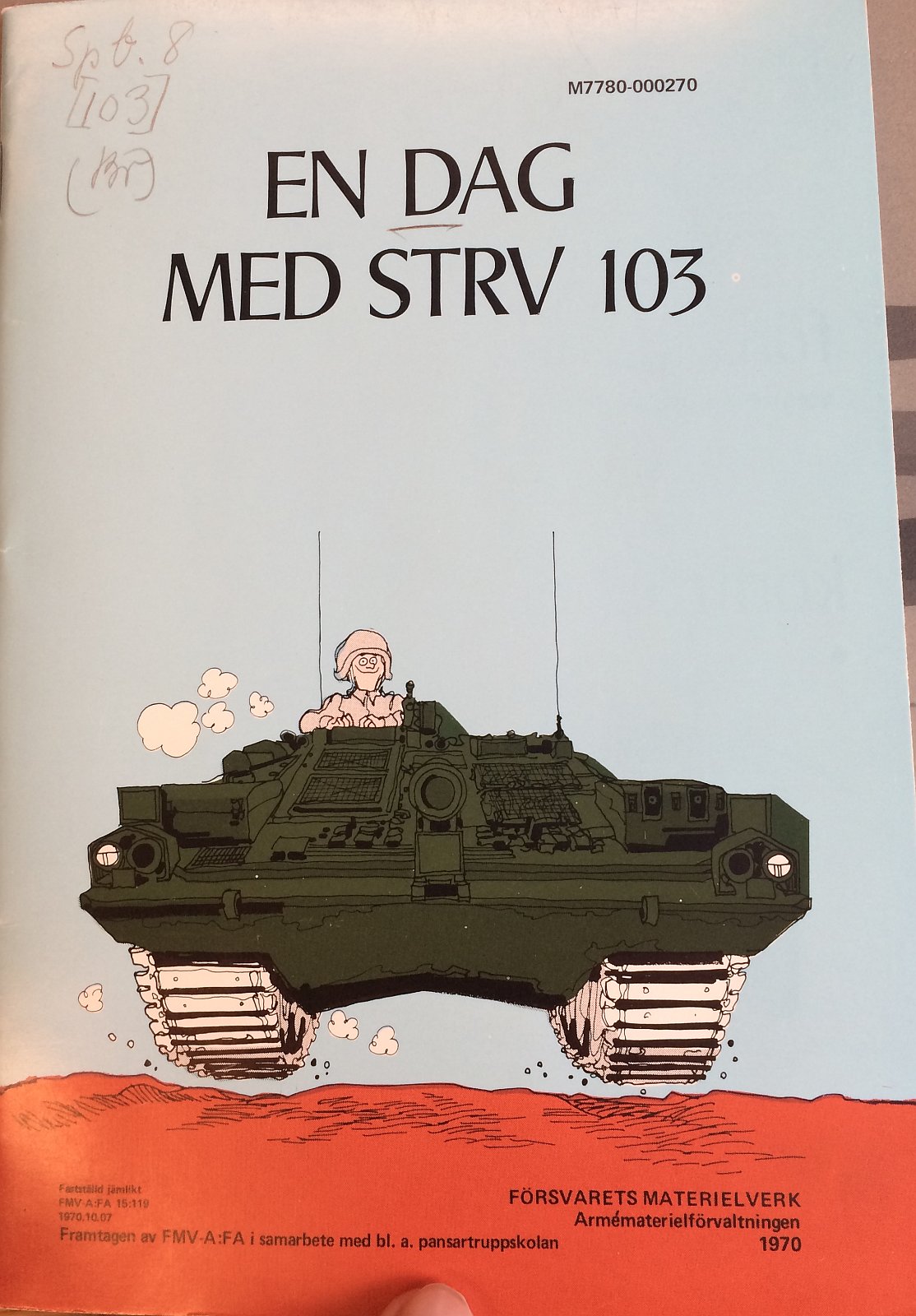
2mLTLYkToday we present “A day with the Strv 103” comic book from 1970.  Think of this as the “tigerfibel” for the S tank.  The text is in Swedish of course, but the pictures are quite entertaining.  Thanks to the Swedish Tank Archives for scanning and posting this document.

Click here to go to the gallery for “A day with Strv 103”

Serbia sells 282 T-55 tanks to Pakistan?

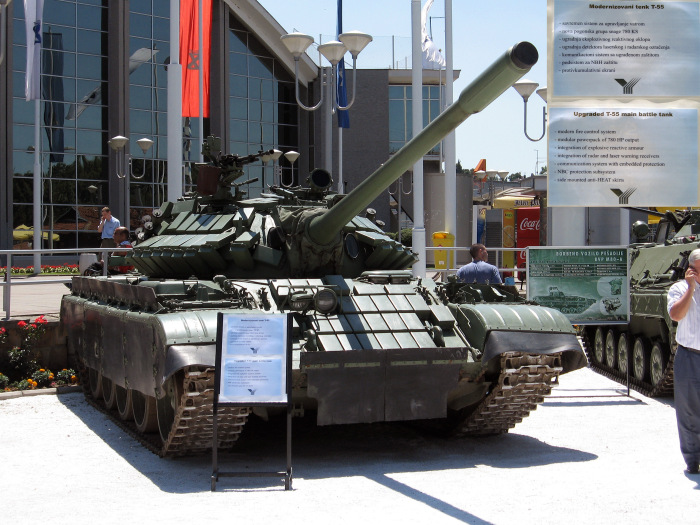
T-55H_Partner_2007An article on In News is reporting that Serbia has reportedly agreed to modernize and sell 282 obsolete T-55 tanks to Pakistan.  According to the article, the contract is worth tens of millions of dollars and that the proceeds from the sale will be used by Serbia to purchase new weapons.  The Chief of the Defense Technology in the Ministry of Defence, Major General Bojan Zrnic indirectly confirmed the sale, saying “It is true that there was an agreement in principle for the sale of 282 tanks from the arsenal of retired and obsolete military equipment, but I do not want to talk about with which country and the army this deal was made. It would not be appropriate because the contract has not been signed. What can I say is that the offer is extremely favorable for the Army of Serbia as the tanks will not be sold in its current state, they will be modernized first. This task will be entrusted to our defense industry.”  No details are given in the article as to what sort of modifications the Serbians will be making on these vehicles in order to modernize them.  It is probably safe to assume the modernization will be similar to their T-55H variant.

Read the full article here.

Video: Abrams rolls over car bomb

This video showed up on youtube today.  We have no idea when this footage was taken or if it has appeared online before.

War is Boring article on T-55

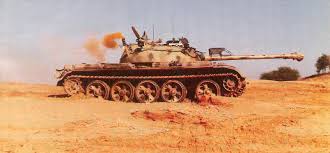
imagesThe blog War is Boring has a new article on the history of the T-54/55.  Like most articles on War is Boring, this is not an in-depth article nor does it delve much into technical matters concerning the tank.  However, people may find it an entertaining quick read.  We did take the liberty of posting in the comment section of the article pointing out the authors error in referring to the T-34 suspension as a “leaf spring” system.

Excerpt:

Like the AK-47 but for tanks, T-54 and T-55s endure on battlefields around the world. Simple to operate and maintain, these decades-old Soviet armored beasts are still popular in small nations and with non-state irregular forces — a true “people’s tank.”

If a coup or fratricidal civil war breaks out in one of Moscow’s current or former beneficiaries, there’s good chances T-54 or T-55s are taking part.

When Afghanistan collapsed in the 1990s, the Taliban and Northern Alliance coalition both inherited T-55s formerly belonging to the communist government. The tanks served in Yugoslavia’s multi-sided civil war during the same decade.

Today, captured Iraqi and Syrian T-55s serve under the black flag of Islamic State and other rebel groups fighting in the region. For these insurgent armies, the 60-year old tanks are just as useful as far more modern designs such as the M1 Abrams.

Read full article here.

Satire: Patton translated into modern business/military speak

hqdefaultEvery once in a while we like to take a break from our usual content and present something humorous.  Recently in an online forum, we were discussing the latest issue of ARMOR and how much the style of writing has changed over the years.  In our opinion, military writing has become far too laden with buzz words and business-speak, resulting in articles that are far more effective as sleeping aids than as ways of transmitting useful information.  I issued a challenge to the other forum members to rewrite Patton’s famous Blood and Guts speech in the style of modern officer-speak.   A forum participant by the name of xthetenth rose to the challenge, providing the following rendition.  We present it here in a paragraph by paragraph comparison with the original.  We hope you find it as amusing we we did.

—————

[Read more…]

Video: Norwegian Telemark Battalion live fire exercise

From War News Today comes this video showing Norwegian ground forces conducting exercises.

Article declares that T-14 Armata is “Pretty Stale”

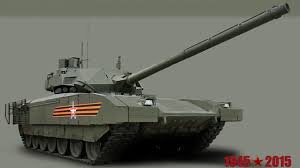
download (1)An article from ISH ETH Zurich by Joseph Trevithick attempts to deflate some of the hype surrounding the new Russian T-14 Armada tank, declaring it to be pretty “stale.”  The author of the piece seems to be basing his conclusions on some comments made by noted tank expert Steven Zaloga, who is quoted as saying “A lot of this stuff is really stale” in regards to the new family of Russian armored vehicles displayed during the May Victory Parade.  Zaloga is also quoted as saying that in the end “the Russians are not leaping ahead” and that “this is an attempt to catch up.”  Considering the amount of media hype and nationalistic pride that the Armata has attracted, these comments from one of the worlds foremost tank and AFV researchers are bound to grab some attention.

Article excerpt:

But despite these and other boasts, the Russia’s new fleet is much less impressive when compared to many Western designs, even some that are decades old at this point. The T-14 is lighter and not necessarily any better armed or armored than the American M1A2 Abrams, the British Challenger 2 or the German Leopard 2, according to an infographic originally specifications sheet made up by the Russian TASS news service. The specifications were later translated into English by the U.S. Army’s Foreign Military Studies Office (FMSO). Of course, both Moscow and Washington are generally tight-lipped about the exact details.
In terms of armor protection specifically, the T-14 is probably no more impressive than the tanks Washington and Berlin have had in service for two decades now, based on educated estimates. And while Western engineers have generally focused on passive armor, the Pentagon and others continue to experiment with their own active protection systems. The Armata’s Afghanit system is also just the latest development in a series countermeasures the Russian Army has been using since the fighting in Afghanistan – an experience the new device’s moniker clearly references. Soviet commanders – like their counterparts around the world – have found active protection systems and explosive reactive armor can be very dangerous to ground troops near vehicles equipped with these protective measures too.
As for armament, the range estimates for the T-14 seem generous. However, Leopard 2s can already hit targets at similar distances with the help of Israeli LAHAT missiles. Armata crews would probably have to fall back on gun-launched guided weapons when trying knock out enemies beyond some 5,000 to 6,000 meters too. Not that much of this matters, since the Russian sensors can’t necessarily find the mark much farther away. The “target detection range” is only vaguely “greater than 5,000 meters,” the TASS-provided specs said.

Read the full article here.

Guardian article on British collector Kevin Wheatcroft

The Guardian published an article this week on British collector of armored vehicles and Nazi memorabilia Kevin Wheatcroft.  The article deals primarily with Wheatcroft’s Nazi memorabilia collection rather than with his collection of Tanks and AFVs.  That said, tank and AFV aficionados will still find it interesting, if for no other reason than to learn a bit about the rather media shy man behind the largest private AFV collection in the UK.

Article excerpt:

wheatcroftWe stood beside the muscular bulk of a Panzer IV tank, patched with rust and freckled with bullet holes, its tracks trailing barbed wire. Wheatcroft scratched at the palimpsest of paintwork to reveal layers of colour beneath: its current livery, the duck-egg blue of the Christian Phalangists from the Lebanese civil war, flaking away to the green of the Czech army who used the vehicles in the 1960s and 70s, and finally the original German taupe. The tank was abandoned in the Sinai desert until Wheatcroft arrived on one of his regular shopping trips to the region and shipped it home to Leicestershire.

Wheatcroft owns a fleet of 88 tanks – more than the Danish and Belgian armies combined. The majority of the tanks are German, and Wheatcroft recently acted as an adviser to David Ayer, the director of Fury (in which Brad Pitt played the commander of a German-based US Sherman tank in the final days of the war). “They still got a lot of things wrong,” he told me. “I was sitting in the cinema with my daughter saying, ‘That wouldn’t have happened’ and ‘That isn’t right.’ Good film, though.”

Around the tanks sat a number of strange hybrid vehicles with caterpillar tracks at the back, lorry wheels at the front. Wheatcroft explained to me that these were half-tracks, deliberately designed by the Nazis so as not to flout the terms of the Treaty of Versailles, which stipulated that the Germans could not build tanks. Wheatcroft owns more of these than anyone else in the world, as well as having the largest collection of Kettenkrads, which are half-motorbike, half-tank, and were built to be dropped out of gliders. “They just look very cool,” he said with a grin.

Alongside the machines’ stories of wartime escapades and the sometimes dangerous lengths that Wheatcroft had gone to in order to secure them were the dazzling facts of their value. “The Panzer IV cost me $25,000. I’ve been offered two and a half million for it now. It’s the same with the half-tracks. They regularly go for over a million each. Even the Kettenkrads, which I’ve picked up for as little as £1,000, go for £150,000.” I tried to work out the total value of the machines around me, and gave up somewhere north of £50m. Wheatcroft had made himself a fortune, almost without realising it.

To read the entire article, go here.

To go to the website for the Wheatcroft Collection, go here.