From the Editor: Lights First Every Time?

(A year ago we had posted an earlier version of this post on our old blog.)

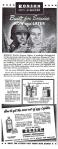
ronson-ad-1944-02Most people familiar with the history for of the M4 Sherman tank have heard the story that the British nick-named them “Ronsons” after the famous cigarette lighter due to the flammability of the Sherman tank.  The story goes that the troops co-opted the Ronson slogan of ” lights first every time” to describe their vehicles.  This story has been reported in many books and TV shows about the Sherman tank.

Certainly, the idea that the Sherman was uniquely susceptible to burning is a bit of a fable.  According to one common version of the myth, the Sherman burned easily due to the fact that it used “high octane” gasoline while its German opponents used diesel (the most famous example of this myth is in the Academy Award winning film “Patton”.)   In reality, the vast majority of German tanks and armored vehicles used gasoline engines and the Sherman ran on the same 80 octane fuel as every other US Army vehicle.  When a tank is penetrated by an armor piercing shell and brews up, ammunition is the most common culprit, not fuel.  The Sherman got a bad reputation in the early stages of the Normandy campaign for catching on fire in part due to improper stowage of ammunition.  Once the US introduced the “wet stowage” system of ammo storage into the M4 Sherman, the rate of tanks that burned when hit decreased significantly.

That troops may have called their tanks a derogatory nickname like Ronson seems pretty plausible.  The only problem with the Ronson nickname is the explanation that this was due to the slogan “lights first every time.”  The issue is that this slogan appears in almost no surviving print ads, and not in any ads from the period right before or during the war.  The most common slogan used in print ads for the Ronson is “The World’s Greatest Lighter.”  To a leaser extent, the slogan “Flip… It’s Lit… Release… It’s Out” or “Press… It’s Lit… Release… It’s Out” appears regularly.  Nowhere does the slogan “lights first every time” appear, except in a single ad from 1929 which states “Lights every time.”The lone

So what does this mean?  Not much really.  Perhaps the “lights every time” slogan was used in a radio jingle and not in print ads.  Or perhaps the troops mistakenly attributed the slogan to the Ronson brand.  However, based on the available print ads its probably fair to question the validity of the “lights every time” myth.

For those wanting to examine a large number of Ronson ads arraigned by date, please consult this page.

Below is a sample of Ronson ads

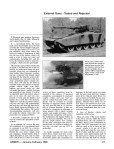
From the Vault: The External Gun Turret (ARMOR Jan-Feb 1996)

With all the attention focused on the new Russian T14 Armata tank, we thought it was appropriate to post this article from the Jan-Feb 1996 issue of ARMOR on the issues involved with an external gun turret.  According to what is known so far about the Armata, it features all three crewmen seated in the hull with an unmanned turret.  The article addresses some of the advantages and disadvantages of such a layout, although it is primarily critical of the idea.  Of course, the article is almost 20 years old so the author’s concerns about crew visibility and situational awareness do not take into account the huge advances in miniaturized cameras and video devices in the past decade.

BAE integrates “active damping” system to CV90 suspension

CV90_F1Army-technology.com is reporting that defense contractor BAE has incorporated “Formula One” suspension technology into the CV90 infantry fighting vehicle.  Referred to as an “active damping suspension”, these systems have been used in Formula One race cars since the early 90’s.  The system functions by sensing the speed of the vehicle and lay-out of the terrain ahead and responding by adjusting the suspension to keep the CV90 level, which reduces the wear and tear on the vehicle. Originally operational on carbon-fibre racing cars weighing no more than 700kg, the suspension system has been modified for the first time, to work on heavy tracked vehicles weighing up to 35 tons.  Reportedly, the suspension enables the vehicle to travel up to 40% faster than existing armored vehicles.

The full article can be read here.

Leichttraktor pictures and documents from Swedish Tank Archives blog

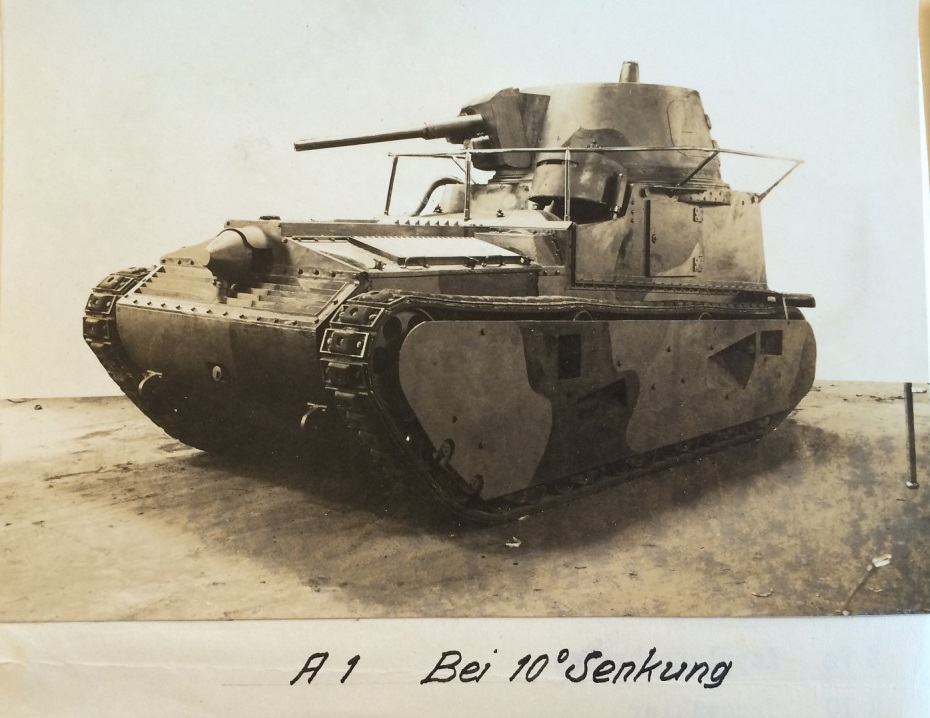
leichttracktorRen Hanxue, creator of the Swedish Tank Archives blog, recently posted a PDF of documents and pictures from the Swedish Archives pertaining to the German Leichttraktor.  The documents are of course in German so we are not entirely sure what they contain.  However, the pictures are very interesting, providing shots of not just the vehicle but also of some of the automotive components and subsystems.  The Leichttraktor is a fairly obscure vehicle, being a German post WWI design that never saw mass production.  It is most widely known as the tier one German tank in the World of Tanks video game, where it is commonly referred to as the “Loltraktor.”

The PDF is available here.

We highly recommend Swedish Tank Archives.  People with an interest in Swedish tanks will find it a valuable resource.  The site also contains documents relating to Swedish evaluations of foreign vehicles such as the Chieftain, AMX 13, and T-80U.  Ren Hanxue also maintains a youtube page with some videos if Swedish tank terrain trails including Centurion, Strv 104, T-72 and T-80 tanks.

German Newspaper challenges German policy of no DU tank ammo

leopard_2a6_2A recent article in German newspaper Die Welt makes the claim that German tungsten based APFSDS 120mm ammunition is ineffective against the armor of Russian T90 MBTs.  The author of the article, Han Ruhle, was the Chief of Policy Planning Staff in the German Department of Defense 1982-1988.  He lays the blame for the lack of effective depleted uranium APFSDS round in the German inventory at the feet of German environmentalists and anti-nuclear activists.  The article states that:

Currently, the Bundeswehr has a limited effective means of anti-tank ammunition with the DM63, an arrow-tungsten-based ammunition. Their penetrating power is indeed improved significantly over the old munitions and corresponds with the enhanced 120-millimeter cannon to just the level of the old uranium core ammunition of the US from the 80s. However, this is not enough to penetrate the newer versions of the T80- and T90 tanks.

The full article can be viewed here (in German).  This article comes at a time when the German military has suffered a number of embarrassments regarding equipment effectiveness, procurement and readiness.  The G36 rifle has come under criticism for inaccuracy at high temperatures, the Puma IFV has suffered a series of delays and cost overruns and earlier this year a German unit on exercises was shown with broomsticks substituted for missing gun barrels.

Not surprisingly, the decidedly pro-Russian news site Sputnik International pounced on this article, declaring “German Army has no Chance against Russian Tanks

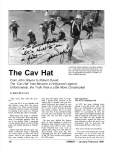
From the Vault: History of the Cav Hat

Today we present an article from the Jan-Feb 1996 issue of ARMOR on the history of the Cav Hat.  Written by Major Mark Farrar, this piece looks at this iconic item, detailing its history both in popular culture and in military service.

From the Vault: The Grim Reaper

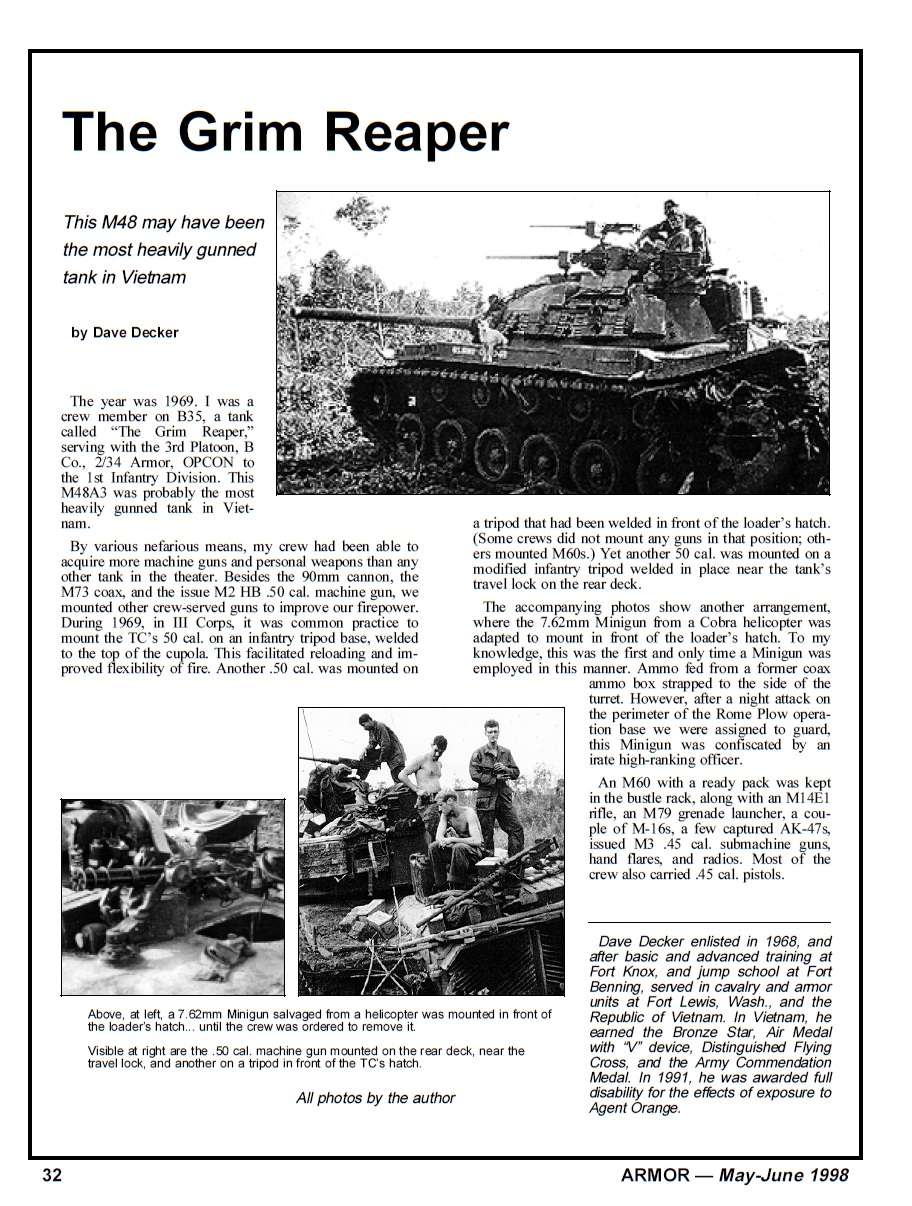
Another interesting item from ARMOR magazine.  This comes from the May-Jun 1998 issue.  It’s a one page description of the most heavily armed tank in Vietnam, the Grim Reaper.  According to former crewmate Dave Decker, this vehicle was modified by it’s crew to have up to three .50 cal machine guns on the roof.  The article notes that for a short period of time, the crew also mounted the 7.62 Minigun from a Cobra helicopter on the front of the loaders hatch!  The author notes that this gun “was confiscated by an irate high-ranking officer.”

The Grim Reaper

From the Vault: An Israeli view on Soviet tanks

Today we present another article from ARMOR, the official journal of the armor branch.  This piece is an evaluation of Soviet tanks by Lieutenant Colonel David Eshel of the Isaeli Defense Forces and it appeared in the May-Jun 1988 issue.  In this article, the author focuses primarily on the T54/55 and the T62, since both of these vehicles were captured in large numbers by the IDF and pressed into service.  Col. Eshel notes the many modifications that the IDF made to these vehicles as well as listing some of the problems they encountered with the Soviet designs.  While Eshel makes many critical comments about these vehicles, he ends the piece with the following remarks:

In short, Israeli experience in tank combat reveals shortcomings in Soviet tank designs. However, Soviet tanks are, in principle, excellent fighting machines, combat proven and viable under field conditions.  If manned by determined and highly-trained crews, they can be a most dangerous and deadly opponent.

Memorial built near first tank factory

_82548458_82548457The BBC is reporting that a life sized tribute to the world’s first tank has been installed on a traffic roundabout in Lincoln, the city where the first tanks were built.  The memorial, which depicts a Mark I tank, was built to coincide with the 100th anniversary of WWI.  The Tritton Road roundabout is just yards away from the William Foster and Co factory where tanks, including the first prototype “Little Willie”, were made as early as 1915.

Full article here.  Link to Lincoln Tank Mamorial site here.

Audio article on German WW1 tank Mephisto

Tank-Mephisto-Queensland-MuseumThe Australian Broadcasting Corporation (ABC) is featuring an hour long audio article on the WW1 German tank Mephisto.  The program is part of the show “Conversations with Richard Fidler.”  The episode can be listened to here.

Episode description:

The first tanks were invented in a desperate attempt to end the agony of trench warfare.  They inspired a new kind of terror on the battlefield – German soldiers called it ‘Panzerschreck’: Tank Terror.  Mephisto was deployed against Australian soldiers in France, but the Australians managed to steal the tank from right under the noses of the German army.  Although brought to Australia with enormous fanfare, Mephisto lay neglected for decades.

Further listening and information

With special thanks to Major General John Cantwell, Jeff Hopkins-Weise, Stephen Dando-Collins and Dr Michael Westaway.  Mephisto is on display at the Workshops Rail Museum, where it will remain until early 2018.  The Queensland Museum’s Anzac Legacy Gallery announced as part of the Anzac Centenary commemorations, will eventually provide a permanent home for Mephisto.

Listen to John Cantwell’s 2012 conversation with Richard.

Explore the ABC’s WW1 Centenary site, Australia Remembers.