From the Editor: The Hull Machine Gunner

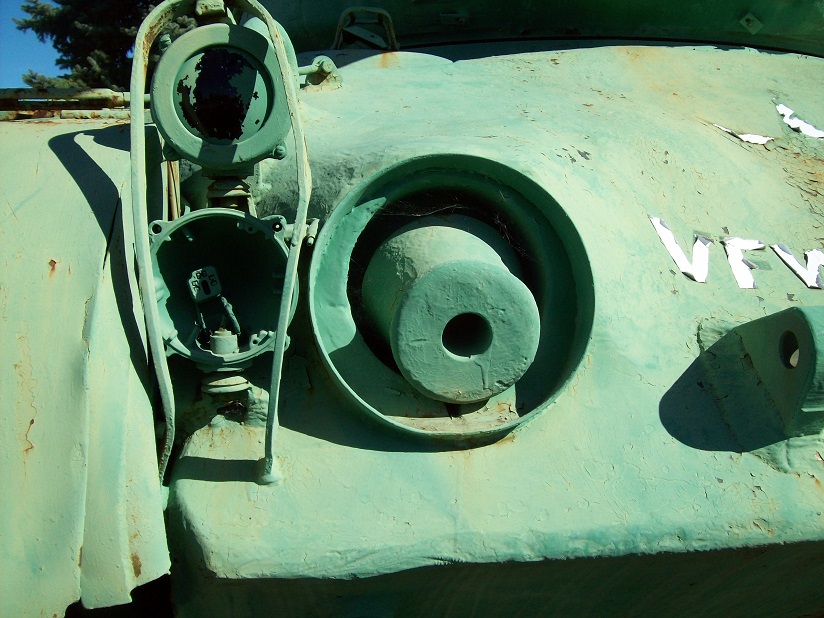
bow gunOne of the unique characteristics of WW2 era tanks is the hull machine gunner position.  This crew position was assigned a variety of names in different armies, being referred to as the assistant driver, radio operator, or bow gunner to name a few. A large majority of the tanks designed and used during the war had this position as part of their crew layout, although it quickly disappeared from tank design in the post war period.

In the 1920’s and early 1930’s, tank design was still in its formative stages and vehicle crew and component layout varied dramatically.  However, by the late 30’s a consensus starts to emerge in regards to crew layout.  In Germany, the Panzer III and IV established the layout that would be most common during the war, a five man crew with three in the turret and two in the hull, a driver and the hull machine gunner.  The Soviet Union, USA, Czechoslovokia and Japan also adopted the hull gunner concept, although their early war tanks typically had two men in the turret (T-34, M2 and M3 light tank, LT vz 35 and 38, Type 97).  The two major exceptions to the move toward bow gunners were the United Kingdom and France.  French tank design was fairly unique, relying primarily on smaller vehicles with 2 man crews (Renault and Hotchkiss infantry tanks) or larger tanks such as the Somua S35 or Char B1 Bis which had a radio operator position but did not give him a machine gun to operate. British pre-war tank design varied.  The Matilda II (A12) infantry tank had a very modern crew layout of driver in the hull and three in the turret.  On the other hand, the Cruiser Mk I introduced into service in 1939 had two hull machine gunners, each with his own turret!

[Read more…]

Overlord’s Blog: Tigers for Breakfast

David Lister at Overlord’s blog has posted an article about an action involving Tiger tanks in North Africa called “Tigers for Breakfast“.

By January 1943 the war had turned against Germany. At this point the allies were pushing the Germans from two sides in North Africa, including in Tunisia. On the 31st two companies of infantry and two troops of six pounder guns were dug in covering the road leading to Robaa. They were on an area of rocky rough terrain on the side of the hill, with the German lines somewhere to their front. At about 0600, in the pitch darkness reports start to filter back from the infantry that they can hear tank movement to the front. Immediately the two troop commanders of the AT guns leapt out of the truck they’d been sleeping in and struggled up the hill. The Lieutenant for the 2nd Troop in his haste just threw on a greatcoat over his pyjamas before dashing to his troop. Lt Stanley Edwards of 1st Troop however had only to pull on his boots.

Read the full post here.

Veteran Tank Commander recalls service in Vietnam

vietnam vetThe Tyler Morning Telegraph has posted a story about Vietnam War Purple Heart recipient Virgil Melton Jr. recalling his service as a Marine Corps tank commander in the Vietnam war.  Melton earned his Purple Heart on Aug. 15, 1968 at the age of 19 at an action near the Ben Hai River called Operation Lam Son 250. According to the article:

“We smelled food,” Melton said. “We smelled cooking, we were that close. They were eating breakfast. … We could see their chow lines.”  Enemy fighters spotted the tanks lined along the ridge and began shouting in alarm, sending troops scrambling for cover and weaponry.  “It was a total surprise; they never thought we would go that far in the DMZ (demilitarized zone),” Melton said. “They knew they were caught.”  The tanks began firing, destroying the enemy’s light artillery. They responded, shooting off rocket powered grenades, mortars and machine guns before scattering in all directions, pursued by the Americans.  “We fought from daybreak that morning when we could hardly see, until late that evening,” Melton said. “Then it started getting dark, fast, and we knew we needed to get out of there.”  The tankers tried to make a hasty getaway to safer territory, but two crafts inadvertently rolled over hidden land mines.

The article does not specify what sort of tank Melton served in, but judging from the details provided in the article, it is possible the “tanks” referenced in the article are actually LVTP-5 Amphibious Armored Personnel Carriers.

Full Article here.

From the Vault: Zaloga on the Polish Cavalry VS German Panzers myth

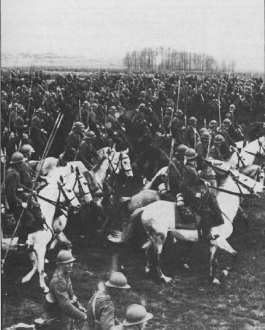
polish cavalryDigging through old issues of ARMOR magazine, we have found an article from 1984 written by well known historian and tank expert Steven Zaloga titled “Polish Cavalry Against the Panzers.”  In this piece, Zaloga seeks to put to bed the long standing myth regarding Polish Cavalry troops conducting brave yet futile charges against German Panzers.  As Zaloga puts it:

“Tales of Polish cavalry charges against German tanks during the September 1939 campaign still remain widely believed even amongst serious historians who are otherwise skeptical of similar German propaganda excesses of the period.  The subject has been dealt with in extensive detail by Polish military historians, but most of this material is inaccessible to western historians due to the language barrier.”

The article is can be read in the image gallery below (ARMOR is a government publication and not under copyright.)  These pages are from the Jan-Feb 1984 issue of ARMOR.

[Read more…]

WWII 12th Armored Division veteran recalls driving tank

hellcat 12armorThe Newark Advocate has posted an article about Albert “Pete” Holman, a WWII veteran of the 12th Armored Division.  According to the article the 91-year-old Newark resident still has the driver’s license he received after training, giving him the authority to drive a tank. He has binders and books full of WWII history and memorabilia and enjoys sharing his memories with others.  “I enjoyed some (aspects of the war), but I’m no big hero,” he said. “I just did what they told me to do, but I liked getting to drive a tank.”  Last May, Holman attended Heath’s first Armed Forces Day parade and saw a Sherman tank, just like the one he drove during the war.  It brought back lots of memories, he said.  “It looks big now, but it didn’t look that big when I drove it,” he said. “I think I could still drive one, but my legs might not hold.”

Read the full article here.

Prime Portal AFV photo collection

photo imageWe recently stumbled across the Prime Portal website while looking for AFV photos.  The site itself is a bit dated looking but the number of galleries is truly impressive.  A rough count indicates at least a thousand individual galleries on this page.  AFV enthusiasts will find much to look at here. 

Below is a list of all the galleries found on the Prime Portal site.    Please go to their website to view the galleries.

[Read more…]

Tank Chats #4 Vickers Armstrongs Mark E

David Fletcher MBE of the Tank Museum returns with another Tank Chat video.  This episode looks at the Vickers Armstrong Mark E.


Tank Museum text:

[Read more…]

Lithuania may purchase PzH 2000 SPG

pzh2000 (1)Defense News is reporting that on Wednesday Germany said it wants to sell howitzer-type mobile artillery vehicles to Lithuania as the Baltic NATO nation boosts its defenses amid concerns over neighboring Russia.  The news emerged during a visit by Lithuanian Defence Minister Juozas Olekas to his German counterpart Ursula von der Leyen.  Lithuania is also interested in potentially purchasing Boxer infantry fighting vehicles from Germany as well.  The German Ministry of Defense stated that the program was for 12 PzH 2000 howitzers. Any Boxer purchase would include the Organisation for Joint Armament Co-operation (OCCAR), which oversees the programme for Germany and the Netherlands.

Article here.

LAAD 2015 News Links

858da7ceToday wraps up the LAAD Defense and Security International Exhibition 2015 in Rio de Janeiro, Brazil.  Below is a list of links to news stories related to armored fighting vehicles on display at LAAD.

IHS Jane’s 360 – LAAD 2015: Ares looks to enhance lethality of Brazil’s Guaranis

IHS Jane’s 360 – LAAD 2015: Brazilian Army remains steadfast on its strategic projects

IHS Jane’s 360 – LAAD 2015: BAE’s Brazilian M113 upgrades provide springboard for further AFV work

Shepard – LAAD 2015: Brazil-made Gladiador II makes first appearance

Shepard – LAAD 2015: Brazilian M113 modernisation nears completion

Shepard – LAAD 2015: ST Kinetics Brazil subsidiary makes debut

Defense Update – LAAD 2015: Expanding Brazil’s wheeled armored vehicle family

From the Vault: Vickers Valiant MBT

Today we present an article on the mostly forgotten Vickers Valiant Main Battle Tank. This article is from the March-April 1983 issue of ARMOR and is authored by noted tank expert Richard Ogorkiewicz.  The Valiant MBT (also knows as the Vickers MBT Mk 4) was designed in 1977 as a follow up to the Vickers MBT developed in the 1960’s as a private venture.  While the original Vickers Mk 1 MBT was relatively successful, being adopted by the armies of India (as the Vijayanta) and Kuwait, and the later Mk 3 version was used by Nigeria and Kenya, the Mk 4 Valiant never made it past the prototype stage.  The primarly selling point of the Mk 4 was the inclusion of Chobham armor and a “universal” turret capable of mounting either the L7 105mm gun, the 120mm rifled gun of the Chieftain MBT, or the Rheinmetall 120mm gun of the Leopard 2.  Unlike most British main battle tanks, the Vickers series used a torsion bar suspension rather than the Horstmann system found on Centurion or Chieftain.  It’s worth pointing out that the Vickers MBT Mk 4 was the second unsuccessful British tank to be named “Valiant.”  The first was a dreadful WW2 era infantry tank prototype (A38) developed by the Ruston & Hornsby company.  This vehicle is preserved at the Tank Museum in Bovington, in part as an example to armor students on how not to design a tank.