It’s been a little while since we did a round-up of recent internet articles about tanks and AFVs. Frankly, there has not been as much news as usual the past couple weeks. As usual, click on the headline if you would like to read the full article.
Business Insider – US tanks are getting a small update that signals a big shift to defending Europe against Russia
 Having settled into their nine-month deployment to Europe, members of the 3rd Armored Brigade Combat Team from the US Army’s 4th Infantry Division are making a slight update to their vehicles. Earlier this month, the first M1A2 Abrams tank with a woodland green paint scheme appeared in Europe, signaling the unit’s shift to a camouflage scheme more appropriate for its new surroundings than the desert tan colors previously used.
Bangkok Post – China tank deal cut ‘due to cash woes’
 The Royal Thai Army (RTA) has cut the number of Chinese VT-4 battle tanks it wants to buy from 98 to 60 due to insufficient funds, army chief Chalermchai Sittisat said Thursday. Gen Chalermchai said the 60 new tanks will be divided equally between the 2nd and 3rd Cavalry Battalions in the northeastern provinces of Udon Thani and Khon Kaen. The new tanks will replace US-made M-41 models which will be decommissioned after having been in service for more than 40 years, he said.
Defense News – Army speeds up future Modular Active Protection System for combat vehicles
Detroit Arsenal, Mich. — The Army is speeding up development work on its future  . As the service works on expediting interim solutions for combat vehicle Active Protection Systems, officials are simultaneously ramping up some of the first MAPS tests using soft-kill countermeasures. There is also a plan to begin using the first prototypes of a common controller toward the end of the year. Once the common controller is available, the Army will begin “layered testing,” mixing both soft-kill and hard-kill countermeasures, Col. Glenn Dean told Defense News in a March 27 interview at the Detroit Arsenal in Michigan.
Defense News – Spain to spend $4 billion on new combat vehicles suited for hybrid warfare
 MADRID – Spain plans to acquire 348 “Piranha 5” 8×8 wheeled armored fighting vehicles from General Dynamics European Land Systems (GDELS) in a first phase of purchase, Secretary of State of Defense Vicente Conde told the national Congress. He also added that in other phases of acquisition the total number of units for the Spanish Army could be around 1,000. The Spanish defense ministry’s No. 2 leader said that the total estimated budget of this program will be €3.8 billion (US $4 billion): €1.6 billion (US $1.7 billion) for the acquisition itself and €2.2 billion (US $2.4 billion) for the maintenance and modernization services during the 30 years of useful life of the program.
Sputnik – Latin American States Mull Buying US Armored Vehicles to Fight Security Threats
 WASHINGTON (Sputnik) — The armored vehicles will help Latin Americans to fight some ‘illicit networks’ operating within state borders and threatening local governments, according to the US Southern Command. “The threat from ‘illicit networks’ in Latin America continues to grow,” US Southern Command Deputy Commander Lieutenant General Joseph DiSalvo stated in the release. “And armored vehicle modernization efforts by partner nations there will play a part in combating the threat.” Potential clients include Peru, which may soon finalize a sales deal with the United States to purchase Stryker vehicles, the release noted.
Next Big Future.com – Russia developing 152 mm tank gun and small battlefield nuclear weapons
 Russia in considering upgrading future T-14 main battle tnks to use the 2A83 152 mm gun instead of its current 2A82 125 mm gun. The 2A83 gun has a high-speed APFSDS shell with a 1,980 m/s muzzle velocity, only dropping to 1,900 m/s at 2 km. However, Russian engineers have so far kept the 125 mm-size gun, assessing that improvements in ammunition could be enough to increase effectiveness, while concluding that a larger bore weapon would offer few practical advantage. Russia is both miniaturizing the nuclear warheads and using sub-kiloton low-yield warheads. Battlefield nuclear weapons could be pared with the larger tank gun.

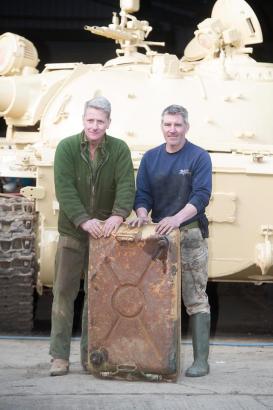 Nick Mead, 55, discovered the five gold bars in the Russian T54/69 while restoring it to add to his collection of 150 military vehicles.
 . This new book explores the British Centurion Main Battle Tank. Written by Simon Dunston, this is a hardcover book of 160 pages with numerous color photos, charts and images.
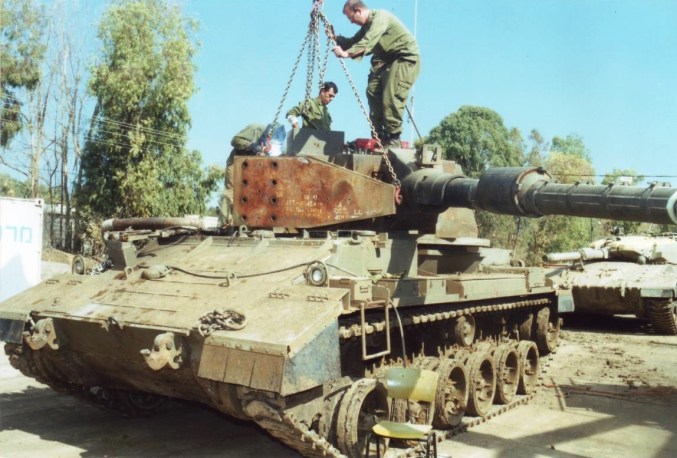
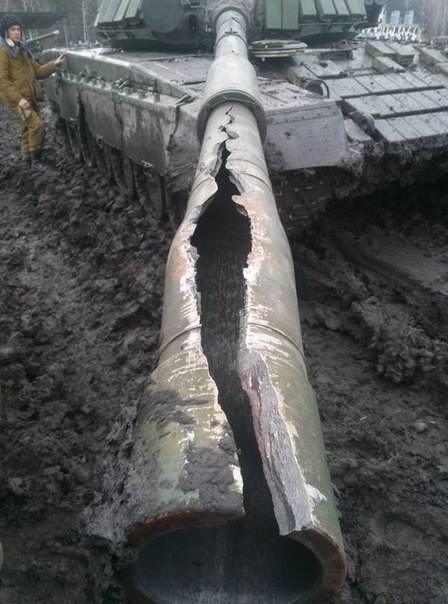
 The U.S. Army boasts a motorpool stacked to the rafters with 6,000 M1 Abrams main battle tanks — more tanks than some countries have soldiers. Yet for some crazy reason, Congress keeps buying more. Actually, the reason isn’t totally crazy. The U.S. only has one factory left that’s totally dedicated to the production of main battle tanks — General Dynamics’ (NYSE:GD) factory in Lima, Ohio. Sporadic demand from tank-buyers, however, keeps this factory always on the edge of having to shut down operations — at which point the U.S. wouldn’t be able to build tanks if it suddenly needed to. (A shutdown would also cost jobs in an important Congressional district.)
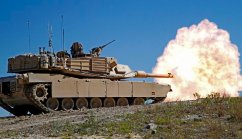 U.S. tanks are now roughly on par with Russian tanks, according to a top general, and the American military doesn’t have the technology to recover its former advantage. “I would not say that we have the world class tank that we had for many, many years,” Lieutenant General John Murray said during a Senate Armed Services subcommittee hearing on modernizing the Army. “I’ll be the optimist and say that we’re at parity with a lot of different nations.”
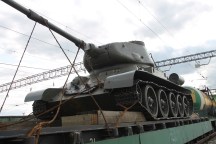 Russian authorities have slapped a three-year suspended sentence on a Moscow man for trying to smuggle a World War II-era tank into neighboring Kazakhstan, state news agency Itar-Tass reports. The man—whose name federal authorities did not divulge—obtained a Soviet Т-34-85 circa from 1945, from a Latvian citizen at the bargain price of €20,000, but planned to sell it off to a buyer in Kazakhstan for more than 10 times that amount.
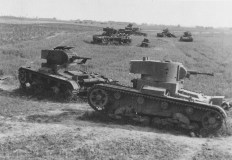 A thousand coffee table books and countless hours of popular history programs have described the Battle of Prokhorovka, part of the Third Reich’s 1943 Operation Citadel, as the largest tank battle in history. Near the city of Kursk on the Eastern Front, hundreds of Soviet tanks slammed into the 2nd SS Panzer Corps in an enormous conflagration of flesh and metal. Prokhorovka was certainly an important clash and one of the largest tank battles ever, but it might be time to retire its description as the biggest — a claim which has been seriously questioned in recent years by historians with access to Soviet archives opened since the end of the Cold War.
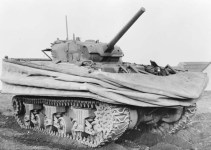 If you’ve seen the blockbuster movies The Longest Day (currently on Netflix) or Saving Private Ryan, a big part of the story is how infantry fought through the obstacles on Omaha Beach (the wisdom of sending two divisions into that meat-grinder can be debated at another time). But the lack of tank support wasn’t part of the plan. In fact, it was one hell of an instance where that notorious and unwelcome Murphy’s Law put in an appearance, costing the infantry some much-needed support. It would have been their secret weapon: the Dual-Drive, or DD, tank.
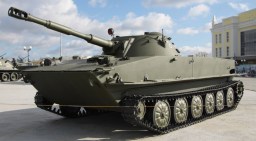 The PT-76 seems like a minor oddity of the Cold War — a Soviet amphibious light tank with thin armor and an unimpressive gun. Certainly it seemed bound for rough treatment on modern battlefields full of heavy weapons and heavier tanks. But the floating PT-76 chalked up a remarkable record, carrying knife-wielding Himalayan soldiers into battle, sinking gunboats on the Ganges Delta, dueling powerful U.S. Patton tanks in Vietnam, and launching amphibious surprise attacks on both sides of the same Middle Eastern war. The first article in this two-part series will look at the origin and characteristics of the PT-76, the nasty shock it gave U.S. forces in Vietnam, and the historic countermeasure used against it.
 Tank and AFV News