From the Vault: Story of Soviet Armor from ARMOR magazine 1949-1952

Several days ago we posted a letter written by a German general to ARMOR magazine in 1951 in response to an earlier article on the history of Soviet armor.  We noted that the article on Soviet armor that prompted the letter was not available for download on the ARMOR magazine site.  A fellow named Paul Mutter tracked down the article and sent us a digital copy.  The Soviet history article actually turned out to be a four part series called “The Story of Soviet Armor” by Garrett Underhill and originally appeared in the Jan-Feb 1949, May-Jun 1949, Mar-Apr 1950 and May-Jun 1950 issues of ARMOR.  In 1952 Mr. Underhill added to his story of Soviet armor with an article on assault guns and self propelled artillery.  This article is available in the Nov-Dec 1952 issue of ARMOR.  We have posted image galleries of all five articles for those that may be interested in looking at them.  For those wanting a PDF copy, the “SU” article is available as part of the Nov-Dec Issue of ARMOR which can be downloaded here.  For a PDF of the four part “Story of Soviet Armor” article, please visit this internet archive page we created.  When taken all together, these articles add up to over 50 pages, essentially a small book.  For those interested in what the US knew and thought about Soviet armor in the early Cold War Era, these articles should provide some valuable insight.

Story of Soviet Armor Part I Early Days (Jan-Feb 1949)
[Read more…]

From the Vault: Robert Icks on Liddell Hart

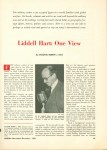
Today we present an article from the November-December 1952 issue of ARMOR written by Colenel Robert J. Icks title “Lidell Hart: One View.” Icks was a pioneer in the writing and researching of tanks and armored warfare, writing numerous books on the topic starting in the 1920’s up through to the 1970’s. In “The Fighting Tanks 1916-1933“, which he co-authored with Ralph Jones and George Rarey, Icks is described as possessing “one of the most complete individual tank libraries in the world.” At the time of his death in 1985, his library was bequeathed to the Patton Museum. A list of his collection can be viewed here, it is listed as 70 linear feet of material!

In the course of his research on tanks, Icks carried on a correspondence with British journalist, historian and military theorist Basil Liddell Hart.  Widely credited as one of the prophets of modern mechanized warfare, Liddell Hart was one of the most prolific writers on military matters in the 20th century. A WW1 British Army captain, Liddell Hart retired from the army in 1927 to embark on a career as a journalist and historian. Following WW2, Liddell Hart continued to write, among his most well known works were his books based on interviews with surviving German Generals (The Other Side of the Hill, The German Generals Talk) , his editing of the Rommel Papers as well as his single volume history of the war.  Liddell Hart was no stranger to controversy, and his strong opinions on matters often have drawn strong replies from historians and military thinkers.  This article presents Colonel Icks view on Liddell Hart and his writings.

From the Editor: Research question for Eastern Front experts

While browsing through old issues of ARMOR, we came across this letter to the editor in the Jan-Feb 1951 issue from Generalmajor H. B. Mueller-Hillebran, former Chief of Staff of Germany’s XXXVI Panzer Corps & Third Panzer Army.  His letter is in response to an article about Soviet tanks (which unfortunately is in an ARMOR issue not available for download) in which he explains German policy on using captured enemy armor.  He also makes the rather startling claim that in the Ukraine from the end of October to the middle of December, his Panzer regiment destroyed 356 Russian tanks while only losing 12 of their own vehicles (a 30 to 1 kill ratio?!)  He states that his regiment was equipped with around 100 tanks, half of which were Pz IV and half of which were Stug III.  Unfortunately he does not specify the name of his Panzer regiment and his claim of a 30 to 1 kill ratio is a bit hard to swallow.  We would be very curious to hear from anyone with access to the Soviet era archives what the Red Army records from this period show in terms of tank losses in Ukraine in late 1943.

German letter to ARMOR

From the Editor: The Hull Machine Gunner

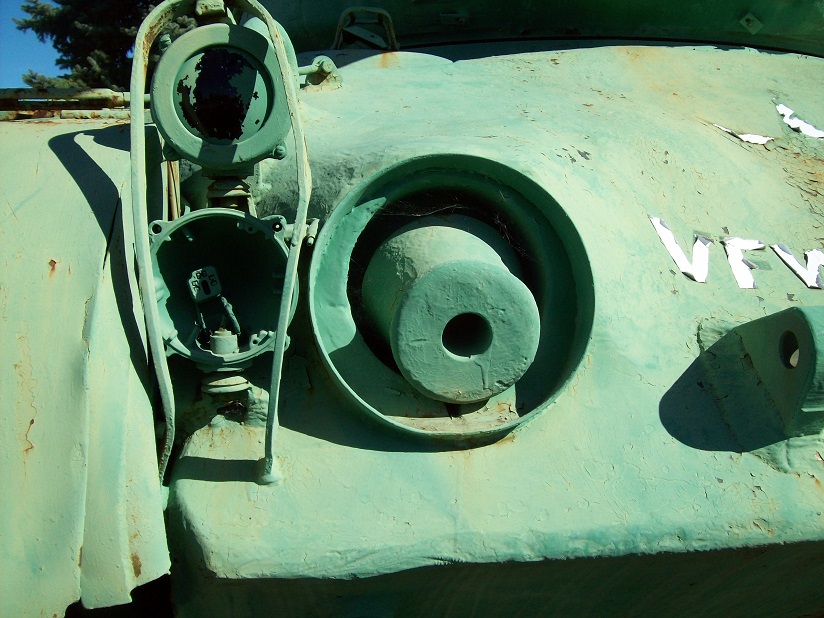
bow gunOne of the unique characteristics of WW2 era tanks is the hull machine gunner position.  This crew position was assigned a variety of names in different armies, being referred to as the assistant driver, radio operator, or bow gunner to name a few. A large majority of the tanks designed and used during the war had this position as part of their crew layout, although it quickly disappeared from tank design in the post war period.

In the 1920’s and early 1930’s, tank design was still in its formative stages and vehicle crew and component layout varied dramatically.  However, by the late 30’s a consensus starts to emerge in regards to crew layout.  In Germany, the Panzer III and IV established the layout that would be most common during the war, a five man crew with three in the turret and two in the hull, a driver and the hull machine gunner.  The Soviet Union, USA, Czechoslovokia and Japan also adopted the hull gunner concept, although their early war tanks typically had two men in the turret (T-34, M2 and M3 light tank, LT vz 35 and 38, Type 97).  The two major exceptions to the move toward bow gunners were the United Kingdom and France.  French tank design was fairly unique, relying primarily on smaller vehicles with 2 man crews (Renault and Hotchkiss infantry tanks) or larger tanks such as the Somua S35 or Char B1 Bis which had a radio operator position but did not give him a machine gun to operate. British pre-war tank design varied.  The Matilda II (A12) infantry tank had a very modern crew layout of driver in the hull and three in the turret.  On the other hand, the Cruiser Mk I introduced into service in 1939 had two hull machine gunners, each with his own turret!

[Read more…]

From the Vault: Zaloga on the Polish Cavalry VS German Panzers myth

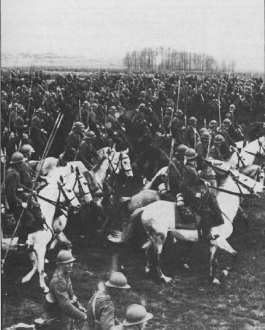
polish cavalryDigging through old issues of ARMOR magazine, we have found an article from 1984 written by well known historian and tank expert Steven Zaloga titled “Polish Cavalry Against the Panzers.”  In this piece, Zaloga seeks to put to bed the long standing myth regarding Polish Cavalry troops conducting brave yet futile charges against German Panzers.  As Zaloga puts it:

“Tales of Polish cavalry charges against German tanks during the September 1939 campaign still remain widely believed even amongst serious historians who are otherwise skeptical of similar German propaganda excesses of the period.  The subject has been dealt with in extensive detail by Polish military historians, but most of this material is inaccessible to western historians due to the language barrier.”

The article is can be read in the image gallery below (ARMOR is a government publication and not under copyright.)  These pages are from the Jan-Feb 1984 issue of ARMOR.

[Read more…]