Last month the blog Tankograd posted one of their characteristically epic pieces on the T-54 tank. This post is full of details and images describing the vehicle in great detail. Tankograd blog is a must-read for fans of Soviet armor. Click on the headline below to go to the Tankograd post.
Tankograd: T-54 Red Dawn
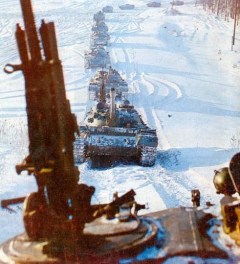 The T-54 was reasonably advanced for its era, arguably more so than the American Patton family up til the M60, but it could never quite be described as being on the cutting edge. It is rationally constructed and technically excellent where the traditional three criteria of mobility, firepower and protection are concerned, but it was also plagued by drawbacks that may not be immediately obvious at first glance. Some of the drawbacks have received quite a lot of attention, like the issue of internal space. Others, like the cooling system that threw dust 20 feet into the air, are less well known. The usual criticism that Soviet tanks had subpar fire control systems is partially true with the T-54, as it lacked a rangefinding device. But what is less well known is that the sight was very well made, very convenient to use and had higher magnification than the ones used in contemporary Western tanks. A thorough inspection of the tank will tell you that the T-54 was very competitive for its time, and remained capable of fulfilling front line roles well after newer and better designs took its place in the limelight.
More often than not, the Soviet military industry had been plagued by lackluster technological capabilities in some fields. This was especially true immediately after the end of the war. Some factories were short of qualified personnel, worsening the quality of the tanks they built. Nizhny Tagil, for instance, was almost totally devoid of experienced and qualified staff after the war ended, as most of the Kharkov Design Bureau workers and engineers had decided to return to their headquarters in Kharkov in Soviet Ukraine once the war was over.
 This iteration of the BMP family is technically excellent in the application of available technologies and the number of features it has, but if there is one thing that nearly all BMP-2 crewmembers know, it is that it is a rather unpolished product, if a brilliant one for its time. To the untrained eye, it might seem that the BMP-2 is simply a marginally more impactful rehash of the old and obsolete BMP-1 design, and while that is true, the sentiment and the connotations behind such an accusation point to an incorrect mindset. The BMP-2 is a product improved BMP-1, but it is not quite the same thing as its predecessor. Far from it. It is so heavily modified that the only similarities are in the general layout, and the powertrain, which was retained as is. Everything else was changed to some extent, the most obvious being, of course, the new turret, now bristling with gadgets appropriate with its era.
 The
The 
 Tank and AFV News