Chinese tank maker Norinco uses social media to trash talk Armata

Norinco tankBloomberg Business is reporting that Chinese tank manufacturer Norinco  is using social media to lob taunts at its Russian rival’s most advanced tank, the T-14 Armata.  Using popular messaging service WeChat, Norinco took aim at a widely reported and embarrassing incident involving the T-14 Armata, in which one of the vehicles ground to an abrupt halt on Red Square during rehearsals for the 70th anniversary celebrations of World War II victory.  According to the article, the Norinco WeChat post said “The T-14’s transmission is not well-developed, as we saw through a malfunction taking place during a rehearsal before the May 9 parade. The VT-4 has never encountered such problems so far. Our tanks also have world-class fire-control systems, which the Russians are still trying to catch up with.”

Norinco’s sales have expanded faster than any other major defense company over the past five years, surpassing Lockheed Martin Corp., maker of the F-35 fighter, and General Dynamics Corp.  The Chinese armaments maker’s $62 billion in revenue as of 2013 and more than 275,000 employees embody the clout of China’s defense industry, which the U.S. Pentagon recently warned in an annual report “has the potential to reduce core U.S. military technological advantages.”  With foreign sales of $7.4 billion over the five years through 2013, China overtook France to become the world’s fourth-largest arms exporter, according to the Stockholm International Peace Research Institute.

Read full article here.

Video: WWI tank crushes car

io9.com recently pointed out this British Pathe video of a tank crushing a car in 1918.  While the video identifies this event happening “somewhere in the UK”, it is believed that this video was actually shot in Toronto.

From the Vault: Public domain WWI era tank books

big willieToday we present several books covering First World War armor that are in the public domain.  All of these books are free to download in a variety of formats at internet archive.  These books were all written shortly after the war and so represent what was then the current thought on armor and mechanization.  Just click on the title to go to the Internet Archive download page.

Our first offering is “Tanks in the Great War: 1914-1918” by J.F.C. Fuller published in 1920.  This name should be familiar to those with even a passing interest in the history of tanks.  Fuller was the author of the British strategy at the Battle of Cambrai, and would help plan the tank operations for the Autumn offensives of 1918.

Second is “Tanks 19-14-1918: The Log-book of a Pioneer” by Sir Albert G. Stern published in 1919.  Stern was one of the key figures in early British tank development, having served as the Secretary of the Landships Committee in 1915.  Stern headed up the creation of the Allied Mark VIII tank in the later part of the war.

The next books is “The Tank Corps” by Clough Williams-Ellis and Amabel Williams-Ellis published in 1919.  As the name of the book implies, this is an early history of the British WWI Tank Corps.  William-Ellis was known primarily for his work as an architect.

Our fourth selection is “The Tank in Action” by Captain D.G. Browne published in 1920.  This also is a history of the British Tank Corps during WWI.

The next book is a memior from a WWI British Tanker.  “A Company of Tanks” by William Hentry Lowe Watson, published in 1920.

The final book we present is probably one of the earliest fiction stories written about tankers.  “Men and Tanks” by J.C. Macintosh, published 1921.

Stryker upgrade budget increased to $371million

Breaking Defense.com is reporting that funding to upgun the Army’s General Dynamics-built Stryker armored vehicle has grown 350 percent in three weeks.  The article lists reasons for this budget increase as fear of Russia and the situation in the Ukraine as well as lobbying from General Dynamics.  In mid-May, the House approved a $79.5 million addition to the administration’s budget request. Yesterday, the Senate, not to be outdone, voted $371 million — four and a half times more. The House Appropriations Committee has actually approved $411 million on Tuesday, but that hasn’t passed the full chamber yet. The upgrade in question is called the Medium Caliber Remote Weapons Station (MCRWS), a remotely controlled turret containing a 30mm quick-firing cannon. Containing only the gun and ammo, the system takes up less room than a manned turret, so the Stryker can still carry the same number of troops, which was a critical consideration for the Army.

Full article available here.

Marine Corps Tiger Competition

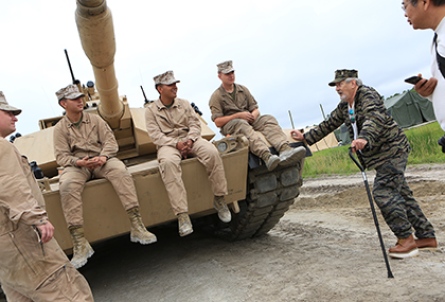
tankJDNews.com is reporting that this past Friday Marine Corps tankers gathered in Sneads Ferry NC to watch tank crews compete for the service’s top spot.  The annual Tiger Competition, in its 13th year, brings together the top performing crews from tank battalions around the country vying for the covenanted McCard Trophy- named after Medal of Honor recipient Gunnery Sgt. R. H. McCard who died during the Battle of Saipan while serving with 4th Tank Battalion. This year’s champions were from Camp Lejeune’s 2nd Tank Battalion: Staff Sgt. Joseph Lowery, tank commander; Cpl. Charles Smith III, gunner; Lance Cpl. Ryan Foster, loader; Lance Cpl. Keondre Mitchell, driver.  The winning team advances to compete in the U.S. Army’s Sullivan Cup competition next spring.

Full Article here.

A century of the tank: Mark 1 vs Altay

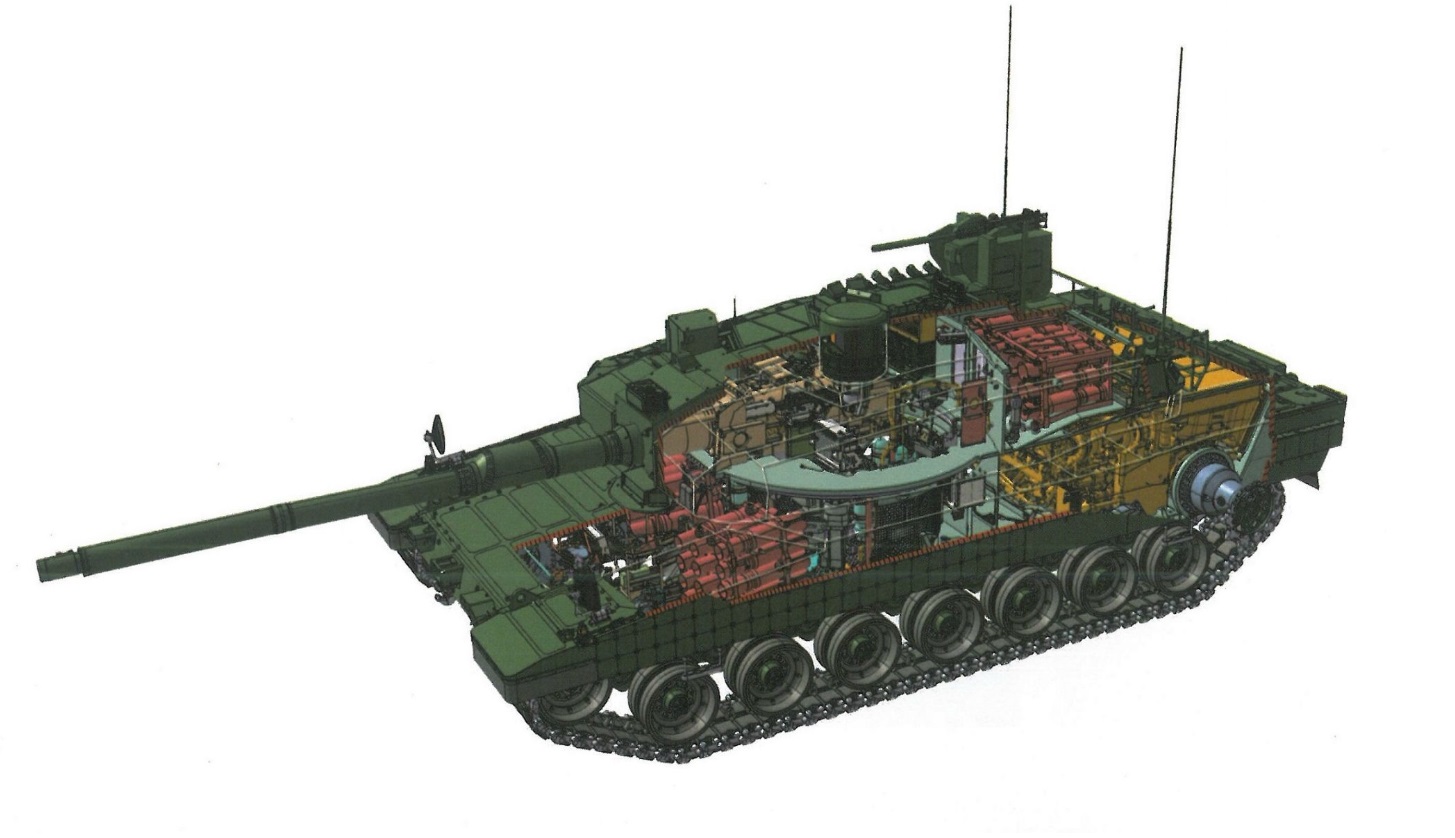
01 - Front CoverTurkish defense contractor Otokar has published a 12 page advertising supplement titled “A century of the tank: Mark 1 vs Altay.”  The article contrasts the Mark 1 tank of a 100 years ago with Otokar’s new Altay main battle tank.  The piece includes a good deal of information about he Altay, including a nice cutaway picture of the vehicle.  The article also includes an essay on the Future of the tank provided by Bovington Tank Museum curator David Willey.  At the end of the piece, David Fletcher of the tank museum is thanked, it’s fair to assume he provided much of the information regarding the Mark 1.

A PDF of the article may be downloaded here.  Also, it can be viewed in an Imgur gallery here.

Altay cutaway

WW2 British tanker returns target model to Bovington

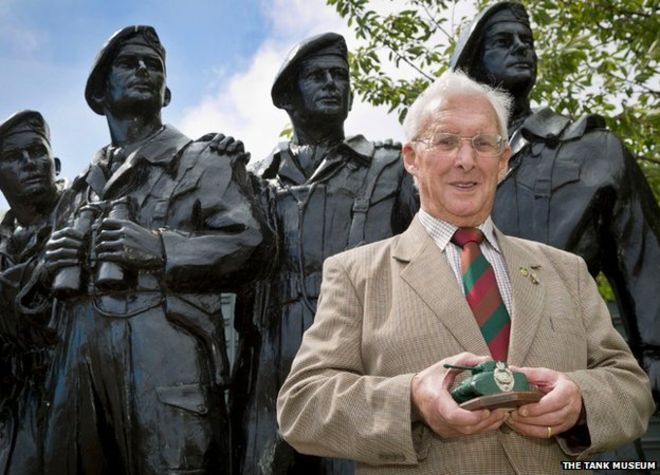
_83448274_83448273The BBC is reporting about a WW2 veteran who has returned a model tank he took from an army camp more than 70 years ago.  According to the article, George Martin, 88, nabbed the small lead Sherman tank used for training from Bovington in Dorset in 1944.  Martin had trained with the 52nd Royal tank Regiment as a gunner for a Sherman tank.  The small lead Sherman tank was part of a training exercise.  Martin kept one of the models as a souvenir, keeping it with him for the rest of his service in Egypt, Japan and Burma until he left the Army in 1953.  The model Sherman then resided on his mantelpiece until he recently decided to donate it to the Tank Museum at Bovington.  According to Martin, “I was worried that if I died it would be thrown away and that its story would be forgotten”.  Commented Tank Museum curator David Willey: “This lead tank is not an item we previously held in the collection and coming to us with such a good story – and the fact it’s been cherished so long by its owner – makes this a very worthy addition to our collections here.”

From the Vault: Story of Soviet Armor from ARMOR magazine 1949-1952

Several days ago we posted a letter written by a German general to ARMOR magazine in 1951 in response to an earlier article on the history of Soviet armor.  We noted that the article on Soviet armor that prompted the letter was not available for download on the ARMOR magazine site.  A fellow named Paul Mutter tracked down the article and sent us a digital copy.  The Soviet history article actually turned out to be a four part series called “The Story of Soviet Armor” by Garrett Underhill and originally appeared in the Jan-Feb 1949, May-Jun 1949, Mar-Apr 1950 and May-Jun 1950 issues of ARMOR.  In 1952 Mr. Underhill added to his story of Soviet armor with an article on assault guns and self propelled artillery.  This article is available in the Nov-Dec 1952 issue of ARMOR.  We have posted image galleries of all five articles for those that may be interested in looking at them.  For those wanting a PDF copy, the “SU” article is available as part of the Nov-Dec Issue of ARMOR which can be downloaded here.  For a PDF of the four part “Story of Soviet Armor” article, please visit this internet archive page we created.  When taken all together, these articles add up to over 50 pages, essentially a small book.  For those interested in what the US knew and thought about Soviet armor in the early Cold War Era, these articles should provide some valuable insight.

Story of Soviet Armor Part I Early Days (Jan-Feb 1949)

[Read more…]

Nicholas “The Chieftain” Moran on Myths of American Armor

Att the recent TankFest Northwest event at the Flying Heritage Collection, World of Tanks researcher Nicholas Moran made a presentation on “The Myths of American Armor in WW2.” Fortunately for those unable to attend, his talk was video recorded and posted in the Chieftain’s Hatch section of the WoT forums.

Tankchats #6 Vickers Light MKVI B

The Tank Museum has released another video in their Tankchats series featuring David Fletcher.  This episode looks at the Vickers Light Tank MKVI B.

Being, in terms of numbers, the most significant British tank at the outbreak of war, the Mark VIB saw service with the British Expeditionary Force in France, the Eighth Army in North Africa and in various subsidiary theatres. As a reconnaissance vehicle it was satisfactory, as a fighting tank quite useless since armour protection was minimal and the armament ineffective against enemy tanks.