From ABC (Australia) comes an article on ex-WWII tanks still in use as paddock bashers on Australian farms.
The cows do not seem too perturbed but they make sure they get out of the way whenever the members of the Busted Arse Tank Repairs and Co roll by on an armoured vehicle.
These giant machines may seem out of place on the otherwise quiet, rural property near Oberon in central-west New South Wales.
But their owner said in the years following World War II, ex-military vehicles played an important role on many Australian farms and he and his band of tank tinkerers want to pay tribute to that history.
Many sheds on farms across Australia are jam-packed full of dusty collections of tools, equipment and junk.
But the shed owned by Matt McMahon, a cattle producer in the Oberon district, contains some massive rusty specimens that speak of a little-known part of Australia’s farming history.
It is a collection of tanks and other ex-military vehicles which was originally started by his father, John McMahon, in the decades following World War II.
In the great tradition of farmers making do with what was to hand, many snapped up cheap ex-military vehicles at auction.
“I’ve read stories of people getting a whole row of them for 50 quid.”
Mr McMahon said tanks helped shape many Australian properties including his, where his father cleared land…….
 by Steven Zaloga. As the title implies, this book looks at the contest between German armor and US infantry equipped with the M1 Anti-Tank Rocket Launcher, aka, the Bazooka during the December 1944 German offensive. Like the other books in this series, it is a softcover volume of 80 pages with color and black and white photos and illustrations.
 Over at the World of Tanks website, tank researcher Nicholas “The Chieftain” Moran has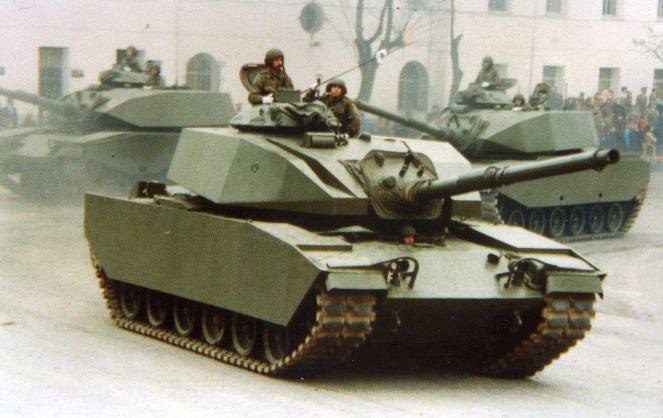
 Over the weekend images surfaced online of a Hezbollah parade in Qusair, Syria, featuring U.S. armored personnel carriers affixed with antiaircraft guns. The images prompted a flurry of speculation about the vehicles’ origin and whether the group had pilfered the stocks of the U.S.-supplied Lebanese military.
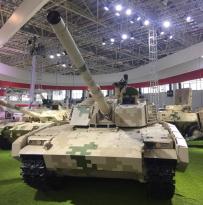 At the Airshow China event, a few new details on the Chinese tank VT-5 were released. The combat weight of the tank is claimed to be between 33 and 36 metric tons, depending on fitted armor package. Two different armor configurations for the VT-5 are currently being offered by Norinco, one optimized for conventional combat and one fitted with enhanced side armor protection. The armament is confirmed to be a conventional 105 mm rifled gun, which is fitted with a thermal sleeve, a fume extractor and a bustle-mounted autoloader. Together with the computerized fire control system, the effective combat range is claimed to be 3,000 metres or more. The stabilized gun can be used stationary or fired from the move without affecting the accuracy of the VT-5. A remotely controlled weapon station (RWS) serves as secondary armament.
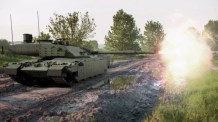 BAE Systems Land (UK), teamed with General Dynamics Land Systems UK and Rheinmetall Defence, have been downselected for the Challenger 2 Life Extension Programme (LEP) Assessment Phase (AP) with contract award due in December 2016. The aim of the Challenger 2 LEP is to replace obsolete sub-systems in the turret area including the commander’s and gunner’s stabilised sighting systems and control handles, gun control equipment, and fire-control computer, and then to fit new commander’s, gunner’s and loader’s displays. Also bidding for the LEP were CMI Defence (Belgium), teamed with Ricardo (UK); Krauss-Maffei Wegmann (Germany), teamed with Pearson Engineering (UK); Lockheed Martin UK, teamed with Elbit UK; and RUAG Defence (Switzerland), with all of these having additional team members.
 The Army is now engineering a far-superior M1A2 SEP v4 Abrams tank variant for the 2020s and beyond –designed to be more lethal, faster, lighter weight, better protected, equipped with new sensors and armed with upgraded, more effective weapons, service officials said. Advanced networking technology with next-generation sights, sensors, targeting systems and digital networking technology — are all key elements of an ongoing upgrade to position the platform to successfully engage in combat against rapidly emerging threats, such as the prospect of confronting a Russian T-14 Armata or Chinese 3rd generation Type 99 tank.
 The Israel Defense Forces is reviewing the possibility of female soldiers serving in tank brigades, a brigadier general told a Knesset committee, though the head of the army’s Armored Corps has voiced hesitation, if not outright opposition, to the notion. Speaking before the Knesset’s powerful Foreign Affairs and Defense Committee on Monday about the prospect of shortening the required service time for male soldiers, Brig. Gen. Eran Shani mentioned the army was also conducting research to see if positions for women could be expanded, including in the Armored Corps and elite 669 rescue unit.
 When someone mentions a list of the best tanks in history, the names are always the same: Tiger, T-34, M-1 Abrams. And always from the same nations: Germany, Russia, America. But great tanks from Great Britain? Though the British were the ones to develop armored fighting vehicles in World War I, British tanks of the Second World War can generally be described in one word: awful. There were tanks that could barely move without breaking down. Tanks that were fast but too thinly armored, or heavily armored but too slow. Tanks with radios that didn’t work. Tanks with guns that could shoot armor-piercing shells at other tanks, but not high-explosive rounds at infantry and antitank guns.
 As of recently, I’ve gone through the Japanese National Archive files, looking through to find documents that relate to my studies. While I was there, I stumbled across something that caught my interest. Of said documents, the one of most importance was a file called “Military Secrets No.1”. The reports were held by the Ministry of Defense, Army records section, Munitions Mobilization district. Contained in these files were a 3-page production chart of late war tracked vehicles of the Japanese army. Located within the chart I found a number besides the Type 5 Ho-Ri tank destroyer. A vehicle that until recently was only known to have made it to wooden mockup stages. In this lengthy article I will cover my findings on the tank project. Unfortunately visual representations of the tank are still being looked at. So I will use existing found sources for this.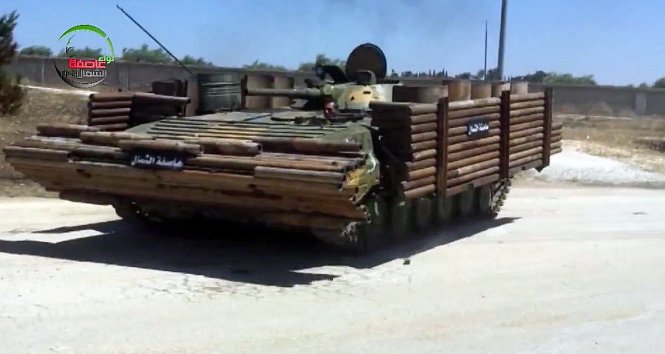
 When the topic of Sherman tanks in the Middle East comes up, most people generally think about the Israeli “Super Shermans.” However, Egypt also operated a number of Sherman tanks in the period of 1949 – 1973. For those wanting to learn about these Egyptian Sherman tank, author Christopher Weeks has put together a short new book titled “
 Tank and AFV News