 We recently had the chance to pose a few questions to Dr. Alaric Searle, Professor of Modern European History at the University of Salford Manchester and author of the new book Armoured Warfare: A Military, Political and Global History
—————————————————-
How did you become interested in the topic of armored warfare?
While I was an undergraduate studying History at Edinburgh University, I took a course on the Great War in my final year. This led to my discovery of the writings of J.F.C. Fuller, so I then decided to write a final year dissertation on the British Tank Corps in the First World War.
You state in the preface of Armoured Warfare: A Military, Political and Global History

The book takes a rather broad “global” approach to the subject. Was it a challenge to condense the topic down into a book that was of reasonable length?
There is a simple answer to that question – yes! While it is always possible to condense chapters and text, what I did find was that some explanations became unclear, so I had to return to the manuscript later and clear up some of the lack of precision by adding in more explanation. What was most irritating with the word length was that one or two conflicts simply could not be included. The two most obvious ones are the Soviet-Finnish Winter War of 1939-40 and the Indo-Pakistan wars. If there is a second edition of the book, then I will definitely include those conflicts.
Were there topics addressed in the book you would like to return to in a later work in more detail?
Oh, yes. I am currently working on an article comparing war elephants and tanks. I delivered an early version of this idea to a seminar at Oxford University last year. The reaction was very positive, so this has encouraged me to expand my talk into a longer article. Some of the ideas I developed in the final chapter on the visual history of the tank I would likewise want to turn into some articles. And, I am working on a full-length monograph re-examining the military theories of Major-General J.F.C. Fuller. So, there is going to be more work on this subject appearing over the next two or three years from my pen.
Typically with books about armor, the cover photo features a Tiger tank or something along those lines. Your book has a rather interesting photo of what looks like a location in Vietnam with some M113 troop carriers and a helicopter taken from the roof of an M48. Is there a reason for why that particular photo is on the cover? [Read more…]

 GRAFENWOEHR TRAINING AREA, Germany, March 7, 2017 — Tank and maintenance crews from the 1st Battalion, 66th Armor Regiment assigned here are giving their M1A2 Abrams main battle tanks a buffed-up look that improves the tanks’ overall defensive capabilities. The crews, with the 3rd Armored Brigade Combat Team, 4th Infantry Division, which is serving as the initial ABCT rotational force in support of Atlantic Resolve, began installing the Abrams Reactive Armor Tile system Feb. 28 to tank hulls and turrets.
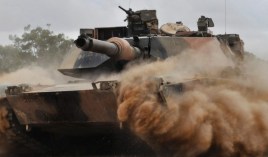 As the Defence Department gears into “new and enhanced capability”, spending around $195 billion over the next 10 years, most people are aware of the large-scale builds: the Air Warfare Destroyers, the 12 future submarines, the future frigates and Australia’s step into the aviation future with 72 F-35 stealth fighters. Less well known is the resurgence of a defence technology which has not made many headlines for the past 45 years: the main battle tank.
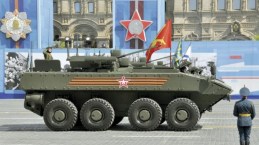 Russia has released additional details of its latest Bumerang (Boomerang) family of wheeled 8×8 armoured fighting vehicles (AFVs) that are the long-term replacement for the currently deployed BTR-80 8×8 amphibious armoured personnel carrier (APC). The Bumerang chassis has the designation VPK-7829, with the infantry fighting vehicle (IFV) variant designated the K-17 and the APC model is designated the K-16 (while under development the vehicle was referred to as the Gilza, which is Russian for ‘cartridge’).
 Israel’s first women seeking to become tank-crew members started the process this week as Israel strives to join countries like Norway, Canada and Australia on the short list of states with women in tanks. At the end of their basic training in mixed-gender battalions, 15 of the women will be selected for a pilot program to see if they are fit to serve in tanks. Selection will be based in large part on motivation and physical fitness. In light of certain rabbis’ and reserve officers’ wariness about women serving in the military and/or the Armored Corps, the army’s pushing of the process seems to be sending a message in support of women in combat.
 Yugoimport’s Lazar 3 8×8 MultiRole Armoured Combat Vehicle has entered service with Serbia in the armoured personnel carrier (APC) configuration. The vehicle has a welded steel chassis to which its monocoque steel hull – which features spall liners – is bolted. In its baseline form the vehicle has all round ballistic protection to Standardization Agreement (STANAG) 4569 Level 3, and over the frontal arc this is increased to Level 3+. Mine protection is to STANAG 4569 Level 3a and 3b, and the floor has two levels of protection.
 On Feb 24, 2017, US tank commander and survivor of the Bataan Death March Lester Tenney passed away in California at age 96. A member of the 192nd Tank Battalion National Guard at the beginning of WWII, Tenney served as a radio operator and later a tank commander during the fighting on Bataan in the Philippines in December of 1941. After being taken prisoner, Tenney survived the Bataan Death March as well as over three years as a POW forced to labor in a coal mine. Following the war, Tenney was released and made a new home in California. He would go on to obtain a doctorate in finance from the University of Southern California, taught at San Diego State and Arizona State Universities and founded a company providing financial advice to corporations. He authored a book based on his experiences titled
  , published in 1995. He also worked with other former P.O.W.s to seek an apology from the government of Japan, an effort that proved successful in 2009 when Japan’s ambassador to the US, Ichiro Fugisaki, apologized on behalf of his government.
 and is authored by well known British AFV expert David Fletcher. This is a 160 page hardcover book. As with others of this series, it features plenty of photos, charts and diagrams.
 SABOT Publications is relaunching the Warmachines series of photo reference books initially created by Verlinden Publications. SABOT Publications recently purchased Verlinden Publications, including all of its photographs, slides, books, and other intellectual property. We hope to continue the success and variety of titles that the Warmachines series offered. With a couple of new 1/35 scale kits expected to come out on the M1 ABV, this vehicle will be our first book in the new series. The second book will focus on the Stryker MGS in combat in Iraq and Afghanistan.

 For those interested in WWII Armor history, be sure to check out
 Tank and AFV News