Book Alert: Ghost Division by A. Harding Ganz

51qp8C5tyFL._SX395_BO1,204,203,200_For those interested in the history of WW2 German Panzer units, a new book has been released on the history of the 11th Panzer Division.  Titled “Ghost Division: The 11th “Gespenster” Panzer Division and the German Armored Force in World War II“, this new book is authored by A. Harding Ganz, published by Stackpole books and contains 416 pages.


Publishers Description:

Nicknamed the “Ghost Division” because of its speed and habit of turning up where its enemies least expected, the German 11th Panzer Division wreaked havoc in the East and West in World War II, playing a pivotal role in some of the biggest engagements, including Barbarossa, Stalingrad, Kursk, and the West.

>Detailed reconstruction of the 11th Panzer Division’s wartime exploits.

>Explores the role played by the German Wehrmacht’s panzer force during World War II, its tactical prowess, and tenacity of its soldiers.

>Draws on archival sources as well as interviews and correspondence with veterans.

Author information:

Born in New York City, A. Harding Ganz is professor emeritus at Ohio State University. He served as a tank platoon leader in the U.S. Army stationed in Germany in the 1960s and earned his master’s from Columbia University and his doctorate from Ohio State. He has written for publications such as Armor magazine and the Journal of Military History. He lives in Newark, Ohio, near Columbus.
New issue of ARMOR available for download

armor oct-dec 2015The latest issue of ARMOR: The Professional Bulletin of the Armor Branch, is available for download.  The majority of articles in this issue seem to deal with either leadership principles or logistics issues.  Unlike cold war era issues of ARMOR, there is not much here that will be of much interest for AFV enthusiasts.
Book Review: M48 vs Centurion: Indo-Pakistani War 1965

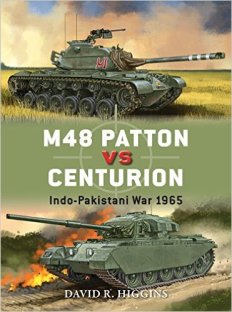
M48 vs Centurion: Indo-Pakistani War 1965 by David R.  Higgins

51LwRVTUmDL._SX369_BO1,204,203,200_The Indo-Pakistani War of 1965 featured the largest tank battles seen up to that point since the Second World War.  However, these battles would soon be eclipsed in size and in the popular consciousness by the armored battles of the Arab-Israeli wars of 1967 and 1973.  While much ink has been spilled regarding the tank battle of the Arab-Israeli wars, far less has been written about the Indo-Pakistani War of 1965.  Fortunately, author David Higgins seeks to fill the void with his new entry in the Osprey Duel series with M48 Patton vs Centurion: Indo-Pakistani War 1965.

While the Indo-Pakistani War of 1965 may have some superficial similarities to the more well-known Arab-Israeli wars, there are some important differences.  While M48 Patton tanks and Centurion tanks were used in both conflicts, in the Arab-Israeli wars both of these tanks were operated by the Israelis against Soviet built Arab operated tanks.  The Indo-Pakistani war of 1965 features U.S. built Patton tanks lined up against British Centurion tanks, making it one of the few examples of a postwar armor conflict featuring Western built tanks on both sides.  The other noticeable difference between the two conflicts was that the difference in crew training and quality was not nearly as pronounced in the Indo-Pakistani war as it was between Arab and Israeli forces.

The format of the book follows the same pattern as earlier Osprey Duel books and is Mr. Higgins fifth book in the series.   A good deal of technical information is presented about both tanks, as is the norm in this series.  While there are considerable differences between the two tanks, it becomes clear that they are fairly well matched adversaries.  The Centurion and the M48 are both well-known and the technical descriptions of the vehicle may be “old hat” for well-read on the topic.  That said, the vehicle descriptions are well written and contain some nice illustrations.  The technical descriptions are followed by a section describing the history and organization of the Indian and Pakistani armored forces, information which will probably be new to many readers.   This section is followed by a description of the events of the campaign, interesting reading of a war which has not been described often in other sources.

The conclusion of the book notes that neither vehicle proved itself as markedly superior to the other, factors such as morale, crew training and leadership being more important in determining the outcome of any particular engagement between the two combatants.  The war was essentially a draw and while crews on both sides often fought bravely, higher level leadership was often tentative and ineffective on both sides.   The book does not really say if Western observers took many lessons from this particular war, either in regards to the performance of the vehicles or the tactics used.

Available through Amazon for under $15, this book is well worth the price.  By our count, Mr. Higgins is second only to Steven Zaloga in the number of tank themed “Duel” series books authored thus far.  Based on this book and his previous entries in the series, we hope to see more “Duel” books from Mr. Higgins in the future.


Book News: The History of the Panzerwaffe

panzerwaffeEarlier in the year we posted that the book “The History of the Panzerwaffe Volume 1: 1939-1942” by Thomas Anderson would be released on October 20 of this year.  That date has been pushed back to December 17, 2015 according to the Osprey Publishing website.  Thomas Anderson has written several hardcover books for Osprey on German WW2 Armor.  This new book promises to be a substantial work, coming in at 304 pages.  And just in time for Christmas for all those Panzer fans out there.

Publishers Description:

ABOUT THIS PRODUCT
The Germans transformed armoured warfare from a lumbering and ponderous experiment in World War I into something that could decide the outcome of conflicts. This technical and operational history is the definitive guide to the legendary Panzerwaffe, from its very infancy to the days when it made Europe its garden path at the height of Nazi German power. With rare and revealing combat reports, along with photographs sourced from previously unseen private and archival collections, it uncovers the technical and operational stories of the formidable armoured beasts that formed the backbone of the German war machine – tanks such as the Panzer I, II and 38(t).

BIOGRAPHICAL NOTE
A German national, Thomas Anderson is a specialist in German armored fighting vehicles of World War II. He has spent decades researching in archives throughout Germany and the rest of Europe to discover little known facts and never previously published photographs of the might of the Panzerwaffe. A modeler, he regularly contributes to popular modeling and historical magazines across the globe including Military Modelcraft International (UK), Steel Art (Italy), Historia Militar (Spain) and Batailles & Blindes (France) as well as many others.

CONTENTS
1 Laying the foundation – pre-war establishment 2 The seizure of Czechoslovakia – backing the Panzerwaffe 3 Poland – the ordeal 4 France – at eye level 5 The Balkans – the unwanted campaign 6 Russia – an overmighty opponent? 7 1942 – upgrading the Panzers 8 North Africa – defeat instead of superiority 9 Dark prospects – Waiting for the new tanks 10 Tank recovery and repair 1935-42

Book review of Tanks in Hell

tanks in tarawaThe Spectrum has published a review of the new book by Oscar Gilbert and Romain Cansiere, Tanks in Hell: A Marine Corps Tank Company on Tarawa.  This book was published earlier this year by Casemate.  Oscar Gilbert is the author of several books, with a focus on US Marine Corps armor.

Book Review excerpt:

Charlie Mason’s tank was inching its way toward a Japanese pillbox when incoming machine-gun fire sprayed his M4A2 Sherman, he remembered, “like hail on a tin roof.”

Mason’s tank, the CONGA, was part of Charlie Company, 1st Corps Medium Tank Battalion. Its job was to silence enemy strongpoints that acted as scythes against the lightly armed Marines invading the beaches of Tarawa.

After a bit of cat and mouse, CONGA fired and obliterated the Japanese pillbox. The victory, however, was short-lived. Later that day, CONGA was knocked out of action.

So it went for armor on Tarawa during World War II.

In the new book Tanks in Hell: A Marine Corps Tank Company on Tarawa(Casemate, $34.95), authors Oscar E. Gilbert and Romain Cansiere paint a vivid description of combat inside what was often referred to as “steel coffins.” And while writing about the fighting in the Gilbert Islands is not uncommon, focusing a book specifically on a single tank company on Tarawa is.

Read the full review here.

Book Alert: A30 Challenger Tank A Technical History

A new book by British researcher P.M. Knight is now available from Lulu.com.  This new volume looks at the history and development of the WW2 era British A30 Challenger tank (not to be confused with the modern Challenger MBT).  This is the third book that Mr. Knight has written on British WW2 armor, having also published volumes on the Covenanter and Crusader Cruiser tanks.  The book is available at Lulu.com and should be available through Amazon in a few weeks.

Publishers Description:

product_thumbnailThe A30 Challenger was devised during 1942 as a means of mounting the powerful 17 pounder anti-tank gun on the chassis of what was intended to be the British Army’s next Cruiser tank, the Cromwell. The subsequent development programme was subject to a degree of controversy as to the role and efficacy of such a vehicle, and, in the event, only 200 machines were ordered. The first examples did not see action until August 1944, and even then they were often viewed only as “stop-gaps” until the arrival of the A34 Comet. However, there were those, especially among its design team at Rolls-Royce in Belper, Derbyshire, who came to believe that the Challenger represented a missed opportunity to provide the Army with an unprecedented combination of firepower and mobility. This book examines the story of what would be an innovative and successful, if somewhat rarefied, tank and its subsequent development as a self-propelled anti-tank gun.
Book Alert: British Armoured Formations 1939 – 1945, A Bibliography

For those interested in the history of British Armor during WW2, please consider this very useful reference book by John A. Smith, British Armoured Formations 1939 – 1945, A Biography:  Annotated and Illustrated, Incorporating Armoured Regiments, Brigades and Divisions in Service During World War Two.  According to the author, this work  provides a listing for each armored regiment, brigade and division, and includes not only the standard histories but also the private regimental publications, the memoirs and biographies of veterans, plus a summary of each unit’s journals/newspapers/etc. There is also a color illustration section that shows some of the rarer titles listed in the book.  There is also a notes section for each book with the authors observations on the content, including awards and honors, print run numbers where established, guidance on the quantity of content relevant to WWII, and more.

For a sample of the book, go to the author’s website www.tankfactory.co.uk.  Aside from the sample pages, there is an order page for those wishing to purchase a copy, as well as a page listing other books on British Armor that the author has available for sale from his personal collection.

British Armored formations

Book Alert: Fallen Sentinel

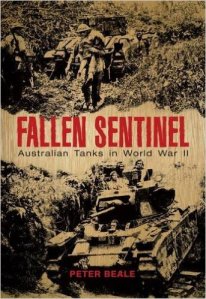
fallen sentinelAmazon has listed a release date of January 2016 for the book “Fallen Sentinel: Australian Tanks in World War II.” We assume this is a release date for a US edition since the book has been available in Australia or in a digital version since 2011.  Authored by Peter Beale, this hardcover book is listed at 320 pages published by Big Sky Publishing.   Peter Beale is best known for his book “Death by Design” which gives a critical evaluation of World War II British tank development.  While British WW2 tank development has been covered over the years fairly extensively by authors such as David Fletcher, AJ Smithers and Peter Beale, this book is the first to cover Australian tank development in substantial detail.  A preview of the book is available on Amazon here.

Publishers Description:

Fallen Sentinel tells the story of Australian tanks in World War II, a dismal tale for both tankman and taxpayer. Against the backdrop of the sweeping conquest of Western Europe by Hitler’s Panzers, the Australian Government, cash-strapped and resource poor, attempted to field its own tank force to do battle with the Axis forces. Three armoured divisions were created — and all three disbanded before they had seen action. In what became a prodigious waste of time, material, and human endeavour, sixty-six Australian cruiser tanks were produced — the Sentinel tank —none of which would ever take the field of battle. This is a book that portrays governments under pressure and the bureaucratic bungles that saw opportunities lost and precious resources squandered. Fallen Sentinel presents a careful dissection of government process in the crucible of war, a rare gem in an age when most wartime histories focus on the front-line soldier. Peter Beale presents a damning indictment of the frailty of government under pressure, a bureaucracy in crisis and the extraordinary failure of government process at the highest level. Modern-day governments would do well to heed the lessons of this book.

Book Review: T-64 Battle Tank by Zaloga

51mOjKKttzL._SX369_BO1,204,203,200_People familiar with Osprey’s New Vanguard series and with Steven Zaloga will know exactly what to expect from this title; a well written, well researched book with quality photos and illustrations. Mr. Zaloga also wrote the New Vanguard series books on the Soviet T-62, T-72 and T-80, so this volume completes the set nicely. That the T-64 is the last of the Soviet Cold War MBT’s to get its own New Vanguard book is indicative of how this vehicle has been overshadowed by its more well known stablemates. Ironically, the T-64 was perhaps the most important of the Cold War Soviet designs, setting the template for all the Soviet tanks that followed. Zaloga does a very nice job in describing the internal politics that led to the development of the T-64, a tale with more than a few characters and plot twists. It is perhaps appropriate that this book came out now, as it’s only been in the last year that the T-64 has seen combat, being used extensively in the fighting in Ukraine.

The only complaint regarding this book is the length.  As with all the Osprey New Vanguard titles, the book is only 48 pages.  Considering the number of photos and illustrations, the space available for text is rather limited and one gets the impression that Mr. Zaloga could easily fill a larger volume with his knowledge of this topic.  The “Further Reading” section at the end of the book shows that a good deal of information is available regarding the T-64, but it is almost exclusively in Russian language sources.  We can only hope that a publisher offers Mr. Zaloga a chance to write a more detailed hard cover book on Soviet post war tank development, perhaps an updated version of his classic “Soviet Tanks and Combat Vehicles: 1946 to Present” published back in 1987.  That said, this New Vanguard T-64 book is at present the best (and one of the few) volumes out there dedicated specifically to this essential battle tank of the cold war.

.

New Issue of ARMOR posted online

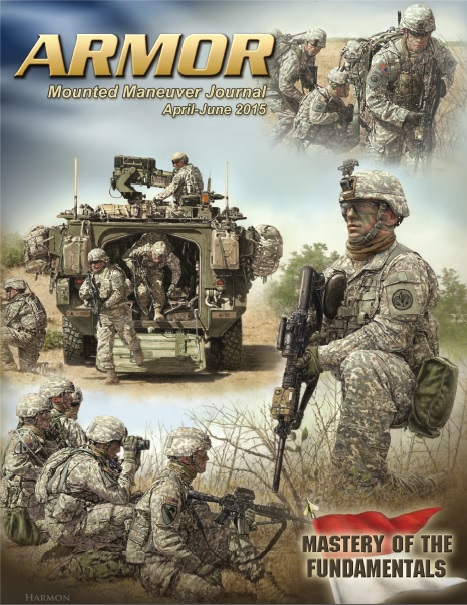
After much delay, the April-June 2015 issue of ARMOR Mounted Maneuver Journal has been posted online in PDF format.  Tank and AFV aficionados interested in hardware will probably find the article on the BMPT Terminator-2 to be the most interesting.  Those who like armor history will find the piece about the 37th tank battalion at Arracourt to be worthwhile.  Click on the image below to download the PDF file.

armor 2015