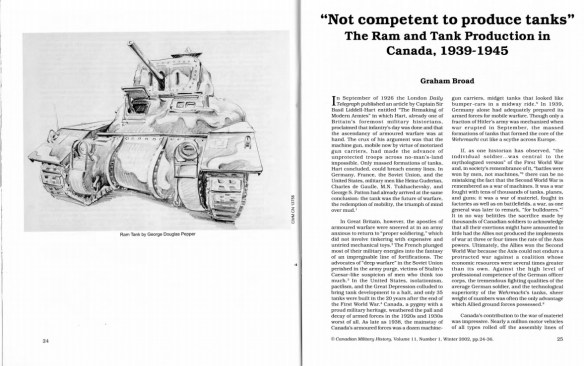
From the Vault: The Ram and Tank Production in Canada, 1939-1945

ram tank article

From the pages of Canadian Military History comes an article on the role Canada played in WW2 tank production and design.  “Not compentent to produce tanks” the Ram and Tank Production in Canada, 1939-1945 by Grahm Broad is a ten page long examination of the topic.  Aside from repeating some of the well worn myths about German tank superiority (a Panther is worth five Shermans!), it’s worth a read.

Download the PDF here.

From the Vault: The Development of American Armor 1917-1940

Dummy training tankThis article originally was serialized in four parts in the 1969 run of ARMOR magazine.  Written by Timothy K. Nenninger, it  gives a good description of the development of American armor from 1917 to 1940.  We have provided links to the four parts below which can be downloaded in PDF form.

Part I World War 1 Experience

Part II The Tank Corps Reorganized

Part III The Experimental Mechanized Forces

Part IV A Revised Mechanization policy

From the Vault: Six-Ton Tank

From the Nov-Dec 1968 issue of ARMOR we present this article by Konrad Schreier on the US Six-Ton Tank.  The article may be viewed as individual images below or you can download the entire ARMOR issue as a PDF here (article starts on page 183 of PDF)

From the Vault: the Secret Museum at Kubinka

This article by Jim Warford originally appeared in the Sept-Oct 2001 edition of ARMOR magazine and it takes a look at the captured US  made vehicles that found their way into the collection at the Kubinka tank museum outside of Moscow.  Of particular interest is the information on the Israeli Magach 4 tank which was captured by Syria in 1982.  It was recently announced that this vehicle will be returned by Russia to Israel.  We have also included in the gallery below a copy of a letter written by Steven Zaloga with appeared in the Nov-Dec 2001 issue of ARMOR in which he provides some additional information on the Museum as well as a response from Jim Warford  from the Jan-Feb 2002 issue.  To download PDF copies of the full ARMOR issues mentioned, just click on the hyperlinks in the text.

From the Vault: Peiper on WW2 Tanks

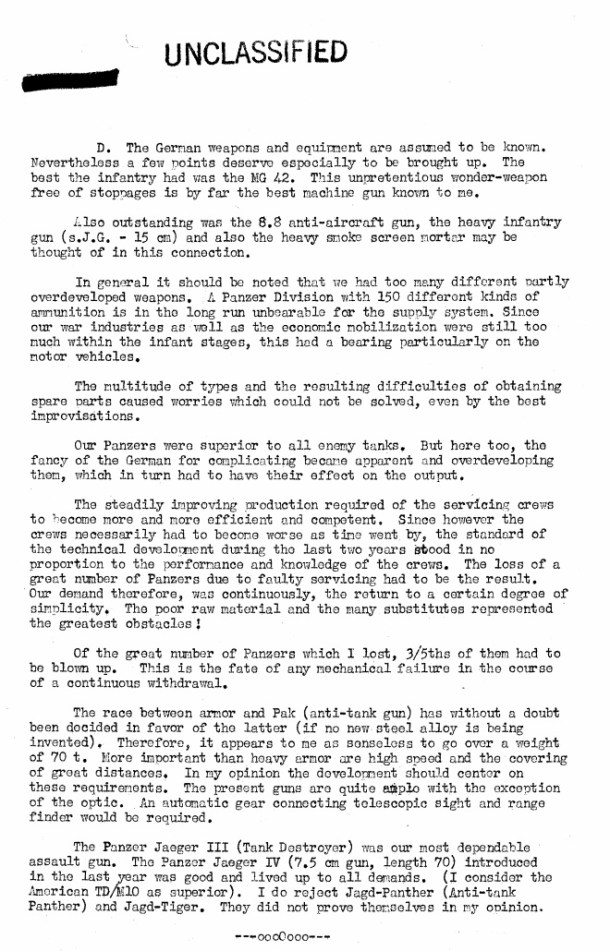
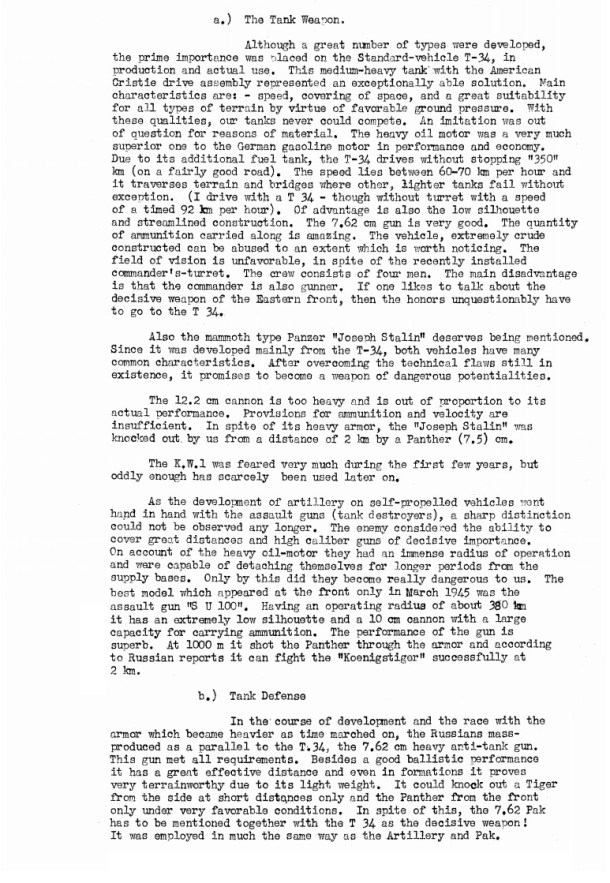
While surfing the CARL (Combined Arms Research Library) Digital Library, we came across a document labeled War experiences of commanders of German Panzer units.  The document is from 1953 and contains accounts by General Sepp Dietrich and Colonel Joachim Peiper, Commander of the First SS Panzer Regiment, First SS Panzer Division, and their involvement in World War II, between 1939 and 1945. The account was written by them for the trial judge advocate while they were awaiting trial for the Malmedy Massacre.  The section written by Dietrich is fairly short and only deals with the large scale strategic situation.  Peiper’s section is longer and deals with specific weapons systems and tactics.    The entire paper can be downloaded as a PDF here.  We have posted below the two pages of material from Peiper that may be of interest to AFV enthusiasts.

Probably the most surprising thing in these two pages is his statement that while  he the considered the Stug III and Jagdpanzer IV good vehicles, he judged the US M10 as superior.  He also seems to hold both the JagdPanther and JagdTiger in low regard.

To anyone that downloads and reads the full PDF, please keep in mind that these two men were part of a criminal organization (the SS) and were guilty of war crimes for with they served jail time.  Their descriptions of the war are rather self serving and their racist world view comes through clearly, especially when describing their Soviet adversaries.  Consider this the closest that Tank and AFV News will ever come to issuing a “trigger warning.”

Pieper on equipmentPieper on equipment 2

From the Vault: Tank Development at GM in WW2


This video is essentially a PR piece for General Motors but it does have some nice footage of M5 light tanks and other vehicles running around at a proving ground.  One thing worth noting is that the model vehicles built for testing suspension designs shown in the video would appear to have nothing to do with the M5 light tanks shown later in the video.  The models shown appears to simulate individually sprung road wheels, unlike the volute spring system on an M5.  Our best guess is that this model is part of the early design work for the program eventually leading up to the M18 Hellcat tank destroyer, which was built by Buick.

Here is the model from the video:

GM suspension test model

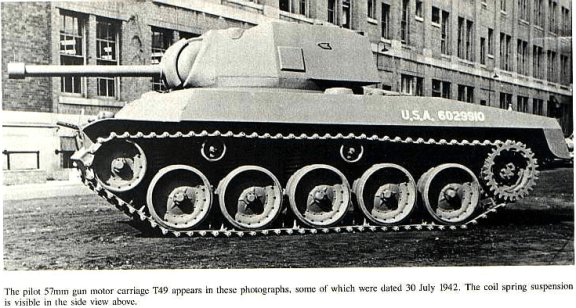
Here is the T49 gun motor carriage:

T-49

From the Vault: Seek, Strike, and Destroy: US Army Tank Destroyer Doctrine in World War II

Leavenworth papers TDFor those interested in the history of US Tank Destroyers,  check out  Seek, Strike, and Destroy: US Army Tank Destroyer Doctrine in World War II by Dr. Christopher Gabel published in 1985.  This paper takes a critical yet fair look at the tank destroyer branch during WWII, explaining why it was created and how it functioned during the war.  At over 79 pages long, this paper is pretty close to being a book.  And even better than a book, it’s available for free.
The paper may be viewed at the Hathi Trust Digital Library site or a slightly lower quality copy can be downloaded at the  Combined Arms Research Library.

From the Vault: Soviet Tank Company Tactics (1976)

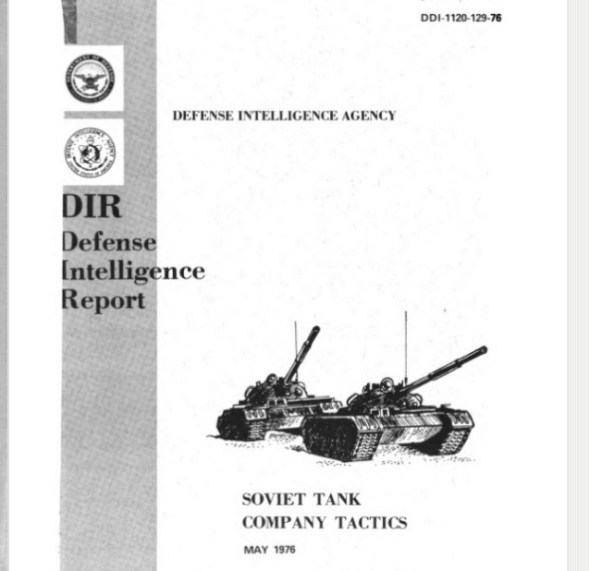
For those you wondering what the US military knew about Soviet armor tactics in the 1970’s, this document may prove of interest.  From the Defense Intelligence Agency is this report from 1976 on Soviet Tank Company Tactics.

From the Preface:

This study of Soviet tank company tactics is written as a “how they fight” manual.  Many of the concepts and methods used by the Soviets appear to the US or NATO military reader so alien that there is a temptation to say “This is unworkable.”  The reader should appreciate that the Soviet tank company commander has a vastly different task than his US or NATO equivalent.  His task is to train and lead his company as directed by well established principles set out in field service regulations, and as interpreted by his superiors.  The company fights either as part of a battalion size unit, or with the close support of other tank, motorized rifle, and artillery units.  the battalion is the basic unit of maneuver in the Soviet Ground Forces and a company is best regarded as a fire team.

The entire report can be read at the website for the Hathi Trust Digital Library.  Click on the image below to read the report.

Soviet tank company tactics


Readers may be amused at this artists rendition of a Soviet T-72 tank found in this report.  This is a good example of the confusion in the West in this period regarding the new generation of Soviet tanks represented by the T-64 and T-72.

T-72 artists rendition 1976

From the Vault: “Crack that Tank” 1943

This video came to our attention when it was posted earlier this month on the Facebook page for The Armor Journal.  It’s a rather entertaining US Army training film for infantry on how to stop enemy tanks.  Whoever was responsible for the M3 Medium tank modified to appear as an enemy vehicle in this film certainly exercised a bit of creative license…


From the Vault: PS Magazine on the M60A2 (1975)

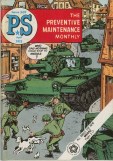
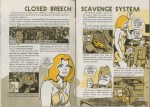
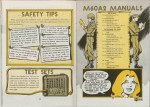
PS mag M60A2While perusing the online archive of old PS Magazine issues, we came across this article on the M60A2 from 1975.  This piece gives some interesting insight into the operation of the US Army’s least successful MBT of the cold war.  Apparently, the turret of the M60A2 was cramped enough to warrant a warning to soldiers with big feet to avoid kicking the gunners panels which could result in knocking “the firing and alignment mechanisms outta whack.”  The article can be viewed as individual images below or the entire issue can be downloaded as a PDF here.