Exhibition at Hatfield House commemorating 100 years since first tank trials

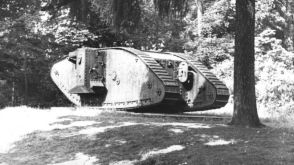
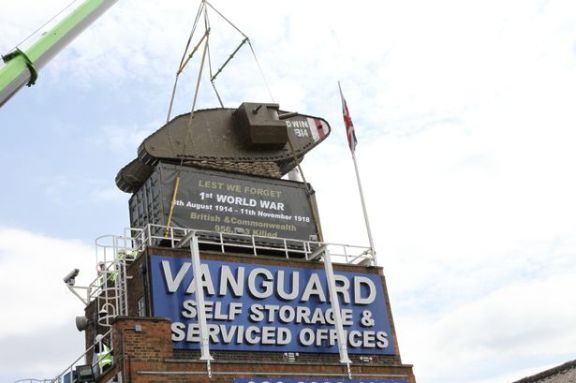
_88934549_8463ba7d-6ccc-4267-bbac-4f1eedbafa63The BBC is running a story about a historic exhibition at the Hatfield House in Hertfordshire UK.  In early 1916 a Mark I tank was trialled at the grounds of the Hatfield House in front of military personnel, politicians and King George V.  These trials are considered the first tank trails in the UK.  At the end of WWI, the 4th Marquess, owner of Hatfield House, was presented with a Mark I tank used in the trials.  In 1969 the tank was given to the Tank Museum in Bovington.  To mark the 100th anniversary of the first tank trials at Hatfield, a replica Mark IV tank owned by  Mac and William McCullagh has been loaned the Hatfield estate where it will be on display.  The exhibition at Hatfield House will run to 30 September 2016.  The replica Mark IV is named “Edwin B14” after a relative of the owners who died at the Battle of Messine Ride in June 1917.  In 2014 this replica tank was placed on top of the Vanguard Holdings Ltd building in Greenford to mark the 100 anniversary of the start of WWI.
DBR_WTL_230614tank_02JPG

For more information on the Mark I tank at Bovington, click here.

Stuart tank returned to site of American Car and Foundry factory

WNEP 16 News (Pennsylvania) is reporting that a WW2 era Stuart light tank has found a new home in Berwick PA, site of the former American Car and Foundry factory.

The Stuart Light Tank, called a Stuie, was among 15,000 Stuie Tanks built from 1940 to 1944 at the former American Car and Foundry factory that once stood inside the industrial park.

The tanks were used in combat during World War II in Europe. Many at the celebration are veterans of the war.

“It’s almost like uniting a family.When you lose somebody in battle and they’re over there, and they finally come home, that’s the closing,” said Donald.

Veteran Joe Messina worked at the factory, testing the tanks.

“I test drove them before they went out,” said Messina. “I test drove them when they came out the gate and then I took them.”

The plan is to eventually have the Stuie Tank placed at the entrance to the industrial park. It will serve as a memorial to the Stuie Tanks, the factory, and the thousands of people who worked there.

There is already a historical marker set at the memorial site, which was put there last September on V-E Day to honor the 9,000 workers.

Berwick stuart

Sentinel tank finds new home at Queensland museum

7271734-3x2-940x627ABC Far North (Australia) has posted an article about an AC1 Sentinel tank that has found a new home at the Australian Armour and Artillery Museum in Cairns.  Only 65 Sentinel tanks were produced by Australia during WW2 and only 3 of the AC1 still remain in existence (as well as 2 AC3 models, an AC4 and a few AC1 hulls converted into agricultural tractors.)  This particular Sentinel AC1 was owned by the late Jacques Littlefield as part of his large private collection.  The video game company Wargaming purchased the Littlefield Sentinel and has donated it to the Australian Armor & Artillery Museum where it will be put on display after some minor renovations.  The ABC Far North article quotes Wargaming America’s director of militaria relations Nicholas Moran:

“Australia had never built a proper tank before, so by the time the tank was ready for testing in July 1942 it was a little outdated.”

“By the time the fighting really got going against the Japanese, the Americans and British had started producing tanks of their own in large numbers and to a standard design.

“So it just simply didn’t make sense for Australia to continue to produce their own tank.”

The closest any Sentinel tank ever came to seeing actual military service was in the shooting of the film The Rats of Tobruk.

“If you see The Rats of Tobruk they’ve got German iron crosses on the side of them,” Mr Moran said.

“That was pretty typical of movies in the post-war industry; they didn’t really think the audience cared if a tank looked realistic, as long as it had a German cross on the side.

“In fairness, at least the Sentinel was unusual enough that it wasn’t going to be confused with something the Allies were using.”

For the full ABC article, click here.

Earlier this month Wargaming released a short video about this particular AC1 Sentinel.


For a list of the remaining Sentinel tanks in the world, click here to view a PDF of surviving Canadian and Australian Cruiser tanks hosted by the Surviving Panzers website.

Video: Engines of War 2016

This video shows some of the vehicles on display as part of the 2016 “Engines of War” exhibition in Russia.  This exhibition features 120 vehicles from 16 different countries from the Second World War.

Tank Chats #16 Panther

Sherman tank on Ebay

For those with a half-million dollars to spare and the desire to be the envy of all their tank loving friends, there is a M4A2E8 Sherman tank for sale on Ebay right now.  This vehicle is listed as “complete, running and driving.”  There are no live guns on the vehicle, but the tank is described as having every accessory it was issued with as well as a stack of manuals.  The vehicle is located in Texas.  Below are some photos, there is a larger photo gallery at the ebay listing for the tank.

Yuri Pasholok articles via Archive Awareness

The Archive Awareness blog has recently translated and posted several articles by Russian tank researcher Yuri Pasholok.  We have posted the first paragraph of each article below with a link to the full version over at Archive Awareness.

Cromwell: English Dictator in Soviet Fields

Over the years of the Great Patriotic War, over 5000 British and Canadian tanks were sent to the Soviet Union. Most of them were so called Infantry tanks, with thick armour and low speeds. Light tank shipments were limited to 20 Tetrarchs. As for Cruiser tanks, they never made it into the Red Army. Despite an initial desire to receive Cromwells, they only made it to the trial stage. Read on to discover why these tanks were rejected.


AMX 50 120: Long Road to a Dead End

At an unusual parade in Paris on July 14th, 1951, the French military showed off all their newest vehicles that was adopted by the army or still undergoing trials. EBR armoured cars and ARL 44 tanks drove along the Champs-Élysées. The parade was concluded with the passage of two Foch tank destroyers and two AMX 50 tanks. Only a chosen few knew that these tanks will not enter mass production and that superior tanks are already on the drawing board.


M6A2E1: Heavy Clownshoe

The Heavy Tank M6 had the worst fate of all mass produced heavy tanks of WWII. A decent vehicle with competitive characteristics became another victim of work dragging on too long. The tank was accepted into service, but only 40 vehicles in 3 modifications were produced, and none of them saw combat. By 1943, the M6 was obsolete and its road to the front lines was closed. However, a heavily modified version of the tank was soon once again in demand, and urgently. This is the modernization covered by this article.


Valentine Mods in the USSR

The Infantry Tank Mk.III, or Valentine, was the most produced British tank of WWII. However, the British themselves actively used Valentines from 1941 to the first half of 1943. The Soviet Union, who received almost half of these tanks, used them much more actively. Known as “Valentin” or MK-3/MK-III, these tanks debuted in the Battle for Moscow in the fall of 1941 and survived until the end of the war in some units. The Valentine was one of a few foreign tanks that saw a large scale conversion effort.

Stars and Stripes: 100 Years of Tanks

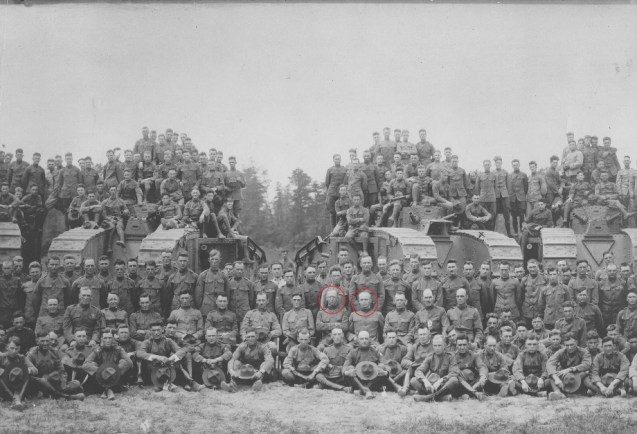
Stars and Stripes has posted a page devoted to “Tanks: from Novelty to Necessity in 100 years.”  The page is intended for those that are not particularly familiar with the topic so the information is pretty basic.  That said, it’s a very sharp looking page with some nice photos and videos.  Our favorite image in the article is this one from 1921 showing the US Tank Corps stationed at Camp Meade.

Early armor force picture

The two men circled in red are Maj. George S. Patton (left) and Capt. Dwight D. Eisenhower (right).

The Stars and Stripes article can be viewed here. 

“Military History” Youtube Channel

The Youtube Channel “Military History” has a number of videos pertaining to tanks and armored warfare in World War II.  The narrator has a strong accent but is fairly understandable.


The Chieftain’s Hatch: Patton Troubles

Over at the WoT forum, Nicholas “The Chieftain” Moran has posted a second article about the issues encountered during the early testing of the M46 “Patton” Medium Tank.

Excerpt:

Last week, we saw how Armored Board was not entirely happy with the T40 medium tanks which they had received for testing. Bearing in mind that the M46 entered production before Armored Board had even started testing T40, the testing was as much just to prepare Fort Knox for things to keep a particular eye out when they finally did get some M46s to play with. Some defects had been noticed by Aberdeen before Fort Knox received the vehicles, and some modifications incorporated. Some.

M46 #12 as it arrived. This tank survived the testing process. Note the name painted on the side.

These new M46 tanks showed up in the very beginning of 1950, Fort Knox immediately ceased the T40 testing program, parked the four vehicles, and set about the four M46s they received. The first thing they did was break them in gently, running about 200 road miles, and not exceeding 2,200 rpm. Then the testing started. Over the course of the test, the four tanks ran the following distances.

Read the full article here.