Today we present this image generated by sonar of a WW2 era British Valentine tank lost at sea. Several of these vehicles are at the bottom of Studland Bay and can be viewed as 3-D images here.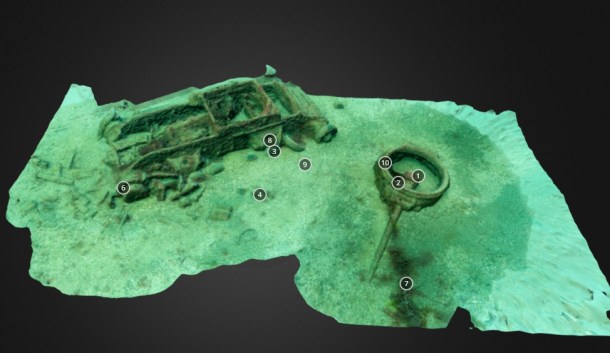
Photo of the Day: Sonar Scan of Valentine Tank
March 3, 2016 by Leave a Comment
New Edition of USA Historical AFV Register released
February 29, 2016 by 2 Comments
 A new 2016 edition of the USA Historical AFV Register is available for download in PDF format. This is the first update of the register since 2011 and was assembled by Michel van Loon and Neil Baumgardner for the AFV Association. The register is intended to provide a cataloging of all of the historical Armored Fighting Vehicles (AFV), including tanks, APCs and self-propelled artillery, etc that are on preserved or otherwise displayed in museums or as monuments in the United States. As such the registry ranges from the World War I-era Skeleton Tank to modern M1 Abrams tanks. However, the registry is not intended to include modern AFVs that are still in service.
Download the USA Historical AFV Register here.
Registers for other regions can be found here.
The Chieftain’s Hatch: T40/M46
February 29, 2016 by Leave a Comment
Over at the Chieftain’s Hatch section of the WoT forum, Nickolas “The Chieftain” Moran has posted part 1 of an article looking at the history of the US M46 medium tank.
Excerpt:
As it is well known, the M26 Pershing was not an unqualified success. By the end of WW2, deficiencies in the vehicles, many of which were already known even at the time of fielding, became reinforced. Thus, a general improvement program was started, the T40 which ultimately would become M46. It turned out that improving a tank isn’t always all that easy…
The program for T40 really kicked off in the first half of 1948, as a series of conferences between Army Field Forces and Ordnance Dept culminated in a number of changes, particularly to the power train, but also notably weapon and suspension, in what would become the M46. As an improvement of an extant design, tests of the ten T40s were relatively brief. In fact, M46 was standardised by the Ordnance Committee in July 1949, the month before the first T40 showed up at the Aberdeen Proving Grounds!
This did not, however, provide adequate time for field service testing. It’s one thing to run a vehicle around the test track for a couple hundred miles, it’s another to really run them through the grinder on the training grounds. As a result, the Army Field Forces Board #2 (i.e. Armored Board) received four of them to test out while the production run started.
Tank Chats #15 Tortoise
February 25, 2016 by 1 Comment
From the Tank Museum at Bovington comes another installment of the Tank Chats video series. This episode is hosted by museum curator David Willey rather than regular host David Fletcher.
Tankograd blog on the T-10
February 24, 2016 by Leave a Comment
The Tankograd blog has posted a new article examining the history of the Soviet T-10 heavy tank. The authors of the piece engage is a bit of myth-busting, putting forth their opinions on the vehicle. All in all, an entertaining read.
Excerpt:
During the final years of the Great Patriotic War the Red Army’s generals had perfected combined arms operations utilizing withering artillery fire and the devastating salvos from Shturmoviks to create decisive combined arms attacks that smashed through enemy lines.
The weapon of choice for these assaults was the Joseph Stalin 2 or JS-2, an impregnable tank that marked a complete departure from its predecessors. It also foreshadowed the possible terrors of the next Great War when the Soviets had to duke it out against the Allies in Central Europe using main battle tanks on battlefields sown with radiation.
The Joseph Stalins were the antithesis of the earlier T-34’s. Despite the latter’s fame they suffered greatly from German tanks, aircraft, and anti-tank guns, not to mention their own mechanical and ergonomic faults.
The Joseph Stalin had better armor than the heaviest German tanks, had a larger main armament, larger dimensions, greater range, and better everything. Its only shortcomings were an uncomfortable interior and a 600 horsepower diesel engine whose mobility issues Soviet engineers never completely solved. This is why succeeding iterations like the Joseph Stalin-3 and 4 were never popular with the Red Army.
A spectacular success on the battlefield, more than 6,000 JS-2, 3, and 4’s were built and kept as the Red Army’s most lethal tanks during the early Cold War years. Clearly a favorite of their bloodthirsty namesake, when he passed away in 1953 the most recent and last iteration of this near-invincible lineage became the T-10.
Spacious and extremely heavily armed, it was the most atypical tank ever made in the Soviet Union. Yet it never enjoyed the same success as its cost-efficient (and weaker) replacements the T-55 and the T-62.
Why?
The Armored Patrol: Saumur Tank Museum
February 22, 2016 by 1 Comment
The blog “Armored Patrol” is featuring a nice series of posts on the Saumur Tank Museum in France by “Harkonnen.” The article is in four parts. Click on the pictures below to go to each part. The Armored Patrol is a blog primarily of news about World of Tanks and other tank themed video games although they also feature historical themed articles.
-

- Part 1
-

- Part 2
-
- Part 3
-

- Part 4
Tank Talk: The German Panzer V Panther
February 22, 2016 by Leave a Comment
New episode in the “Tank Talk” series featuring Len Dyer of the Nation Armor and cavalry Restoration Center at Fort Benning.
Tiger Tank themed parade float causes controversy
February 16, 2016 by Leave a Comment
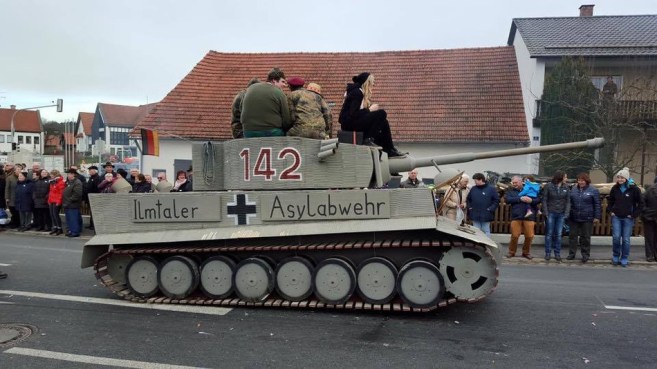
Obviously, this is not a real tiger tank. This is a float that was part of a carnival parade in the town of Steinkirchen bei Pfaffenhofen. The message on the side of the float translates to “asylum defense” and is meant as an anti-immigration message. German authorities are investigating whether or not to press charges against the float builders. German law prohibits the public display of the Nazi swastika, although there is no law against public display of the Balkendreuz. More here.
Tanks inside the Wire
February 14, 2016 by 2 Comments
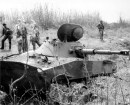 The Newton Citizen (Georgia) has posted an article chronicling the story of Paul Longgrear, a US Army officer who commanded a special forces unit in Vietnam that engaged a unit of North Vietnamese PT-76 tanks.
Excerpt:
Lang Vei soon received a warning from the NSA to stop patrolling trails. The NSA had overheard NVA orders to set up ambushes and reposition men and equipment. The “beast” was stirring.
“The NVA overran the village of Khe Sanh near the Marine base in late January,” Longgrear recalled. “Apparently they thought the Marines would bail out the village, but our mobile strike force hit the NVA from their rear. We killed a bunch of bad guys, but it caused the NVA to change tactics. Instead of using tanks against the Khe Sanh Marine base, they used two tank battalions against Lang Vei, that’s 16 PT-76 tanks.”
Feb. 6, 2330 hours: Sgt. Nickolas Fragos reports, “tanks inside the wire.”
“That’s when all your training kicks in,” Longgrear said. “We left the TOC to man 81mm mortars. It was pitch dark outside, so we lit up the night with illumination rounds so the Montagnards could see the NVA infantry. A tank without infantry support is a rolling coffin.”
Inside the Chieftain’s Hatch: T-55A Part 2
February 12, 2016 by Leave a Comment
Part 2 of Nicholas “The Chieftain” Moran’s look at the T-55A medium tank.

 Tank and AFV News