Tank Chats #9 Whippet – Medium A

The ninth in a series of short films about some of the vehicles in our collection presented by The Tank Museum’s historian David Fletcher MBE.
While the heavy tanks were designed for direct attacks against enemy trenches the Tank Corps also wanted a lighter, faster tank to work with the cavalry over open country. Designed by Sir William Tritton and built by Fosters of Lincoln the Medium A, or Whippet, was the only such tank to see service with the Tank Corps, starting in 1918.


Also, here is a video of the Whippet in use.
The Graveyard of Patton Tanks

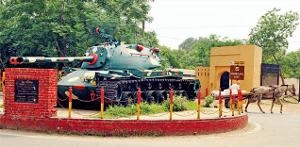
The Times of India has posted an article commemorating the 50th anniversary of the 1965 war between India and Pakistan with a focus on the defeat of Pakistani M48 Patton tanks by Indian forces.

Excerpt:

1-The brave men who had demolished Pakistan’s feared Patton tanks in 1965 are a part of village lore in Asal Uttar, Punjab.

The landscape surrounding the memorial of Abdul Hamid is pretty as a picture postcard. Paddy fields sway in the easy breeze and ashen clouds play hide and seek with the sun. It’s impossible to imagine that 50 years ago the region was the theatre of one of the most intense and decisive tank battles in history.

Asal Uttar and neighbouring villages — Bhura Kuhna, Chima, Amar Kot, Valtoha and Bhura Karimpur — had turned into a battleground for four days. The desperate, do-or-die battle between Pakistan and India began on September 7, 1965.

By the time it was over, Pakistan’s General Ayub Khan’s dream of capturing Amritsar had turned into a nightmare. The combat zone had also become a graveyard for the feared Patton tanks. Pakistan lost 97 tanks in all, including 72 Pattons. Enough to create, for a brief while, an open-air showroom called Patton Nagar in nearby Bhikkiwind.

Read the full article here.

Video of this particular Pakistani M48 on display can be seen in this youtube clip (warning, this clip features some rather poor grammar as well as some inaccurate tank ID)


For those interested in the armored clashes between Indian and Pakistan in the 1965 war, be sure to check out the upcoming book “M48 Patton vs Centurion: INdo-Pakistani War 1965 (Duel)” by David Higgins scheduled for a January 2016 release.

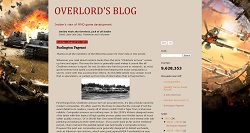
Overlord’s Blog on Chobham armor

Over at Overlord’s Blog, contributor David Lister has written a nice summary of the history of Chobham armor.  Here is a brief excerpt:

overlords blogFirst things first, Chobham armour isn’t an accurate term, it’s like a family name for modern composites. It’s often used by the Press to describe the concept if not the exact detail to its readers, nearly all of whom couldn’t tell a Tiger from a Sherman reliably. Composite armours are nothing new. In the 1930’s Vickers designed some of its tanks with thin layers of high quality armour plate over thicker layers of much softer quality armour. Or in World War One some British tanks were tested with oak planking as backing to their steel armour. If you push back as far as the medieval period, chain mail and the padded jacket was technically a composite armour. However the post war composites were generally designed to defeat warheads, such as siliceous-core armour, which was great against HEAT warheads but was pretty useless against kinetic energy rounds.

Read the entire article here.

Also, be sure to check out this article that Lister links to in the piece.  This is a rather amusing newspaper clip from 1980 showing how wildly inaccurate some of the criticisms of the XM-1 were at the time of it’s entry into service.  It should be noted that Robert Icks, the first person quoted in the article, was one of the most knowledgeable tank experts in the US at the time this article was written.

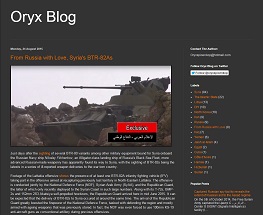
Spotlight on: Oryx Blog

Oryx blogFor those looking for images and information on armored vehicles in current battle zones such as Syria, Libya and Iraq, be sure to check out the Oryx Blog.  While the blog is not exclusively devoted to armored vehicles, there is quite a bit of content there on the topic.  Here are some posts that will be of particular interest to the AFV enthusiast.

Syria’s Steel Beasts: The T-62

Syria’s Steel Beasts: The T-72

Syria’s Steel Beasts: The T-55

Iranian fighting vehicles

The Republican Guard’s armour upgrades: Products of a Four Year War

From Russia with Love, Syria’s BTR-82As

Syria’s TURMS-T equipped T-72s

Inside the Chieftain’s Hatch: M56 Scorpion Part 2

World of tanks researcher Nicholas “The Chieftain” Moran has released the second part of his “Inside the Hatch” video on the M56 Scorpion self propelled anti-tank gun.

For those that missed part one of this series, here it is.

Man killed in AFV accident

2B9A027A00000578-0-image-a-3_1440344442785CBS news is reporting that a 55 year old man was killed in an accident involving a privately owned WWII era AFV in Fairfield California.  The accident occurred during a family reunion party on land owned by Herman Rowland, CEO of Jelly Belly. As part of the festivities, attendees were taking rides on Rowland’s collection of historic AFVs. California Highway Patrol says two men were riding in a 1944 M5 tank when the vehicle started going downhill. One of the men sitting on the front edge of the tank then fell off and was run over.  The name of the victim has not yet been released.

Rowland is a collector of historic AFVs and military vehicles, having purchased an  Abbot 105mm self propelled gun formerly part of the Littlefield collection last October. His collection also includes an M5 Halftrack, an M-561 Gama Goat, M113 APC, FV-603 Saracen APC and several wheeled vehicles.  The vehicle involved in the accident was reported as an M5 tank.  Images of the vehicle in question show a M5 High-Speed Tractor.

Article on Lt. Zvika Greengold, Hero of Yom Kippur War

badass-zvikaThe site Armored Warfare has posted an article about the exploits of Israeli Yom Kippur war tank commander Lt. Zvika Greengold.  Greengold was the commander of a Centurion tank in the Golan facing off against Syrian tank forces. In a series of battles over a 24 period, Greengold and his crew engaged and destroyed numerous Syian vehicles while completely outnumbered.  According to the article, it is not known exactly how many tanks Greengold destroyed but the estimates range from 20 to 40. He was awarded with the highest Israeli military award, the Medal of Valor, for his actions. He survived the war and left the military in 1974 with the rank of Captain. He went on to pursue a political career and today at 63 years old he is mayor of the city of Oakum in Israel.

Read the full article here. 

The Chieftain’s Hatch: Unmanned Patton

hatchlogoOver at his corner of the World of Tanks forum, Nicholas “The Chieftain” Moran has posted a new article about an attempt to make a remote control tank back in 1956.  The project involved an M48A1 tank equipped with a variety of video cameras, remote control devices and electronics at Aberdeen Proving Grounds.  A good number of pictures are included in the report.  As could be guess given the state of the technology of the day, the experiment was not all together successful.   All in all, a very ambitious project considering how new TV technology was in the mid 50’s.

Be sure to check it out at “The Chieftains Hatch.”

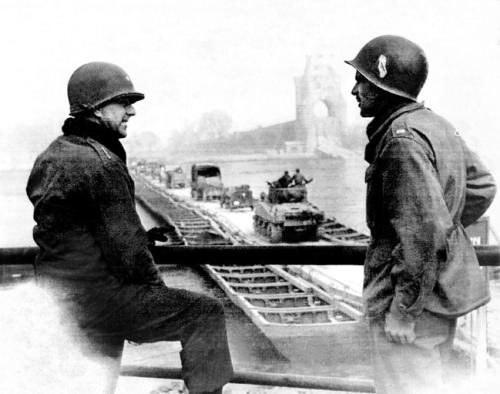
Column on General Devers

20150807__726402-s300-p1_500The regional history section of the York Daily Record (Pennsylvania) has posted a column about  local researcher Rich Robinson, working on a biography of General Jacob Devers.  Devers, also a resident of York PA, was head of the US Armor force during WW2, Robinson is quoted in the article saying “I would very much like to do him (Devers) justice in view of the way he has been maligned over the years but without making him some kind of one dimensional figure.”   Robinson will serve on a panel of Devers experts as part of a two -day event: “Quiet Streak of Lightning: York’s World War II General Jacob L. Devers.” That program is set for Nov. 6-7 at the York County Heritage Trust.  Renowned World War II historian Dr. Scott Wheeler will lead off the conference, presenting on his book: “Jacob L. Devers: A General’s Life.”  The full column can be read here.

From the Vault: M85 .50 Caliber Machine Gun

In honor of being declared the “blog of the month” over at The Firearms Blog (TFB), we will be posting about tank and afv related small arms this month.  A few days ago we posted about the not so successful M73/M219 7.62mm coax machine gun.  Today we will be taking a look at it’s larger cousin, the M85 .50 cal machine gun.  Much like the M73, the M85 had a very mixed reputation among US tankers.  It was intended to replace the venerable M2 .50 cal machine gun which had acquired an excellent reputation throughout WW2 and into the post war era.  However, the M2 was considered rather heavy and bulky for use inside the enclosed commander cupolas common on US postwar tanks.  By the time the M60 MBT was introduced, the M85 went into service, mounted in the commanders cupola/turret.  The M85 was also used by the Marine Corps in the LTVP7.  The M85 was almost 11 inches shorter and 20 pounds lighter than the M2 and featured a quick barrel change option and two different rates of fire.  The M85  could be configured for either left or right hand feeding and in its tank gun configuration was fired by means of a solenoid.  The M85 gun suffered from a history of reliability problems which it was never able to shake.  By the time the US adopted the M1 Abrams MBT in  the 1980’s, the M85 was replaced by the gun it was originally designed to supersede, the M2 .50 cal.  Oddly enough, while the M85 and M2 both fire the same .50 cal round, ammunition for the two weapons is not interchangeable due to the use of different style belt links.   According to globalsecurity.org, the USMC has in storage 3 million .50 caliber cartridges loaded in belts designed for the M85, despite the fact that they removed the gun from their inventory, replacing it on the LTVP7 series (now designated AAV-P7)with the M2.

PS Magazine article on the M85 (Issue #146 1965)

PS Magazine article on the M2 .50 cal (Issue #168 1966