It’s time to go see what’s been going on over at the Tank Archives.com blog. Here is a sample of the latest Russian language articles they have translated into English for your reading pleasure. Click on the headline to read the full article.
Czechoslovakian Dead End
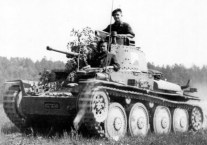 The greatest success of the Czechoslovakian tank industry was with light tanks. The LT vz. 35 and LT vz. 38 turned out to be excellent vehicles, used by several nations during WWII. Despite the fact that Skoda’s T-15 and Pz.Kpfw.38(t) n.A. did not make it past the prototype stage, the chassis of the latter was used for the Jagdpanzer 38(t) tnak destroyer. It is not surprising that, after the end of the war and start of work on the TVP medium tank, work on a new light tank began in parallel. The result of that work was several interesting prototypes, such as the TNH 57/900, Skoda T-17, and the amphibious Letak.
Frenchman in German Hands
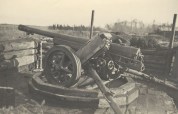 The belligerents in WWII had to improvise time and time again. Obsolete weapons, no longer suitable for their initial purpose, found surprising new applications. One of the most notable examples of such a “second life” is the German conversion of the French 75 mm Mle. 1897 field gun, as a result of which the 19th century weapon became an effective anti-tank gun.
Devourer of Tungsten
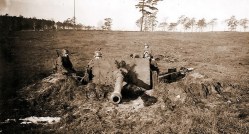 In late summer of 1942, the Red Army captured a German weapon that piqued the interest of the Red Army Main Artillery Directorate. This was the new German tapered bore 7.5 cm Pak 41. Several shells were captured along with the gun, which allowed trials to be performed and several characteristics to be determined. What was this gun, and what were the results of its trials in the USSR?
Adventures of the Centurion in Scandinavia
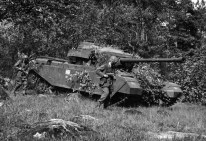 Despite Sweden’s goals to arm itself with domestic designs, foreign tanks in the Swedish army were not a rare sight. In cases when their industry was too slow or designers put out unsatisfactory results, the Swedish military made up the shortfall with foreign purchases. Recall that the Strv m/37, Sweden’s most numerous tank at the start of WWII, was actually the CKD AH-IV-Sv tankette. Later, the Swedes acquired the Strv m/41, a licensed copy of another Czechoslovak vehicle, the LT vz. 38.
The Swedish Army’s Tough Choice
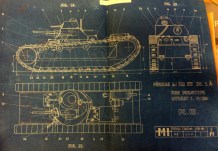 The time between the World Wars was that of rapid technical progress. Even tanks, a relatively new invention, could become obsolete quickly. Even though only several wealthy countries could afford a large number of the newest tanks for their armies, experimental vehicles and small batches cropped up in many nations. Sweden, who managed to retain neutrality during WWI, was among them. Its army was engaged in a lengthy and difficult search for a suitable tank.
British Tank for Soviet Infantry
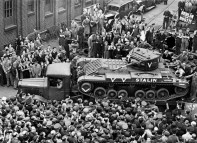 On September 29th, 1941, the first regular Arctic convoy departed from Britain to the USSR. It was indexed PQ-1. On October 11th, 11 transport ships arrived at Arkhangelsk, where they delivered 193 Hawker Hurricane fighters and other military cargo. Among it were 20 Matilda III and Valentine II tanks. So began the delivery of the Valentine tank, which became the most numerous British tank in the Red Army.
Infantry Sweet Spot
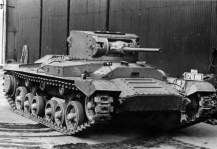 The Valentine infantry tank was the most common British tank of WWII. Like the Matilda, it didn’t last long as a front line tank in the British army, but commander versions and SPGs on the chassis made it to Germany. Its career in other countries was even more eventful. The Red Army used them until the end of the war, and they were widely used in the Pacific theater of war. In some nations, these tanks served as training tanks until the 1950s. What was the history of the creation of this extraordinary tank, and how did the first modifications of the Valentine serve?
Multiturreted Independence
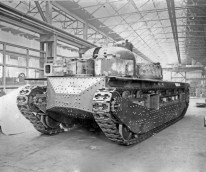 Towards the end of WWI, the French reached first place in the heavy tank development race. A little longer, and the FCM 2C would have seen combat. The French created the first breakthrough tank in the world, which combined powerful armament with armour that, at the time, could be considered shellproof. In addition, the French vehicle became the first multiturreted tank in the world, and its main turret was large enough for three men.
Heavyweight Brainstorming
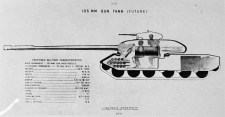 During the years of WWII, American industry made excellent light and medium tanks. SPGs built on their chassis were no less excellent. The only field where American engineers encountered misfortune was the development of heavy tanks. Although the Heavy Tank M6 was built, and even entered service, it was quickly left behind. The tank turned out to be too heavy and insufficiently mobile, without a place in American tank doctrine. Nevertheless, work on American heavy tanks never stopped, and projects like the Chrysler K kept coming.
Exhibit with a History
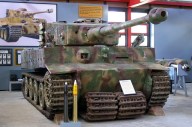 The German Tiger tank currently on display in Saumur is one of only six tanks of this type that survive to this day. Out of the six, the history of this one is the most interesting. This tank fought with two armies on both sides of the front, and had its own personal names.
Pz.Kpfw. Löwe: The German Lion
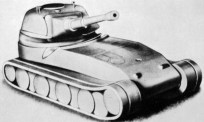 During the Third Reich, the German tank building school was defined, in part, by monsters such as the Maus and E-100. However, the German system of armament from the 1930s had no superheavy monsters like these, and no heavy tanks at all. In the second half of the 1930s, the plan was to have two types of light tanks and two types of medium tanks. How did Germany end up with monsters like the Pz.Kpfw. Löwe, and how were they developed?
 The US Marine Corps’ (USMC’s) two-pronged amphibious vehicle modernisation effort will include some significant survivability upgrades to its legacy AAV7 amphibious assault vehicles, and be complemented with a new personnel carrier with mine resistant ambush protected (MRAP)-levels of protection.
 German media reported on 16 November that only 95 of the 244 Leopard 2 main battle tanks (MBTs) in service with the Bundeswehr are operationally ready. A further 53 vehicles – thought to be Leopard 2A6Ms – are being converted to the new Leopard 2A6M+ standard, and 86 are in a state of disrepair without any spare parts. The German report states that “the unavailability of the required replacement parts would be detrimental”.
 The Ukrainian Ministry of Defence (MoD) has placed an order with the Kiev Armoured Plant for BTR-3DA vehicles, Ukraine-based industry sources reported on 30 October. The order is for an unknown quantity of BTR-3DA infantry fighting vehicles (IFVs), a locally developed upgrade for the BTR family of armoured fighting vehicles. The order follows a series of delays because of MoD concerns that the vehicle was not suitably priced.
 NEW DELHI — India has launched a $4.8 billion program for the domestic production of 1,770 multipurpose future ready combat vehicles by private companies partnered with overseas original equipment manufacturers, but some leaders in the local industry are hesitant about what they consider an overly ambitious program that lacks clarity.
 The Ministry of Defence has spent £381 million upgrading the army’s ageing infantry fighting vehicles even though half of them could now be scrapped to cut costs. Lockheed Martin was hired six years ago to overhaul and fit new gun turrets to Britain’s ageing fleet of Warriors, which have served in the Gulf, Bosnia and Iraq. But Ministry of Defence documents forecast the Warrior upgrade is a year behind schedule, with the programme incurring extra costs as a result of delays.
 The regiment, based at Tidworth in Wiltshire, has commemorated the anniversary of the Cambrai battle. Formed out of the Tank Corps, the tanks broke the stalemate of trench warfare in World War One. Lt Col Simon Ridgway said the soldiers “changed the course of the war” with their courage.
 Russia has boosted its arsenal of tanks and armored vehicles by more than 25,000 over the last half a decade, one of its deputy defense ministers boasted on Wednesday. Russia’s Deputy Minister of Defense and Army General Dmitry Bulgakov told army newspaper Krasnaya Zvezda: “Over the five years between 2012 and 2017, the army has received more than 25,000 units of new armored tank and automobile kit, as well as 4,000 modern items of rocket and artillery weaponry.”
 A Staffordshire Moorlands welder has helped TV presenter Guy Martin build a replica of a WW1 tank for the Armistice Day commemorations in France which marked 100 years since tanks were first used in battle. Welder Chris Shenton, from Leek, has been part of excavator giant JCB’s team to help TV personality Guy Martin to engineer a tribute to the role tanks played in helping change the course of the First World War.
 Tank and AFV News