The National Interest has posted an article about the Raytheon M60A3 Service Life Extension Program (SLEP). The article pretty much parrots the content of a video by Raytheon that was recently posted on youtube.
Frankly, the amount of media attention this upgrade program has gotten is somewhat surprising. M60 upgrade packages are by no means a new phenomena and many seem more impressive than what Raytheon is offering here. While the SLEP offers a substantial firepower increase, improvements to mobility and firepower seem modest. An increase to 950 HP is welcome, but without changes to the transmission and suspension, it is hard to believe that mobility will be increased to any substantial degree. It is possible that these other components are upgraded in the SLEP and simply are not mentioned in the video. Certainly, more impressive mobility upgrades have been offered in the past, such as the Super 60 offered by Teledyne Continental Motors way back in the early eighties. As for modern M60 upgrades, both the Israeli Sabra series and the Jordanian M60 Phoenix seem to offer as much or more than the SLEP. There is also the General Dynamics M60-2000 (also called 120 S), although this upgrade borders on being almost an entirely new tank (with a price tag to match.)

 The extensive modifications include the replacement of the original one-man BMP-1 turret, which was armed with a 73 mm 2A28 smoothbore gun, a 7.62 mm PKT co-axial machine gun (MG), and a KBM 9K11 Malyutka (Sagger) anti-tank guided weapon (ATGW) that was originally mounted on top of the main gun’s barrel.
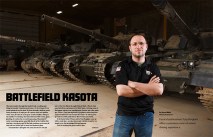 Kasota businessman Tony Borglum offers customers a one-of-a-kind driving experience.
 Turkey’s first indigenously-designed, third generation+ main battle tank (MBT), designated Altay, is ready for serial production, the Hurriyet Daily reports. Hurriyet cites Turkish military vehicles manufacturer Otokar, a branch of the Koç Group, the country’s top industrial conglomerate.
 The U.S. Army and Marine Corps will jointly test a so-called “active protection” system. These tanks and other armored vehicles will be fitted with an Israeli-developed system that shoots down and jams enemy anti-tank weapons. According to U.S. Naval Institute News, this will be the first test of Trophy on American equipment.
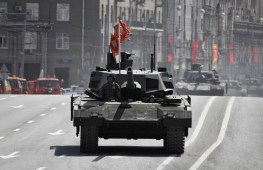 Uralvagonzavod is set to deliver the first batch of 100 operational T-14 Armata main battle tanks to the Russian Ground Forces between 2017 and 2018.
 “Whip” antennas—those long metal rods that used to extend from our cars—look pretty cool in a Smokey and the Bandit kind of way. But for military vehicles, they’re not such a great solution.
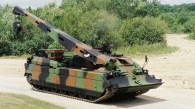 Nexter Systems is moving forward with the upgrade of the French Army Leclerc main battle tanks (MBT) and armoured recovery vehicles (ARV).
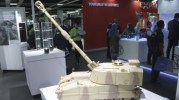 RUAG Defence has developed an enhanced version of the M109 155 mm self-propelled (SP) artillery system aimed at the export market. The company has already upgraded 348 Swiss Army M109sto the Pz Hb 88/95 standard, which represent the only SP artillery deployed by the Swiss Army. Among the improvements are a modified turret and the use of locally manufactured 155 mm/47 calibre chrome plated ordnance in place of the original 155 mm/39 calibre type. This offers an extended range and has a burst rate of fire of three rounds in 15 seconds due to the installation of a flick rammer.
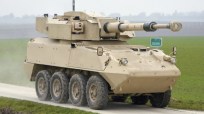 SAGEM is producing its Paseo modular advanced stabilised sighting (MASS) system for an undisclosed export customer. The Paseo MASS has already been shown fitted to CMI Defence Cockerill’s 3030/40 and 3105 turrets on a General Dynamics European Land Systems MOWAG Desert Piranha 5 8×8 armoured fighting vehicle (AFV). That fit features two Paseo MASS systems installed on the right side of the turret mounted one above the other, the top unit for the commander and the lower one for the gunner.
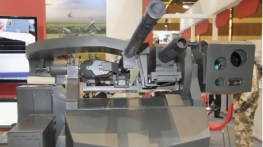 The Design Office Display of Belarus has developed a new version of its Adunok remote-controlled weapon station (RCWS) designated Adunok-W.
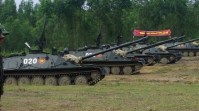 Officials from the Minotor-Service Corporation of Belarus attending the Defense Services Asia (DSA) 2016 exhibition told IHS Jane’s that Vietnamese officials had expressed “strong interest” in purchasing Minotor’s upgrade package for their ASU-85 airborne self-propelled anti-tank guns (SPATGs).


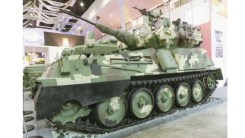 Malaysian army chief, General Raja Mohamed Affandi Raja Mohamed Noor, stated that the army plans to initiate an upgrade programme for its fleet of Alvis Vehicles Scorpion 90 light armoured fighting vehicles (AFVs) and Rheinmetall MAN Military Vehicles Condor 4×4 armoured personnel carriers (APCs) to enable them to continue operational service.
 As anti-tank threats are growing increasingly sophisticated, the Marine Corps is looking at protecting its ground vehicles with active protection and electronic warfare systems to fend off incoming rounds the same way ships and planes do today. Lt. Gen. Robert Walsh, deputy commandant for combat development and integration, said at a Senate Armed Services seapower subcommittee hearing on Wednesday that as technology proliferates, the anti-tank threat is rapidly evolving. The Navy is investing in protecting its ships and aircraft from similar threats, and Walsh said it’s time for the Marine Corps to take the same approach for its ground vehicles.
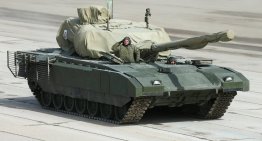 MOSCOW (Sputnik) – Russia produces 70 percent of all tanks produced worldwide, producing one tank per day, Uralvagonzavod General Director Oleg Sienko said.
 Prowling through a river, these are South Korea’s Black Panther tanks that can move effortlessly through 14ft of water thanks to a special ‘snorkel’. The £6million armoured vehicles were put though their paces in an underwater exercise across the South Han River in Yeoju, east of Seoul, today.
 Tanks are being designed with controls that look like a PlayStation gamepad in a bid to encourage video game obsessive to join the army . The new British Challenger II’s firing mechanism is based on the Sony handset in order to make it instantly recognisable to new recruits.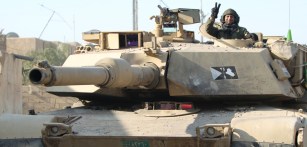

 Tank and AFV News