The blog Below the Turret Ring has been busy lately, having made several new posts. Let’s take a look at what they have been up to. Click on the title to read the full post.
Austria won the Strong Europe Tank Challenge 2017
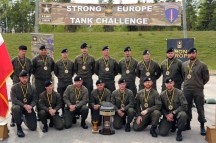 Two days ago the Strong Europe Tank Challenge (SETC) 2017 ended. The winning platoon comes from Austria, one of the first time participants. The soldiers of the Austrian Bundesheer deployed the 1980s’ Leopard 2A4 main battle tank (MBT), beating last year’s winner Germany. In the challenge held from 8th to 11th of May, teams from Austria, France, Germany, Poland, the Ukraine and the United States tried to show their skill in a number of different disciplines. These included offensive actions, defensive actions, target recognition/identification of thirty allied and enemy targets, estimating the range to a target without using the laser rangefinder, accurately reporting targets in a simulated urban area and firing crew weapons (pistols or submachine guns). Also part of the SETC was to recover a tank with simulated damage from an NBC attack, evacuating and treating wounded, calling for fire support by artillery/aircraft and precision driving along a pre-defined track. Crews also had to endure a physical fitness test. In comparison to last year the scoring was changed.
New Turkish combat vehicles presented at IDEF 2017
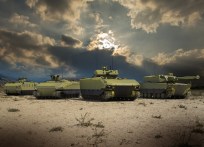 The thirteenth International Defence Industry Fair (IDEF 2017) has been held in Turkey. While not extremely popular with foreign companies – despite having “international” in the name, not many international AFV manufacturers were present – this exposition serves as an opportunity for all Turkish defence companies to present their latest and greatest developments. The company FNSS Defence Systems, a joint-venture of the Nurol Holding and BAE Systems, has presented a number of vehicles from the wheeled PARS family of vehicles (FoV) and the tracked Kaplan-20 and Kaplan-30 armored fighting vehicles (AFVs).
Leopard 2: Poland wants more; Germany and Turkey opt for upgrades
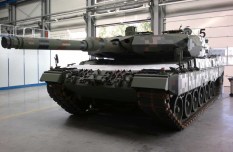 According to a news report from Defence24.com, the Polish Army is interested in buying more Leopard 2 main battle tanks (MBTs). Poland originally received 128 Leopard 2A4s for an extremely low price, a decision made in Germany in order to build up better political relationships between the two countries, which previously due to the second World War and previous conflicts had been terrible. A further 119 Leopard 2 tanks (including 105 relatively modern Leopard 2A5s) were ordered in 2013, after Germany (falsely) decided to downsize it’s tank force. These second-hand tanks also were extremely cheap, costing only €180 million.
Russian T-72B3 receive armor upgrades
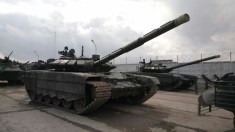 The Russian Army has decided to upgrade the current T-72B3 to a new configuration, which was first seen in the middle of last month. The exact number tanks upgraded has not been disclosed yet. The tank has been called “T-72B3M” or “T-72B4” by different websites, suggesting that the new designation may also not have been revealed yet. It might be known as “T-72B3 mod. 2016” rather than receiving a completely new designation. The upgrade is aimed to improve the survivability of the tank by installing explosive reactive armor (ERA) at the flanks of turret and hull. This armor is apparently identical to that used on the current version of T-90MS “premium” export tank. This reactive armor is not known to provide protection against kinetic energy ammunition such as APFSDS rounds nor against anti-tank guided missiles (ATGMs) or rocket-propelled grenades (RPGs) with tandem shaped charge warhead.
 This past weekend saw the Strong Europe Tank Challenge event take place in Grafenwoehr, Germany. Tank crews from six NATO or NATO-allied countries competed in a series of tests to prove which crew (and vehicles) were the best. The competing nations included the USA, France, Germany, Poland, Austria and Ukraine, each country entering a platoon of four tanks and crews. The inclusion of Ukraine marked a first time for that country in the competition, as well as for their T-64BV tank. The competition was won by Austria, whose crews were operating Leopard 2A4 tanks. Second place was taken by German tankers in Leopard 2A6 tanks. Third place was awarded to the US platoon and their Abrams M1A2 SEP tanks. Poland operated Leopard 2A5 tanks and France had their LeClerc MBT. Stars and Stripes noted that Poland, France and Ukraine all scored close to the top three countries, making for a tough competition.
 Russia displayed the first of 150 upgraded T-72B main battle tanks (MBTs) at the 5 May Victory Day Parade in Moscow. Under a 2016 contract with UralVagonZavod the MBTs are to be brought to what the Russian Ministry of Defence has referred to as the T-72B3 standard, although the upgraded tanks feature a number of differences to the existing T-72B3 standard, being variously reported under the designations T-72B3M and T-72B4. It is possible the MBTs will not receive a full type designation and will instead use a year designator, potentially T-72B3 obr.2016, or a minor modification designation such as T-72B3-1.
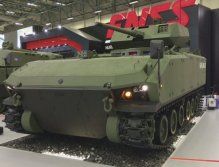 Turkey’s FNSS unveiled a version of its Kaplan tracked armoured vehicle armed with a 30 mm gun at the country’s IDEF 2017 exhibition, held in Istanbul on 9-12 May. The medium-calibre armament is designed to allow the new vehicle to operate alongside main battle tanks (MBTs). The Kaplan-30 Next Generation Armoured Fighting Vehicle (NGAFV) is fitted with an FNSS Teber-30 turret housing a 30 mm Orbital ATK Armament Systems MK44 dual-feed automatic cannon and 7.62 mm coaxial machine gun.
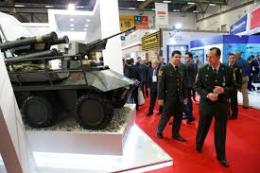 ISTANBUL — Increased insurgency-related violence in Turkey and more turmoil in regional conflict zones have led to a surge in competition among Turkish armored vehicle producers. A United Nations report on human rights in southeast Turkey says about 2,000 people were killed in security operations in the area between July 2015 and December 2016. The report also estimates between 355,000 to 500,000 people are displaced in the area.
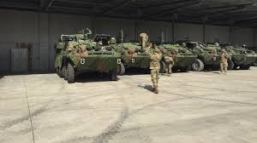 STOCKHOLM — A U.S. Army cavalry regiment in Germany is testing a Stryker upgrade that could increase the vehicle’s survivability as the service conducts training exercises in Europe meant to deter Russia. Soldiers from the Army’s 2nd Cavalry Regiment, stationed in Vilsek, Germany, have installed Saab’s mobile camouflage system, or MCS, on four of its Strykers, said Scott Caldwell, the company’s director of marketing and sales for its Barracuda business unit.
 Aselsan has partnered with the General Directorate of Military Factory (AFGM) to upgrade two of the Turkish Army’s M60T main battle tanks (MBTs) with enhanced survivability. The effort follows the service’s disastrous Euphrates Shield operation in Syria, where a number of its MBTs were destroyed or damaged. Turkey took delivery of 170 upgraded M60T MBTs which were originally updated by Israel Military Industries (IMI), with most of the work carried out by the 2nd Main Maintenance Centre Command at Kayseria. The command has extensive experience with upgrading and overhauling MBTs and other tracked armoured fighting vehicles.
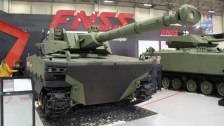 FNSS Savunma Sistemleri has unveiled the first prototype of the Kaplan MT Modern Medium Weight Tank (MMWT) at the IDEF 2017 exhibition. The vehicle under joint development by FNSS and Indonesian defence prime PT Pindad to meet the potential requirements of Indonesia, using internal research and development funding under an agreement signed in 2014.
 COLOGNE, Germany — The German Army is in line for an upgrade of its tanks, based on the expectation that future conflicts will rely heavily on ground warfare with armored vehicles. All told, the Bundeswehr stands to get 104 used Leopard 2 battle tanks out of storage that manufacturer Krauss-Maffei Wegmann will upgrade under a contract with the German Defence Ministry from the A4 configuration to the newest A7V standard. The latest package includes improvements in the areas of information technology, armaments and armor.
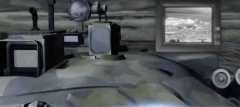 In 2016, the Krasnogorsk plant finished tests of the heat-vision sighting system Irbis for modernized tanks T-80U and T-90. The sights will be supplied to the army after 2017 under the already concluded contract, says the manufacturer’s annual reporting. According to the experts of Mil.Today, commissioning of the new sight will for the first time give Russian tankers a homemade thermal vision device based on the mercury-cadmium-telluride (MCT) matrix, which will bridge a gap between the leading NATO countries in this area.
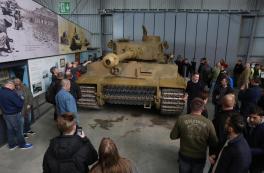 THOUSANDS of people visited The Tank Museum today for an event which included two restored World War Two tanks which featured in Brad Pitt’s blockbuster movie ‘Fury’.
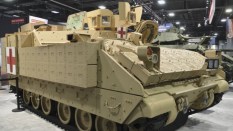 The armed forces of the United States of America are running a number of projects to modernize the land vehicle and amphibious vehicles during the next few years. The Armored Multi-Purpose Vehicle (AMPV), based on a modified Bradley chassis, will replace the obsolete M113 (not called Gavin) in the Army’s inventory. The AMPV features enhanced protection against mines and improvised explosive devices (IEDs), a total of 2,907 AMPVs will replace the M113-based vehicles as general-purpose vehicles, mission command vehicles, mortar carriers, medical evacuation and medical treatment vehicles in the US Army’s Armored Brigade Combat Teams (ABCTs). On the long run a further 1,922 AMPVs might be procured, if the M113 should be replaced at brigade level (and lower) on a one-to-one basis by the AMPV.
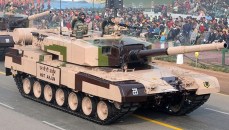 NEW DELHI — The Indian Army is seeking major structural and design changes in the homegrown Arjun Mk-2, but the state-owned Defence Research and Development Organization says the “changes” could take up to seven years, causing a delay in the induction schedule. The service wants DRDO to redesign the hull, the turret structures and use newer material to reduce the tank’s weight. The Arjun Mk-2 currently weighs about 68.6 tons, compared to the 62-ton Arjun Mk-1 tank currently in operation with the Army. The Mk-2 version’s weight makes it inappropriate for operations in the semi-developed sector of the western front bordering Pakistan where tank battles would take place, according to an Indian Army official.
 MOSCOW — Russia’s largest state-owned defense industry holding, Rostec, is set to become even larger. The company has announced plans to take ownership over UralVagonZavod, a subsidiary of the Tractor Plants Concern specializing in military vehicles like tanks and other armored platforms, according to a statement provided to Defense News. Rostec is an umbrella corporation founded in 2007 to begin consolidating and reforming disparate elements of the Russian defense and high-technology base. It is run by Sergey Chemezov, who is reportedly a close friend of President Vladimir Putin. Under Chemezov’s charge, Rostec has taken about two-thirds of Russia’s defense industry under its wing.
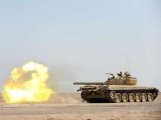 The US Army just put out an invitation for bids on building a modification for Humvees to make them look like Russian T-72 tanks. The invitation for bids states that the mods will help the Army simulate realistic battle scenarios in training. The solicitation also mentions MILES/TESS quite a few times, suggesting the fake tanks will be likely used for Multiple Integrated Laser Engagement System/Tactical Engagement Simulation System — the military’s version of laser tag.
 In another first for the Marine Corps, 2nd Lt. Lillian Polatchek graduated at the top of her class from the Army’s Armor Basic Officer Leaders Course, making her the Corps’ first female tank officer. “I’m just sort of looking at it as another Marine graduating from this course,” Polatchek described her accomplishment in a Defense Department video. She will now serve with the 2 nd Tank Battalion at Camp Lejeune, North Carolina. Polatchek’s graduating class contained 67 students, five of whom were Marines, a Defense Department news story says.
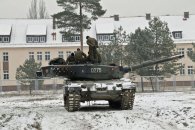 The Polish Ministry of National Defence (MND) has decided to relocate two of its newest tank battalions from the country’s western border to strengthen units stationed in the east. The Leopard 2A5 MBTs of the 34th Armoured Cavalry Brigade (part of the 11th Armoured Cavalry Division) based in Zagan have been moved to the 1st Tank Brigade (part of the 16th Mechanised Division) based in Wesola: a city close to Poland’s capital, Warsaw. While the first tanks began arriving at the beginning of April, the training of drivers, gunners, and commanders has been under way in Wesola since January.
 Aberdeen Proving Ground invites the community to join us as we celebrate the APG Centennial with a live fire demonstration hosted by the U.S. Army Test and Evaluation Command’s Aberdeen Test Center. See tanks, vehicles, small arms and more! FREE & OPEN TO THE PUBLIC!!! Bring the family! Open to children ages 5+.
 Having settled into their nine-month deployment to Europe, members of the 3rd Armored Brigade Combat Team from the US Army’s 4th Infantry Division are making a slight update to their vehicles. Earlier this month, the first M1A2 Abrams tank with a woodland green paint scheme appeared in Europe, signaling the unit’s shift to a camouflage scheme more appropriate for its new surroundings than the desert tan colors previously used.
 The Royal Thai Army (RTA) has cut the number of Chinese VT-4 battle tanks it wants to buy from 98 to 60 due to insufficient funds, army chief Chalermchai Sittisat said Thursday. Gen Chalermchai said the 60 new tanks will be divided equally between the 2nd and 3rd Cavalry Battalions in the northeastern provinces of Udon Thani and Khon Kaen. The new tanks will replace US-made M-41 models which will be decommissioned after having been in service for more than 40 years, he said.
 . As the service works on expediting interim solutions for combat vehicle Active Protection Systems, officials are simultaneously ramping up some of the first MAPS tests using soft-kill countermeasures. There is also a plan to begin using the first prototypes of a common controller toward the end of the year. Once the common controller is available, the Army will begin “layered testing,” mixing both soft-kill and hard-kill countermeasures, Col. Glenn Dean told Defense News in a March 27 interview at the Detroit Arsenal in Michigan.
 MADRID – Spain plans to acquire 348 “Piranha 5” 8×8 wheeled armored fighting vehicles from General Dynamics European Land Systems (GDELS) in a first phase of purchase, Secretary of State of Defense Vicente Conde told the national Congress. He also added that in other phases of acquisition the total number of units for the Spanish Army could be around 1,000. The Spanish defense ministry’s No. 2 leader said that the total estimated budget of this program will be €3.8 billion (US $4 billion): €1.6 billion (US $1.7 billion) for the acquisition itself and €2.2 billion (US $2.4 billion) for the maintenance and modernization services during the 30 years of useful life of the program.
 WASHINGTON (Sputnik) — The armored vehicles will help Latin Americans to fight some ‘illicit networks’ operating within state borders and threatening local governments, according to the US Southern Command. “The threat from ‘illicit networks’ in Latin America continues to grow,” US Southern Command Deputy Commander Lieutenant General Joseph DiSalvo stated in the release. “And armored vehicle modernization efforts by partner nations there will play a part in combating the threat.” Potential clients include Peru, which may soon finalize a sales deal with the United States to purchase Stryker vehicles, the release noted.
 Russia in considering upgrading future T-14 main battle tnks to use the 2A83 152 mm gun instead of its current 2A82 125 mm gun. The 2A83 gun has a high-speed APFSDS shell with a 1,980 m/s muzzle velocity, only dropping to 1,900 m/s at 2 km. However, Russian engineers have so far kept the 125 mm-size gun, assessing that improvements in ammunition could be enough to increase effectiveness, while concluding that a larger bore weapon would offer few practical advantage. Russia is both miniaturizing the nuclear warheads and using sub-kiloton low-yield warheads. Battlefield nuclear weapons could be pared with the larger tank gun.
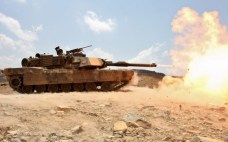 The U.S. Army boasts a motorpool stacked to the rafters with 6,000 M1 Abrams main battle tanks — more tanks than some countries have soldiers. Yet for some crazy reason, Congress keeps buying more. Actually, the reason isn’t totally crazy. The U.S. only has one factory left that’s totally dedicated to the production of main battle tanks — General Dynamics’ (NYSE:GD) factory in Lima, Ohio. Sporadic demand from tank-buyers, however, keeps this factory always on the edge of having to shut down operations — at which point the U.S. wouldn’t be able to build tanks if it suddenly needed to. (A shutdown would also cost jobs in an important Congressional district.)
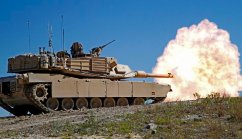 U.S. tanks are now roughly on par with Russian tanks, according to a top general, and the American military doesn’t have the technology to recover its former advantage. “I would not say that we have the world class tank that we had for many, many years,” Lieutenant General John Murray said during a Senate Armed Services subcommittee hearing on modernizing the Army. “I’ll be the optimist and say that we’re at parity with a lot of different nations.”
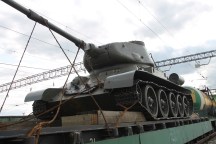 Russian authorities have slapped a three-year suspended sentence on a Moscow man for trying to smuggle a World War II-era tank into neighboring Kazakhstan, state news agency Itar-Tass reports. The man—whose name federal authorities did not divulge—obtained a Soviet Т-34-85 circa from 1945, from a Latvian citizen at the bargain price of €20,000, but planned to sell it off to a buyer in Kazakhstan for more than 10 times that amount.
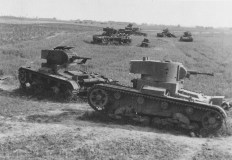 A thousand coffee table books and countless hours of popular history programs have described the Battle of Prokhorovka, part of the Third Reich’s 1943 Operation Citadel, as the largest tank battle in history. Near the city of Kursk on the Eastern Front, hundreds of Soviet tanks slammed into the 2nd SS Panzer Corps in an enormous conflagration of flesh and metal. Prokhorovka was certainly an important clash and one of the largest tank battles ever, but it might be time to retire its description as the biggest — a claim which has been seriously questioned in recent years by historians with access to Soviet archives opened since the end of the Cold War.
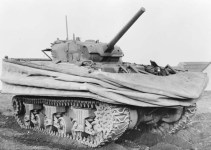 If you’ve seen the blockbuster movies The Longest Day (currently on Netflix) or Saving Private Ryan, a big part of the story is how infantry fought through the obstacles on Omaha Beach (the wisdom of sending two divisions into that meat-grinder can be debated at another time). But the lack of tank support wasn’t part of the plan. In fact, it was one hell of an instance where that notorious and unwelcome Murphy’s Law put in an appearance, costing the infantry some much-needed support. It would have been their secret weapon: the Dual-Drive, or DD, tank.
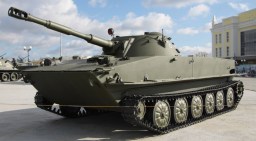 The PT-76 seems like a minor oddity of the Cold War — a Soviet amphibious light tank with thin armor and an unimpressive gun. Certainly it seemed bound for rough treatment on modern battlefields full of heavy weapons and heavier tanks. But the floating PT-76 chalked up a remarkable record, carrying knife-wielding Himalayan soldiers into battle, sinking gunboats on the Ganges Delta, dueling powerful U.S. Patton tanks in Vietnam, and launching amphibious surprise attacks on both sides of the same Middle Eastern war. The first article in this two-part series will look at the origin and characteristics of the PT-76, the nasty shock it gave U.S. forces in Vietnam, and the historic countermeasure used against it.
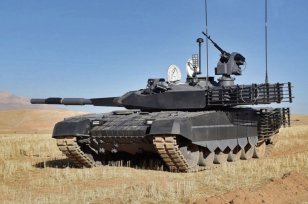 Iran has revealed to the public their new “Karrar” main battle tank. As can be expected, Iranian government sources have described the new vehicle in rather glowing terms, while releasing few details. According to
 Tank and AFV News