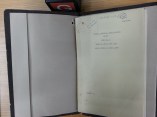
 Today we present a British study from December of 1947 on ‘Motion Studies of German Tanks.” This report examines the ergonomics of late WW2 German tanks Tiger, Tiger II an Panther. The report focuses on crew comfort and efficiency, looking at each crew position and providing analysis. Detailed charts of gun loading times are included in the report, as are diagrams of the ammo storage layout. This report was photographed at a archive by a friend of the site. We have put the report into a PDF and posted it on Internet Archive. The quality of the photos varies, although the report is legible. Due to the way it was photographed, many of the pages are at a bit of an angle.
From the Vault: British Motion Studies on German Tanks
December 22, 2015 by Leave a Comment
Iran to purchase Russian T-90 tanks
December 21, 2015 by Leave a Comment
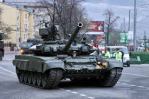 Numerous news sources are reporting that Iran intends to purchase T-90 main battle tanks from Russia. This acquisition would be a significant upgrade for Iranian armored forces which rely on a variety of outdated and heavily modified older AFVs.
Links to articles:
Iran Pulse: Iran’s military bulks up with new Russian tanks
Tass: Iran intends to buy Russian T-90 tanks
Currently, Iran maintains what is probably the most eclectic collection of tanks of any nation, including Soviet designed T-54/55, T-62 and T-72s, Chinese Type 59 and Type 69, the British Chieftain (referred to as Mobarez with modifications), the US M-47 and M-60 (heavily modified M-47 called Sabalan) and the indigenous Zulfiqar MBT 1, 2, and 3.
Tank Chats #12 TOG II*
December 18, 2015 by Leave a Comment
The Tank Museum has released another installment in the “Tank Chats” video series featuring David Fletcher. This episode takes a look at the TOG II tank housed at Bovington Tank Museum.
Description:
This enormous tank was designed on the premise that World War II would evolve in the same way as the First World War. Some believed that existing tanks would not be able to deal with such conditions, and one of the most influential was Sir Albert Stern, who had been secretary to the Landships Committee in the First World War. In company with many others involved in tank design in 1916, including Sir William Tritton, Sir Eustace Tennyson D’Eyncourt, Sir Ernest Swinton and Walter Wilson, Stern was authorised by the War Office to design a heavy tank on First World War principles.
Two prototypes were built, both known as TOG for The Old Gang and they were even manufactured by the company that built Little Willie and the first tanks in 1916, William Foster & Co. of Lincoln.
Armor for the Ages Tiger II article and gallery
December 18, 2015 by Leave a Comment
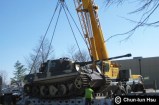 The Armor for the Ages website has posted a new article on the history of the Tiger II tank that was stored at Aberdeen Proving Grounds for many years until it was restored at the Patton Museum in 1992. This vehicle currently resides at Fort Benning. The article includes links to four photo galleries which show the vehicle at various stages of the restoration process. German armor fans are sure to find these galleries of interest.
General Dynamics wins contract to make Abrams SEPv3 pilot vehicles
December 17, 2015 by Leave a Comment
According to a recent press release, General Dynamics Land Systems a contract worth $92.2 million to produce six examples of the M1A2 SEPv3.
The U.S. Army TACOM Lifecycle Management Command has awarded General Dynamics Land Systems a $92.2 million contract to upgrade M1A2 System Enhancement Package (SEP) v2 Abrams tanks to the M1A2 SEP Version 3 (v3) configuration. General Dynamics is working closely with the Army to improve the survivability, maintainability, fuel efficiency, power generation and network capability of its fleet of Abrams Main Battle Tanks.
“Projected for full rate production within the next two years, the Abrams M1A2 SEPv3 will provide the Army with the tank they need to dominate the battlefields of the future,” said Donald Kotchman, vice president of Tracked Combat Vehicles for General Dynamics Land Systems.
The M1A2 SEPv3 production process will begin with a pilot program of six tanks before moving into full-rate production.
Work will be performed by existing employees in Anniston, Ala.; Tallahassee, Fla.; Lima, Ohio; and Scranton, Pa.
Lithuania selets Boxer IFV
December 17, 2015 by Leave a Comment
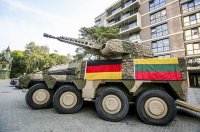 Jane’s is reporting that Lithuania has selected the ARTEC Boxer 8×8 to become their new infantry fighting vehicle (IFV). This news contradicts reports from early November which indicated that Lithuania was leaning toward the purchase of the General Dynamics Styker 8×8. Lithuania plans to buy 88 Boxers, including 84 in an IFV configuration and four command post variants. It is reported that Lithuania has decided to use the UT 30 Mk 2 turret offered separately by Elbit Systems to arm these vehicles. The turret will be armed with a 30 mm cannon and Spike-LR anti-tank guided missile launchers. Delivery of the first 14 Boxer IFVs should be made to the Lithuanian Land Forces in the second half of 2017. All 88 vehicles are to be delivered by the end of 2019. The worth of the purchase is almost equal to Lithuania’s entire defence budget for 2015, which stands at EUR 425m. Next year, however, military spending is going up to EUR 575m.
Book News: The History of the Panzerwaffe
December 15, 2015 by Leave a Comment
 Earlier in the year we posted that the book “The History of the Panzerwaffe Volume 1: 1939-1942” by Thomas Anderson would be released on October 20 of this year. That date has been pushed back to December 17, 2015 according to the Osprey Publishing website. Thomas Anderson has written several hardcover books for Osprey on German WW2 Armor. This new book promises to be a substantial work, coming in at 304 pages. And just in time for Christmas for all those Panzer fans out there.
Publishers Description:
ABOUT THIS PRODUCT
The Germans transformed armoured warfare from a lumbering and ponderous experiment in World War I into something that could decide the outcome of conflicts. This technical and operational history is the definitive guide to the legendary Panzerwaffe, from its very infancy to the days when it made Europe its garden path at the height of Nazi German power. With rare and revealing combat reports, along with photographs sourced from previously unseen private and archival collections, it uncovers the technical and operational stories of the formidable armoured beasts that formed the backbone of the German war machine – tanks such as the Panzer I, II and 38(t).BIOGRAPHICAL NOTE
A German national, Thomas Anderson is a specialist in German armored fighting vehicles of World War II. He has spent decades researching in archives throughout Germany and the rest of Europe to discover little known facts and never previously published photographs of the might of the Panzerwaffe. A modeler, he regularly contributes to popular modeling and historical magazines across the globe including Military Modelcraft International (UK), Steel Art (Italy), Historia Militar (Spain) and Batailles & Blindes (France) as well as many others.CONTENTS
1 Laying the foundation – pre-war establishment 2 The seizure of Czechoslovakia – backing the Panzerwaffe 3 Poland – the ordeal 4 France – at eye level 5 The Balkans – the unwanted campaign 6 Russia – an overmighty opponent? 7 1942 – upgrading the Panzers 8 North Africa – defeat instead of superiority 9 Dark prospects – Waiting for the new tanks 10 Tank recovery and repair 1935-42
From the Vault: The Interphone System in Armored Vehicles
December 15, 2015 by Leave a Comment
Today we present an article from the July-Aug 1946 issue of ARMOR titles “The Interphone System for Armored Vehicles” by Lt. John Heran. This piece explains the operation of the interphone system in US WW2 era tanks. It includes a list of terms used by tankers of the period.


Inside the Chieftain’s Hatch: Achilles Part 2
December 15, 2015 by Leave a Comment
Here is part 2 of the “Inside the Hatch” video series look at the British Achilles variant of the M10 tank destroyer.
Nicholas Moran continues his tour of the Achilles tank destroyer, built on the basis of the American M10. Today, he’s talking about the tank interior and crew member positions. Why can this vehicle be considered the best of its type for its time? What difficulties did the gunner face? What’s the simplest way for the driver to get to his position? You can find answers to these questions and more in the new episode of “Inside the Chieftain’s Hatch.” Happy viewing!
Book review of Tanks in Hell
December 14, 2015 by Leave a Comment
 The Spectrum has published a review of the new book by Oscar Gilbert and Romain Cansiere, Tanks in Hell: A Marine Corps Tank Company on Tarawa. This book was published earlier this year by Casemate. Oscar Gilbert is the author of several books, with a focus on US Marine Corps armor.
Book Review excerpt:
Charlie Mason’s tank was inching its way toward a Japanese pillbox when incoming machine-gun fire sprayed his M4A2 Sherman, he remembered, “like hail on a tin roof.”
Mason’s tank, the CONGA, was part of Charlie Company, 1st Corps Medium Tank Battalion. Its job was to silence enemy strongpoints that acted as scythes against the lightly armed Marines invading the beaches of Tarawa.
After a bit of cat and mouse, CONGA fired and obliterated the Japanese pillbox. The victory, however, was short-lived. Later that day, CONGA was knocked out of action.
So it went for armor on Tarawa during World War II.
In the new book Tanks in Hell: A Marine Corps Tank Company on Tarawa(Casemate, $34.95), authors Oscar E. Gilbert and Romain Cansiere paint a vivid description of combat inside what was often referred to as “steel coffins.” And while writing about the fighting in the Gilbert Islands is not uncommon, focusing a book specifically on a single tank company on Tarawa is.

 Tank and AFV News