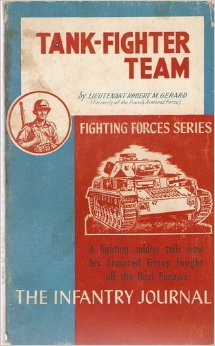
 Today we present the book “Tank-Fighter Team” by Lieutenant Robert M. Gerard. Published in 1942 by the Infantry Journal, this book is an account of tank combat during the Invasion of France in 1940 written by Lt. Gerard, a French commander of a Somua S35 tank. The book tells of how Lt. Gerard and his unit were committed to battle against German tanks as part of a rearguard action, protecting the retreat of a French Infantry division. Following the fall of France, Lt. Gerard was able to escape to the United States where he helped train U.S. soldiers at Fort Knox in the basics of tank combat. This book should prove interesting to those looking for a first hand account of tank combat in France. This book is in the public domain and can be viewed here.
From the Vault: Tank-Fighter Team by Robert Gerard
Book Alert: T-64 Battle Tank
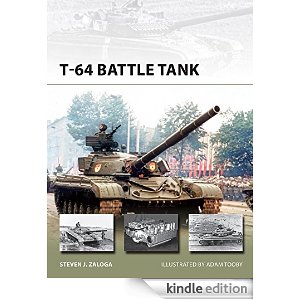 According to Amazon, Osprey Publishing will be releasing a new entry in their New Vanguard line of books titled T-64 Battle Tank on August 18. Authored by Steven Zaloga, this volume completes the coverage of cold war Soviet main battle tanks in the New Vanguard Series (Osprey already published books on the T-54/55, T-62, T-72 and T-80.) The format appears to be the same as the other entries in the NV series and since Steven Zaloga authored the other other NV books on cold war Soviet tanks, readers should have a good idea what to expect from this upcoming book. It is perhaps fortuitous that Osprey waited to cover the T-64 last in this series, since the tank finally saw it’s first use in combat this past year in the crisis in Ukraine.
Publishers description:
The T-64 tank was the most revolutionary design of the whole Cold War, designed to provide the firepower and armor protection of a heavy tank in a medium-weight design. It pioneered a host of sophisticated new technologies including laminate armor, stereoscopic tank rangefinders, opposed-piston engines, smooth-bore tank guns with discarding sabot ammunition, and gun-fired guided projectiles. These impressive features meant that the Russians were loath to part with the secrets of the design, and the T-64 was the only Soviet tank type of the Cold War that was never exported.
Written by an armor expert, this detailed technical history sheds light on the secrets behind the Cold War’s most controversial tank, revealing how its highly advanced technologies proved to be both a blessing and a curse.
Italian tankettes in Ethiopia
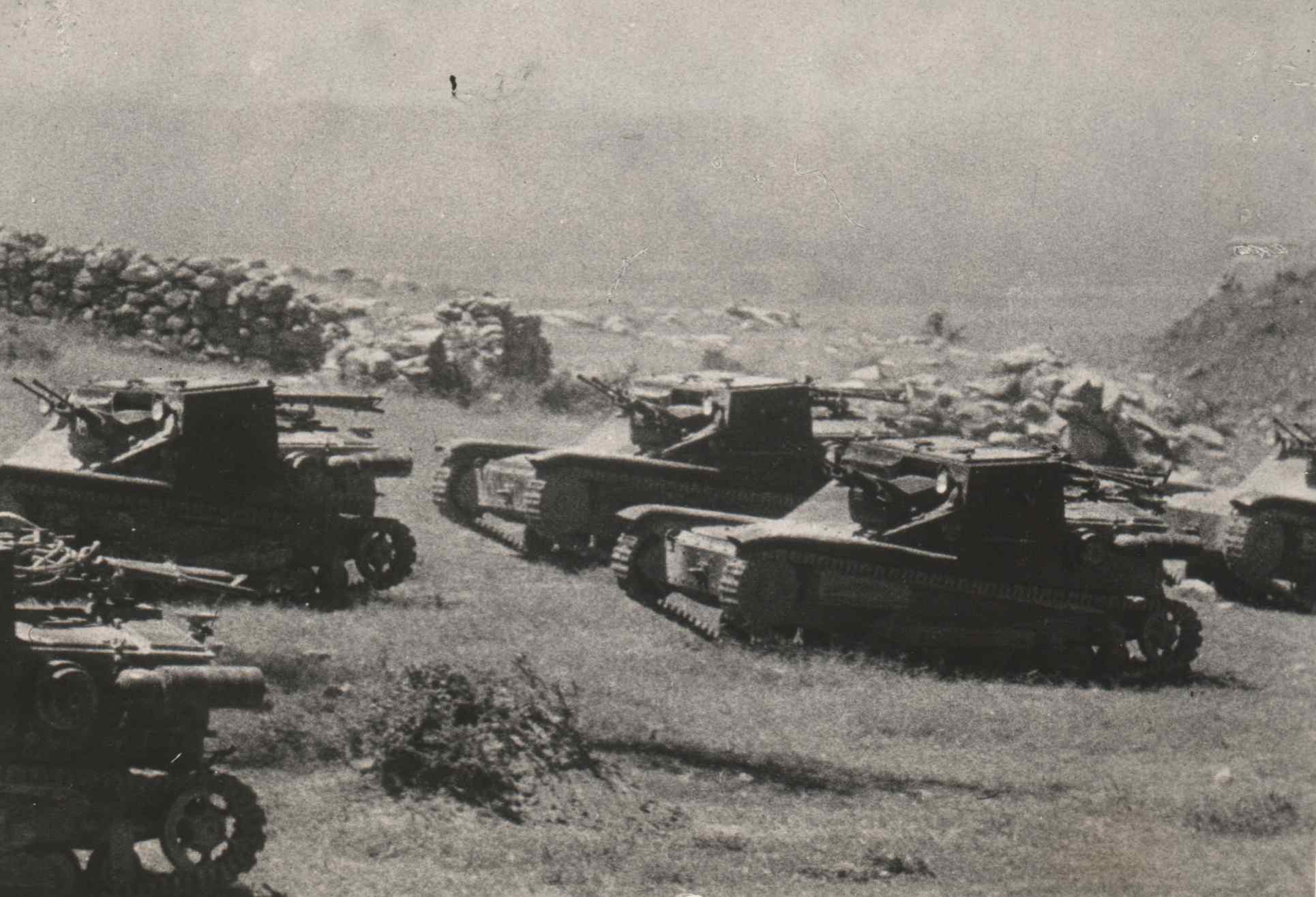
Overlord’s blog has a post titled “Sticks and Stones” about the battle Dembeguina Pass during the Italian invasion of Ethiopia in 1935. The Italian forces in this particular encounter were armed with the CV-35 tankette. The article has some interesting examples of how ineffective these little tanks could be:
One Ethiopian soldier whom had been one of the lead element was armed with nothing more than a sword. His name was Tashemm. His rank was Balambaras, which has no real equivalent that we might recognise. It essentially means he was a trusted person. Tashemm crawled out of the tankettes line of fire and moved round behind it. Sneaking closer he concocted his plan. He climbed up on the rear of the tank and hammered on the hatch with his sword pommel yelling in Italian “Open! Open!”. Immediately the crew of the CV-35 opened their hatches with fatal results.
You might ask why the Italians opened up their hatches. The answer is these simple machines lacked radio’s and so had to communicate by word of mouth. At another battle later in the war a large number of tankette crews were killed and wounded simply because they had to open their hatches to communicate.
Army awards contracts for FFV (Future Fighting Vehicle) designs
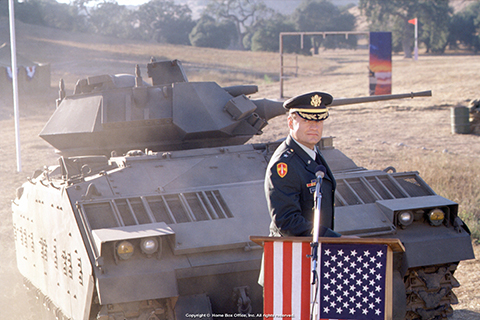 Defense News is reporting that the Pentagon has awarded contracts worth more than $28 million each to BAE Systems Land and Armaments and General Dynamics Land Systems as part of the FFV (Future Fighting Vehicle.) The article describes the FFV program as a design contract that could yield a Bradley replacement or technology spin-outs to upgrade the Bradley. The FFV program is being described as a more pragmatic approach, as opposed to the failed Ground Combat Vehicle and the Future Combat Systems programs of the last two decades. Commented Army Chief of Staff Gen. Ray Odiemo, “One of the problems we’ve had in the past with our major programs is that we tried to build the perfect vehicle. The requirements were so high they were difficult, they took a lot of time, they were over-budget, and we couldn’t meet them.” The article notes that the work is due Nov. 28, 2016.
Rheinmetall, PBZ to develop reconnaissance vehicle
 Defense News is reporting that Germany’s Rheinmetall has teamed up with the state-run Polish Armaments Group (PGZ) to develop a new armored vehicle for Poland’s military. The two partners have agreed to develop a six-wheel-drive armored vehicle that will meet the requirements of the Polish Army’s LOTR [light armored reconnaissance vehicle] procurement program. The designed vehicle is to weigh less than 20 tons and will replace the Soviet built BDRM-2 currently in use by Polish armed forces. German business daily Handelsblatt reported that Poland plans to acquire 200 new vehicles for an estimated US $330 million.
From the Vault: Bibliography of pre-WW2 tank books and articles
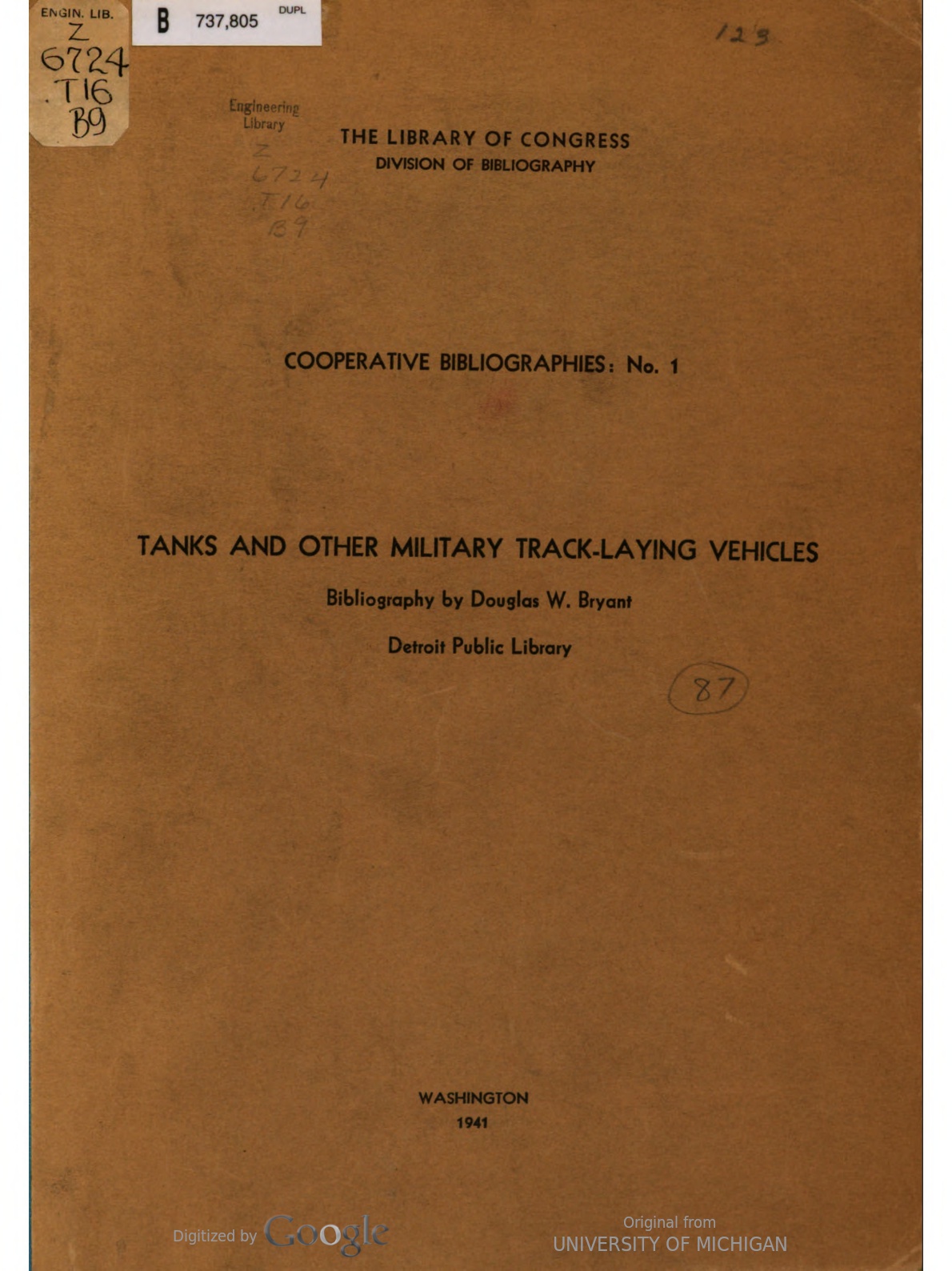 Here is an item that may be useful to those doing research on pre-WWII tanks: “Cooperative Bibliographies No. 1 :Tank and other Military Track-Laying Vehicles” by Douglas Bryant. According to the preface, this document “has been compiled chiefly for the use of those people interested in the design and production of tanks and other military track-laying vehicles. Material on the use of such vehicles and on their tactics in battle has not been included. The bibliography lists what is, in the compiler’s opinion, the best description and technical literature available to the public.”
The document may be viewed at the Hathi Trust Digital Library website.
World of Tanks video on KV-1 recovery from Don river
Wargaming has released a Russian language video about the recovery of a KV-1 tank that was sitting in the Don river for 70 years. Fortunately, English language subtitles are provided.
Chinese tank maker Norinco uses social media to trash talk Armata
 Bloomberg Business is reporting that Chinese tank manufacturer Norinco is using social media to lob taunts at its Russian rival’s most advanced tank, the T-14 Armata. Using popular messaging service WeChat, Norinco took aim at a widely reported and embarrassing incident involving the T-14 Armata, in which one of the vehicles ground to an abrupt halt on Red Square during rehearsals for the 70th anniversary celebrations of World War II victory. According to the article, the Norinco WeChat post said “The T-14’s transmission is not well-developed, as we saw through a malfunction taking place during a rehearsal before the May 9 parade. The VT-4 has never encountered such problems so far. Our tanks also have world-class fire-control systems, which the Russians are still trying to catch up with.”
Norinco’s sales have expanded faster than any other major defense company over the past five years, surpassing Lockheed Martin Corp., maker of the F-35 fighter, and General Dynamics Corp. The Chinese armaments maker’s $62 billion in revenue as of 2013 and more than 275,000 employees embody the clout of China’s defense industry, which the U.S. Pentagon recently warned in an annual report “has the potential to reduce core U.S. military technological advantages.” With foreign sales of $7.4 billion over the five years through 2013, China overtook France to become the world’s fourth-largest arms exporter, according to the Stockholm International Peace Research Institute.
Video: WWI tank crushes car
io9.com recently pointed out this British Pathe video of a tank crushing a car in 1918. While the video identifies this event happening “somewhere in the UK”, it is believed that this video was actually shot in Toronto.
From the Vault: Public domain WWI era tank books
 Today we present several books covering First World War armor that are in the public domain. All of these books are free to download in a variety of formats at internet archive. These books were all written shortly after the war and so represent what was then the current thought on armor and mechanization. Just click on the title to go to the Internet Archive download page.
Our first offering is “Tanks in the Great War: 1914-1918” by J.F.C. Fuller published in 1920. This name should be familiar to those with even a passing interest in the history of tanks. Fuller was the author of the British strategy at the Battle of Cambrai, and would help plan the tank operations for the Autumn offensives of 1918.
Second is “Tanks 19-14-1918: The Log-book of a Pioneer” by Sir Albert G. Stern published in 1919. Stern was one of the key figures in early British tank development, having served as the Secretary of the Landships Committee in 1915. Stern headed up the creation of the Allied Mark VIII tank in the later part of the war.
The next books is “The Tank Corps” by Clough Williams-Ellis and Amabel Williams-Ellis published in 1919. As the name of the book implies, this is an early history of the British WWI Tank Corps. William-Ellis was known primarily for his work as an architect.
Our fourth selection is “The Tank in Action” by Captain D.G. Browne published in 1920. This also is a history of the British Tank Corps during WWI.
The next book is a memior from a WWI British Tanker. “A Company of Tanks” by William Hentry Lowe Watson, published in 1920.
The final book we present is probably one of the earliest fiction stories written about tankers. “Men and Tanks” by J.C. Macintosh, published 1921.

 Tank and AFV News