More on the “Houston-Kid II”

sandstone255.jpgA few days ago we had posted about “Houston-Kid II”, a composite hull M4 105mm gun tank that appeared in some ads for World of Tanks during the Superbowl.  We had asked if anyone knew any details regarding this particular tank.  Thanks to a tip from Wargaming’s North American tank expert Nick Moran, we now know that this tank is from South Africa.  This tank originally came from the South African Defense Force School of Armour in Bloemfontein.  By 2007, it had been handed over to the Sandstone Heritage Trust who went to work making the tank mobile again.  By 2008 the tank was up and running, although with a modern engine not original to any M4 variant.  For details of the restoration, go to the Sandstone Estates website here.  Below is a excerpt from the site explaining the changes made to the vehicle.  The picture below shows the alterations made to the rear deck to accommodate the new cooling fans.

06This example has been modified locally, by fitting a large V8 Mercedes Benz / Atlantis Diesel Engine 442 twin-turbo diesel engine, rated at 400 hp @ 2100 rpm. Max torque is 1600 nm @ 1100-1500 rpm. Fitted directly to the engine is an Allison AC740 CR (close ratio) 4-speed automatic gearbox with the prop-shaft running into the original gearbox which now acts as a transfer box. This in effect gives the vehicle a total of 24 forward and 6 reverse gears.

Top speed is 45 kmh. Fuel consumption is now +/- 2.5 litres per km compared with 9 litres per km with the Continental engine!

Further modifications to this vehicle include the fitment of electronically operated turret turning motors (which were not standard on this specific type) and the fitment of modern optical equipment and sights.

The other major modification on the vehicle was the fitment of twin radiators with accompanying cooling fans. These radiators are fitted in such a way that the complete radiator pack swivels open in less than a minute for easy engine access.
Riding a Tank to Victory at Bougainville

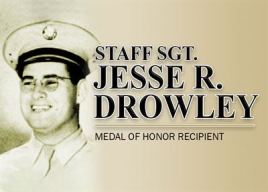
The US Department of Defense website recently posted an article on Staff Sgt. Jesse R. Drowley, a US Army soldier who earned the Medal of Honor during the fighting at Bougainville in early 1944.  While an interesting story in itself, it also gives a brief description of the type of infantry/tank cooperation required by US troops in the intense fighting against Japanese fortifications in the Pacific campaign.

170207-a-zz999-0207WASHINGTON, Feb. 7, 2017 — When Army Staff Sgt. Jesse Ray Drowley arrived alone at an American camp on the Solomon Islands with a gaping wound in his chest, a missing eye and a shredded uniform, a junior officer threatened to court-martial him for abandoning his defense post. Instead, Drowley was put on the path to history.

On Jan. 30, 1944, Drowley was a rifle squad leader with B Company, 132nd Infantry Regiment, Americal Division, when he displayed the bravery that would earn him the Medal of Honor.

The Americal Division arrived on Bougainville on Dec. 25, 1943, as part of the Solomon Islands and New Guinea campaigns. The division was unique in World War II as it carried a name and not a numerical designation. It got its name from “American, New Caledonia,” the South Pacific island on which the unit was provisionally formed for defense in May 1942. Though officially known later as the 23rd Infantry Division, the Americal name remained.

read the rest of the article here


Photo of the Day: Israeli Boy finds tank buried in sand dune.

1168192722

The Israeli newspaper Haaretz is reporting that an Israeli youth found what appears to be the remains of a tank that was buried in the Negev sands of Holot Nitzanim.  The article notes that police also found a land mine and old tank shells at the site.  Officials say they believe the tank was placed there decades ago by the IDF as a training target.  Only one photo of the turret of the tank is included in the article.  It is not clear to us what type of tank this turret belonged to.

Book Alert: Panzergrenadier vs US Armored Infantryman: European Theater of Operations 1944 (Combat)

Osprey released a new entry in their “Combat” series this past month titled Panzergrenadier vs US Armored Infantryman: European Theater of Operations 1944 (Combat). For those familiar with the Osprey Duel series, the Combat series is of a similar format but deals with infantry rather than vehicles/planes/ships. While we don’t normally post book alerts for this particular Opsrey series, we included this title since it deals with mechanized infantry and because it is authored by Steven Zaloga, one of the most prolific and well respected historians of AFV history.  This is a softcover book of 80 pages, well illustrated with black and white and color images.

Publisher’s Description:

During World War II, the two preeminent mechanized infantry forces of the conflict, the German Panzergrenadier arm and the U.S. Army’s armored infantrymen clashed in France and Belgium after the Normandy landings. These engagements went on to profoundly influence the use of mechanized infantry in the postwar world. Drawing upon a variety of sources, this book focuses on three key encounters between July and December of 1944 including during Operation Cobra and the Battle of the Bulge, and examines the origins, equipment, doctrine, and combat record of both forces.

With specially commissioned full-color artwork and maps, this study casts light on the evolving nature of mechanized warfare at the height of World War II

Some recent random tank videos

Here is a collection of tank videos that have appeared on youtube over the past few days.  There is no connecting theme with these other than that they all contain footage of tanks.

Digging up a Convenantor Cruiser tank:

 
US Amphibious landing of Abrams tanks:

 
Having fun with a Leopard I in the snow:

 
Archival footage of East German Schützenpanzenwagen SPW 40, SPW 40 P, and SPW 40 P2:

 
Cleaning up a recently recovered T-34 hull:

M60 in Hannibal NY to be moved

For those that like to keep track of the various armored vehicles on public display in the US, the M60 MBT on display outside the VFW on Route 104 in the town of Hannibal NY is due to be relocated. According to an article in the Buffalo News, a location near the Town Hall was considered, but the final destination for the vehicle has yet to be determined.

51f91538-7267-4bf0-91d0-570c2616a3a2_lA few details remain before West Seneca adds a U.S. Army tank on the Town Hall campus, including where it will go.

Plans show the tank, which saw action in the Middle East, displayed between Town Hall and the West Seneca Library in the Walkway of Freedom complex, once construction on the library addition and renovation are completed.

But Supervisor Sheila Meegan said Monday the proposed spot for the tank might be too close to Town Hall.

“I think we’ll discuss putting the tank on the hill,” she said. “Right now it doesn’t look like the tank will work out.”

“The plan was always to put it in front of Town Hall,” said Jim Manley, chairman of the West Seneca Veterans Committee. “There’s plenty of room out there.”

Read the full Buffalo News article here.

While the article does not note the model of the tank, it appears to be an M60A3 based on the photos of the vehicle available here.


WoT Superbowl ads featuring “Houston-Kid II”

This past weekend World of Tanks video game released a number of somewhat amusing advertisements.  These short ads all follow the same format, starting out as a parody of an unrelated commercial which is rudely interrupted by a Sherman tank.  Normally we don’t post about video game stuff, but these ads did bring one question to mind.  Namely, whose Sherman tank did they use in the ads and how did it get the name “Houston-Kid II”?  By looking at a still shot from one of the ads, we can see that this vehicle is a composite hull M4 armed with a 105mm howitzer.  It also has an unusually long machine gun barrel protruding from the gun mantlet.  The tank has “Houston-Kid II” painted on the side.  From what we can tell, there actually was a Sherman tank used in World War two with that nickname, although it was a M4A3, not a composite hull M4.  A tank named Houston-Kid II is pictured on page 316 of Hunnicutt’s book Sherman: A History of the American Medium Tank.  According to various internet sources this particular tank belonged to the 756th Tank Battalion which was part of the Seventh US Army .  If anyone knows any details about the particular Sherman tank used in the ads, we would be interested to know where this vehicle is located and to whom it belongs.

Ad Screenshot:

houston-kid-ii

Hunnicutt Picture:

houston-kid-hunnicutt

The World of Tanks ads can be viewed below.

[Read more…]

Tank Chats #31 Mark IX

Another “Tank Chats” video from the Tank Museum at Bovington.

The thirty first in a series of short films about some of the vehicles in our collection, presented by The Tank Museum’s historian David Fletcher MBE. The First World War Mark IX, the first armoured personnel carrier, was designed to solve the problem of moving infantry across the battlefield with the fighting tanks.

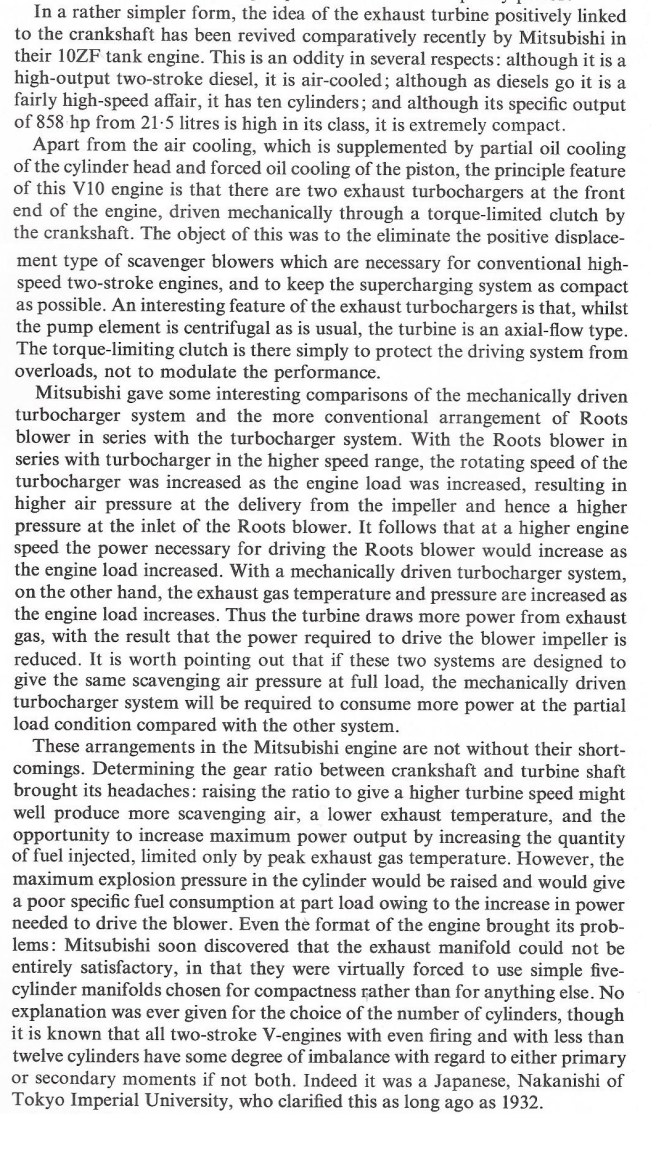
From the Vault: The Japanese 10 ZF engine

A couple weeks ago we presented a description of the Orion engine prototype taken from the 1975 book Some Unusual Engines by LJK Seltright. Today we present another tank engine mentioned in that book, the Japanese 10 ZF V-10 air-cooled two-stroke diesel.  This is the engine that powers the Japanese Type 74 MBT, producing 750 HP.  Compared to western armored vehicles, not much has been published regarding the Japanese Type 74.  This is the first detailed description we have found of this particular engine so we thought it was worth sharing.

10-zf-engine-image10-zf-engine-text

From the Vault: Investigation of the Factors Involved in Steering Tracklaying Vehicles

A couple weeks ago we came into the possession of a 1970 report on factors involved in steering tracklaying vehicles conducted by the Allison division of General Motors for TACOM.  This report will probably be of limited interest to most people, but perhaps a few people will find it worth looking at.  As far as we can tell, this report has not been posted anywhere else.

Download the report at archive.org.

steering-report