The Tank Museum at Bovington presents another installment in their “My Tank Ancestor” series of videos.
The Chieftain’s Hatch: The TD Archives
October 20, 2016 by Leave a Comment
Nicholas Moran, North American researcher for World of Tanks has posted a new article sharing some discoveries from the archives regarding US WWII era tank destroyers.
Excerpt:
Every now and then I come across things in the Tank Destroyer Board archives which are interesting, but not necessarily suitable for a post by themselves. Sometimes I’ll put up the picture or comment on my Facebook page, but I think this collection of writings is worth sharing.
We start with some comments reported to the board in February 1945, from the ETO.
Searchlight Illumination
Searchlights employed so that the beams shine just above the height of a man will cause individuals and vehicles to cast shadows which are easily seen. This reduces the probability of surprise by the enemy in snow covered terrain. - Commanding General, 35th AAA Brigade.[Chieftain’s Note: Those of you who make scale or Lego models may be familiar with this technique. When you drop a part, the use of a torch (flashlight) at floor level casts long shadows, making it easy to find it.]
Photo from the Korean War. Truck and Jeep-mounted searchlights were used as late as VietnamRumors
Much excitement was caused in our command post when a line captain reported 25 Tiger tanks headed our way. Questioned, he admitted he had seen one tank and "assumed there were at least 25 since they usually attacked in mass." Investigation showed there was just one tank, and that between us and it was a road block covered by a minefield, bazooka teams, and three tank destroyers. 1106th Engineer Group.[Chieftain’s Note: Well, this demonstrates the difference between information and intelligence.]

Read the full article at The Chieftain’s Hatch.
AFV News from around the Net
October 20, 2016 by Leave a Comment
Here is a collection of some recent articles and videos concerning tanks and AFVs that are circulating the internet. Click on the headline to read the full article.
DefenseNews.com – Turkey Mulling Upgrade to Leopard 2s, M60s
 ANKARA—Turkey’s military and procurement officials are mulling the options of upgrading hundreds of German-made Leopard 2 and U.S.-made M60 main battle tanks.
One senior procurement official familiar with the program said that about 100 Leopard 2s and 300 M60s would go through an upgrade program. Industry sources say such upgrades would cost Ankara anywhere between $2 million to $3 million per tank. A bunch of 300 to 400 tank upgrades will have a total cost of more than $1 billion. They say Turkey’s defense procurement agency, the Undersecretariat for Defense Industries (SSM in its Turkish acronym) would most likely award the Leopard 2 upgrade contract to the German Rheinmetall’s three-partner, Turkey-based venture, RBSS. Rheinmetall’s partners are the Turkish armored vehicles manufacturer BMC and the Malaysia-based Etika Strategi.
DefenseNews.com – Italy’s New Centauro II Tank Shown Off in Rome
 ROME — Italy’s new tank, the Centauro II, was shown off at a military test range Wednesday, as the country’s Parliament continued to decide whether to fund the vehicle. Deputy Chief of the Defence Staff Lt. Gen. Danilo Errico and Leonardo CEO Mauro Moretti were among guests who gathered Oct. 19 at the Cecchignola Army range on the fringes of Rome to watch a prototype of the wheeled tank being put through its paces. The Army hopes to buy 150 of the vehicles, which is built by a joint venture between Leonardo and Italian truck-maker Iveco.
The Local.de – Two injured after army tank falls 50 metres in Alps
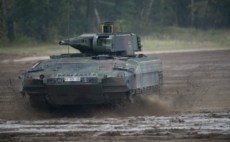 The 31-year-old was airlifted to hospital in Munich in a helicopter after the crash, police reported on Thursday. The 24-year-old driver of the tank was also lightly injured. The crash happened in the mountainous Tyrol region of Austria, where the soldiers were on exercise on Wednesday evening. The driver reportedly lost his way in thick fog and the tank rolled over several times as it fell down the hill. A recovery crane was brought in to the crash site, and only after it had recovered the tank could the two men be freed.
The Daily Telegraph – Army corporal shot dead after driving tank from Holsworthy to Harbour Bridge in 1986
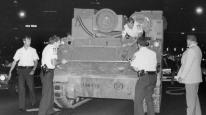 SHOOT the deranged man driving the stolen tank or risk mass Sydney casualties. That was the strange dilemma facing police officer Ron Mason 30 years ago as he climbed on top of a stolen Army tank parked on the Sydney Harbour Bridge. “There is going to be substantial death — either to motorists or train passengers or even in the harbour — if I didn’t shoot him,” retired detective superintendent Ron Mason told The Daily Telegraph on the incident’s anniversary.
CantonRep.com – Tank comes to Clinton
 CLINTON Forty-two tons of steel flew through the air Saturday as the Ohio Veterans’ Memorial Park took possession of its newest relic — an M60A1 tank. A crane gently placed the hulking tank onto a decorative rock garden a few paces from the park’s display of a 1963 Cobra AH-1F helicopter. A VFW post in Defiance donated the M60A1 “Patton” tank to the park. “It actually was going to be melted down for scrap because they had no place to put it,” said Ken Noon, president of the not-for-profit Ohio Veterans’ Memorial Park.
IHS Jane’s – AUSA 2016: BAE Systems debut Bradley Next Generation Prototype
IHS Jane’s – AUSA 2016: BAE Systems Armoured Multipurpose Vehicle program (AMVP) for the US Army
Book Alert: “Everything worked like clockwork…”: The Mechanization of British Regular and Household Cavalry 1918-1942
October 18, 2016 by Leave a Comment
While we try to keep track of all the new books coming out, sometimes one slips past our notice. In this case, the new book “Everything worked like clockwork…”: The Mechanization of British Regular and Household Cavalry 1918-1942 (Wolverhampton Military Studies)
Publisher’s Description:
The mechanization of British and Household Cavalry regiments took place between the two World Wars and on into 1942. This book describes the process by which many horsed cavalrymen were retrained to operate and fight in Armoured Fighting Vehicles (AFVs) and the experiences of some of the men and regiments involved. Extensive use has been made of regimental and War Office archives, and particularly from the Imperial War Museum’s sound archives – the oral testimonies of soldiers who had experienced this huge change. A small number of veterans are, or were, still living and were interviewed by the author for this work. The reason given for the delay in cavalry mechanization – cited in some military histories and much influenced by the writings of Sir Basil Liddell Hart – was the reluctance by the cavalrymen to part with their horses and their technophobic attitude.
This book tests the accuracy of this assertion, together with what was the availability of suitable and sufficient armored fighting vehicles to replace the cavalry’s horses. Of special interest is the examination of the historical papers of the tank manufacturers Vickers, held at the Cambridge University Library, regarding tank development and production. This story of mechanizing the cavalry has been set against the backdrop of the social, economic and political climate of the 1920s and 1930s, and the pressure on politicians of the wider franchise and public opinion. In researching this aspect, the Britain by Mass Observation archives – held at the University of Sussex – have been most illuminating. The interwar impact on cavalry mechanization; the role of the British Army in general; disarmament; and rearmament are describe – again with illustrations from oral testimonies.

Photo of the Day: Chrysler Sherman Tank Ad
October 18, 2016 by Leave a Comment
Today the POTD is not actually a photo but rather an old advertisement from Chrysler Corp that appeared in the Feb 1944 issue of Popular Science. We have a fondness for old ads featuring US tanks, this is a particularly fun one. This ad is about the M4A4 variant of Sherman tank equipped with the Chrysler A57 multi-bank engine. The Multi-bank consisted of five 6-cylinder in-line Chrysler engines mounted together to generate a total of 470 horsepower. The ad is somewhat inaccurate in that the M4A4 was not used by US forces overseas but rather was restricted to training duty or given as lend lease equipment, primarily to the British.

UK may purchase Boxer 8X8 from Germany
October 18, 2016 by Leave a Comment
 Several news sources are reporting that the UK is seriously considering the purchase of 800 German-built Boxer 8×8 multi-role armored vehicle. The deal would be worth 3 billion Pounds, each vehicle costing 4 million Pounds apiece. Reports note that the British MoD are attempting to fast track this purchase by making it a single-source contract, effectively cutting out competitors such as the Patria of Finland, Nexter Systems of France and ST Kinetics from Singapore. The urgency of this purchase is said to be the result of fears of a further drop in the value of the British Pound due to the economic effects of the Brexit. The Boxer would replace the cold-war era FV430 series and the CVR(T) series. Attempts have been made to replace these vehicles several times in the past, resulting in failure due to budget cuts and internal disagreements about requirements. This new plan to purchase the Boxer also has critics. According to Russia Today:
“The MoD is at risk of making a very poor decision, and making it for all the wrong reasons,” a defense industry source told the Times. “A single-source contract would be pursued only because it’s an easy and quick option.” The source claimed that a competition could be timely and save taxpayers “up to 40 per cent on a £3 billion ($3.66bn) programme”.
“The army is in a rush because this has taken decades,” said another insider. “It is nervous the money will go and then the heart of the transformation of the army that [Chief of Staff General] Nick Carter has in mind is in jeopardy because they are going to have a force that doesn’t fit together.”
For more information, here are articles on this story from International Business Times, Defense World.net and Russia Today.
Video: M8 Armored Gun System
October 18, 2016 by Leave a Comment
This video from DefenseWebTV appeared on youtube today. The video features a BAE rep explaining the upgrades of their improved version of the M8 Armored Gun System. The M8, also known as the Buford, was originally selected as the US Army’s replacement for the M551 Sheridan light tank back in the 1990’s. Unfortunately, the M8 program never received funding, thus preventing it from entering production. Originally produced by FMC, the M8 is now owned by BAE who brought it back into the spotlight by featuring it at the 2015 AUSA expo.
Tank Chats #27 Light Tank Mark IIA
October 17, 2016 by Leave a Comment
Here is another episode of the Tank Chats series of videos featuring David Fletcher of the Tank Museum.
From the Vault: A Day in the Life of a Tanker – 1918
October 14, 2016 by 1 Comment
The recent marking of the centenary of the first tanks used in combat has resulted in an increase in interest in WWI tank crew accounts. Here is one of an American tank crewman from 1918 that was published in the Sept-Oct 1973 issues of ARMOR. This two page article recounts the experiences of Sergeant Carl Rosenhagen of Company “C” 301st Heavy Tank Corps. We have posted the pages as images below, or people may download a PDF version here (article is on page 104). A longer version of this account is available in the book War Stories of the Tankers: American Armored Combat, 1918 to Today


AFV News from around the Net
October 14, 2016 by Leave a Comment
Here is a collection of some recent articles concerning tanks and AFVs that are circulating the internet. Click on the headline to read the full article.
Defense News – Italian Parliament Weighs New Tanks, Helicopters
 ROME — The Italian army is a step closer to acquiring new tanks and assault helicopters after plans for the purchases were submitted for parliamentary approval. On Oct. 11 the defense commission of the lower house of the Italian parliament began debating plans by the Italian military to buy the Centauro II tank and an updated version of its A-129 Mangusta helicopter. The Centauro II is a wheeled tank which boasts improvements on the Centauro tank already in service with the Italian army. The commission, which has until November 8 to offer an opinion on the purchases, was once just a rubber-stamping operation for military investments, but under 2012 legislation was given more influence over acquisition.
Colorado Springs Gazette – Fort Carson Strykers vs. Russian tanks: Are they strong enough to stop them?
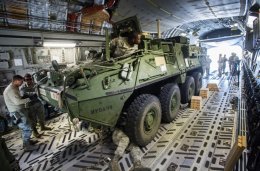 Declining defense budgets along with 15 years of battling terrorists and insurgents have left a more lightly armed Army with the prospect of facing columns of Russian tanks if war erupts in Europe. And even as Fort Carson troops train to be the first to fight if the nation heads to war overseas, politicians and pundits are debating whether the formations we’ll send are strong enough to be more than a speed bump for America’s potential enemies. “The short answer is, no, they are not a replacement for heavy forces for a fight in Europe,” said Steve Bucci, a defense expert for the right-leaning Heritage Foundation in Washington, D.C.
The National Interest – What Makes Japan’s Type 10 Tank So Good
 As a nation that produced exceptionally poor tanks during World War II, Japan during the postwar period had quite a reputation to overcome. Wartime tanks such as the Type 97 “Chi-Ha” were a decade or more behind the rest of the world during a period of exceptionally quick tank development. As Japan rebuilt industry and specialized in cars and trucks, it also built up a cottage tank industry to replace American M4A3E8 and M24 tanks donated to the Ground Self-Defense Force. The Type 61, Type 74, Type 90 and now the Type 10 tanks have all been credible designs more than capable of turning the tanks of Japan’s potential adversaries into smoldering scrap. Remarkably, each design bears little in common with previous versions.
UPI – Estonia receives first armored vehicles from Netherlands
 TALLINN, Estonia, Oct. 11 (UPI) — An initial batch of CV9035 infantry fighting vehicles purchased by Estonia from the Netherlands have arrived in the Baltic nation. The 12 vehicles, together with an armored recovery vehicle, arrived by boat and were being transported to the 1st Infantry Brigade at Estonia’s Tapa Army Base. Estonia signed a contract with the Netherlands for the purchase of 44 used CV9035NL IFVs and six Leopard 1 tank-based support vehicles in late 2014 for 113 million euros. All the vehicles, which will be delivered by 2018, are to undergo maintenance and repairs before arriving in Estonia, the Estonian Ministry of Defense said.
Defense Systems.com – Army accelerates Active Protection Systems technology
 The Army is fast-tracking an emerging technology for Abrams tanks designed to give combat vehicles an opportunity identify, track and destroy approaching enemy rocket-propelled grenades in a matter of milliseconds, service officials said. Called Active Protection Systems, or APS, the technology uses sensors and radar, computer processing, fire control technology and interceptors to find, target and knock down or intercept incoming enemy fire such as RPGs and Anti-Tank Guided Missiles, or ATGMs. Systems of this kind have been in development for many years, however the rapid technological progress of enemy tank rounds, missiles and RPGs is leading the Army to more rapidly test and develop APS for its fleet of Abrams tanks.
Defense World.net – BAE Systems To Deliver First Armored Vehicle For US Army By This Year End
 BAE Systems will be handing over the first of 29 Armored Multi-Purpose Vehicles (AMPV) to the US Army in December. As of early October, one vehicle has been completed with nine vehicles on the production line, the company announced Friday. These vehicles will be put through some 7,500 miles of contractor trials and 21,000 miles of US Army trials.
These prototype/pre-production AMPVs are being built under an Engineering, Manufacturing and Development (EMD) contract awarded in December 2014. Also competing for the AMPV was General Dynamics Land Systems. Critical Design Review has already been passed with a Milestone C decision due in financial year 2019.

 Tank and AFV News