From CBS NewYork comes this video about Yuval Neria, an Israeli war veteran and professor at Columbia University. On Thursday, Oct. 6, 2016, Dr. Neria was reunited on Long Island with a tank like the one he rode in 43 years ago during the 1973 Yom Kippur war. The tank, a 45-ton Israeli Magach 3, is on display at the Museum of American Armor at Old Bethpage Village Restoration. Dr. Neria was commanding a tank during the initial attacks by Egyptian forces in 1973. His unit suffered heavy casualties and he received a leg wound and serious burns. For his actions he was awarded the Israeli Medal of Valor for bravery in combat. Dr. Neria was able to drive the tank, which was restored by the museum. This particular vehicle was originally sold by the US to Jordan, and was captured by the Israeli’s in the 1967 war and incorporated into their own tank inventory.
 The US Army is working to formulate specific requirements for a Mobile Protected Firepower (MPF) platform that so far appears akin to a light or medium tank. Army planners want to “speak definitively about requirements” and then have industry respond with design ideas before the programme begins, Major General David Bassett, programme executive officer for ground combat systems, told reporters on 4 October at the Association of the US Army (AUSA) annual conference. “We’re not willing to wait for a lengthy bottom-up design process”, he said. The army would like to get more than one vendor for a competitive programme, but is not yet sure if there will be sufficient resources for that, Maj Gen Bassett added.
 Army Abrams tanks are being outfitted with high-tech, vehicle-mounted systems which can detect, track and destroy approaching enemy RPG fire within milliseconds. The Army is fast-tracking an emerging technology for Abrams tanks designed to give combat vehicles an opportunity identify, track and destroy approaching enemy rocket-propelled grenades in a matter of milliseconds, service officials said. Called Active Protection Systems, or APS, the technology uses sensors and radar, computer processing, fire control technology and interceptors to find, target and knock down or intercept incoming enemy fire such as RPGs and Anti-Tank Guided Missiles, or ATGMs.
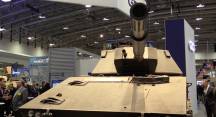 The Army’s long search for a small tank that packs a big punch seems to never end. Now, General Dynamics is looking to do something about that with their new Griffin tank technology demonstrator. Unveiled at this year’s Association of the United States Army (AUSA) convention in Washington DC, this little tank is meant to be a jumping off point for finally fulfilling the Army’s mobile protected firepower requirement. The 27 ton Griffin is a franken-tank of sorts, which is not a bad thing. It uses pieces of existing technology to lower costs and development time–and also return some investment to the Army for projects abandoned years ago.
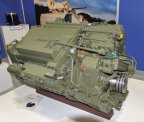 Spain’s SAPA Transmission has developed a new family of automatic transmissions for wheeled and tracked vehicle applications. The SW series of wheeled transmissions is being marketed for use with engines with outputs from 600 hp to 800 hp. The SW 516 and SW 616 have eight forward and two reverse gears while the SW 524 and SW624 have 12 forward and four reverse. For tracked combat vehicles, the company has developed the SG family of automatic transmissions, claimed to deliver more power to the sprocket than conventional automatic transmissions.
 The British Challenger 2 tank is becoming obsolete in the face of new threats such as the Russian T-14 Armata. But the United Kingdom is preparing to embark on an upgrade program to keep up with advances in armored warfare. Britain doesn’t have many other options. For one, the Challenger 2 will remain in service until at least 2035 because it’s too expensive to replace. “We have got issues with the tanks we’ve got and if we don’t do something about it we will have issues,” Gen. Nick Carter, the chief of the British Army General Staff, said last year.
 What’s the fastest way to acquire unmanned ground vehicles? Rig your manned vehicles for remote control. At least that’s the pitch from General Dynamics Land Systems. The maker of the Abrams tank and the Stryker armored fighting vehicle is teaming up with Kairos Autonomi, a company whose kits can turn virtually anything with wheels or tracks into a remote-controlled car. It’s part of a strategic play to meet the U.S. Army’s expanding demand for unmanned ground vehicles.
 The U.S. Army would develop next-generation replacements for its armored vehicles such as the M1A2 Abrams main battle tank and the Bradley fighting vehicle, but the service simply does not have the money for such projects. Instead, the Army is incrementally improving its venerable armored combat vehicles to keep them relevant against a rapidly modernizing threat—the Russian Armata family of combat vehicles for example. The Army does have some concepts that it is developing for next generation combat vehicles—and the service might build prototypes—but there are no plans to bring any such machines into production.


 Tank and AFV News