Here is another installment of AFV news from around the web. This assortment of articles most come from IHS Jane’s 360. Click on the title to go to the full article.
IHS Jane’s – T-90MS Battle tank ready for production
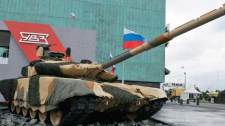 UralVagonZavod (Hangar 2, Stand CE26) has confirmed to the AAD Show Daily that development of its latest T-90MS main battle tank (MBT) is complete and production can commence as soon as orders are placed. The T-90MS is a step change compared with the earlier T-90 MBT and has already been demonstrated in the Middle East, as well as being shown at the recent Army 2016 show in Moscow. Some of the elements of the T-90MS could be back-fitted to earlier T-90 series to enhance their capability, especially in the key areas of armour and firepower.
ABC News – Queensland aerospace company to fix Australian Army’s tank engines on home soil
 A fleet of 59 M1A1 Abrams tanks arrived in Australia in 2007 and until now their engines were sent to the United States to be fixed at a cost of about $500,000 per engine. Aerospace company TAE, which has a depot at the Royal Australian Air Force base at Amberley, south-west of Brisbane, has secured a contract with the army to repair the engines on site at a tenth of the price. TAE CEO Andrew Sanderson said the rebuild program had created 20 local jobs.
IHS Jane’s – Otokar enters final bid for Altay programme
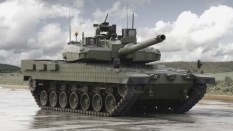 Otokar has submitted its best and final offer (BAFO) to the Turkish Undersecretariat for Defence Industries (SSM) for the first production batch of 250 Altay main battle tanks (MBTs) and associated integrated logistic support (ILS) for the Turkish Land Forces Command (TLFC). The initial Altay MBT production offer was submitted by Otokar in January 2016 and the SSM subsequently requested a BAFO. SSM will decide whether to accept Otokar’s offer or to open up a full-scale competition for the production phase of the Altay programme.
IHS Jane’s – Kurganmashzavod up-armours BMP-3 Dragun
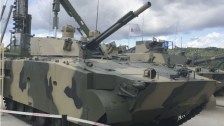 Kurganmashzavod unveiled an upgraded version of its BMP-3 Dragun infantry fighting vehicle (IFV) with additional armour protection at the Army 2016 defence show outside Moscow. “Kurganmashzavod has up-armoured the BMP-3 Dragun IFV. The vehicle has received side skirts made of composite armour and an upgraded electro-optical suite. The company is planning to assemble the Dragun demonstrator for state trials and operational test and evaluation in 2017,” a company representative told IHS Jane`s at the exhibition. He added that Dragun will be the new basis for a whole family of combat vehicles.
IHS Jane’s – China North Industries Corporation VT4 MBT
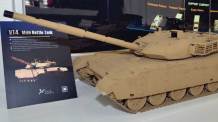 China North Industries Corporation (NORINCO, Hangar 2, Stand CW14) is aiming for a slice of the still significant main battle tank (MBT) market with its latest VT4 MBT, which is being shown here only in model form. It is understood that the first export customer for the VT4 MBT – which was previously called the MBT-3000 – is Thailand, which has placed a contract for 28 vehicles. The VT4 is armed with a 125mm smoothbore gun that is fed by an automatic loader located below the turret that first loads the projectile and then the charge. A total of 38 rounds of separate loading of 125mm ammunition are carried, of which 22 are for ready use in the automatic loader.

 A hundred years ago at the height of the Battle of the Somme , German troops waited at their posts to pick off the first Tommies venturing into the hell of no man’s land when the morning fog lifted. But instead of the normal glints of steel helmets, the beleaguered units, who had suffered 250,000 casualties so far, were not prepared for the First World War monster that was about to be unleashed on them. Rising from the mud, blood and gloom and brushing past the barbed wire protections like they were made of straw came the first tanks ever used in battle.
 A replica of a World War One tank has been placed in Trafalgar Square to mark the 100th anniversary of the war machine. The Mark IV tank, on which the replica is modelled, was first used in warfare in the Battle of the Somme on 15 September 1916. With 57,000 casualties on the first day it is regarded as the bloodiest day in British military history. The tank will be in position in the square until 11:00 BST. David Willey, from Dorset’s Tank Museum, which has provided the machine, said: “The British Army sent its new ‘secret weapon’ into action – and it did so in order to prevent the sort of casualties experienced on that first day of the battle.”
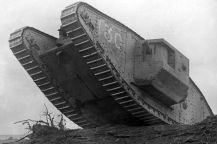 The tank, which would go on to dominate 20th Century warfare, first stormed on to the shattered battlefields of the Somme 100 years ago. Rushed into battle by desperate generals with barely any testing, its debut was a messy experiment with questionable results. A select group of young men were the first to feel its terrible influence and have their lives changed by it. William Dawson came from Boston in Lincolnshire and was the eldest of four children. His father had drowned at sea in 1898 when he was 10 years old and as soon as he left school, Dawson went to work to support the family.
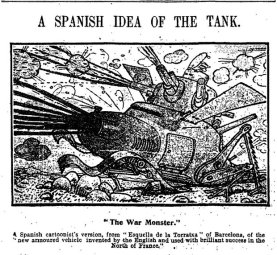 One hundred years ago the face of modern warfare changed forever when tanks were used for the first time. On the morning of 15 September 1916 the British attacked German positions at Flers-Courcelette – part of the larger Somme offensive – with 32 tanks. The results were decidedly mixed but this faltering introduction was not reflected in contemporary press reports. The Guardian and Observer enthusiastically reported on their deployment and the hope that they might break the stalemate. An initial report of ‘mystery machines’ appeared in the Observer on 17 September, containing a multitude of questions and speculations. ‘Do they attack as battering rams or as gun carriers, or both? Are we to conceive them as a sort of ironclad van…ploughing ponderously onward through hedges of wire, over holes, over trenches to the bewilderment and affright of the Hun?’
 Created by the Tank Museum at Bovington, this page includes a number of links to videos and articles on WW1 era tanks. These includes a number of profiles of some of the first “tank men.” Individual articles include:
 The July-September 2016 issue of
  In September 1967, the Soviet military launched Exercise Dnepr, one of the largest exercises in Soviet military history. Most observers and military analysts focused both on the size of the exercise and the large-scale use of airborne forces. The Soviet army actually dropped two complete airborne divisions with all their equipment in support of a front-level offensive during the exercise.
 Tank and AFV News