IHS Jane’s is reporting that a Turkish M60T MBT survived a hit by the Islamic State using a Russian made 9K129 Kornet ATGW. On April 19, video appeared online claiming to show the destruction of a Turkish tank by an ISIS guided missle near Mosul. The video shows the missile striking the tank but ends shorting after the initial detonation. IHS Jane’s states that the Turkey’s Anadolu Agency reported that the Islamic State carried out an attack on a M60 tank at Bashiqah. The source said the tank had been slightly damaged and there were no casualties in the camp. The IHS Jane’s article also includes a picture of an M60T with damage to its turret add-on armor.

Here is the video of the missile strike:
Oddly enough, this incident mirrors a situation from earlier this year in Syria where a Russian built T-90 was struck by a US made TOW missile. Video was released claiming to show the destruction of the tank, although much like this current video, it cuts off after the initial impact and explosion of the missile warhead. Later, it was revealed that the T-90 survived the missile strike with only minor damage.
 The subject of this article is one of two Marder IIs shipped to the United States after having been surrendered in Austria to the U.S. forces as the war ended. One was sent to the Aberdeen Proving Grounds (APG) while the other was sent to the Armor School Museum at Fort Knox which eventually became the Patton Museum of Cavalry and Armor. Both Marders were part of the 1. Panzer Division in its Panzer Aufklärungs Abteilung (reconnaissance battalion). The 1. Panzer Division was listed as still having 12 Marder IIs as of March 1945.
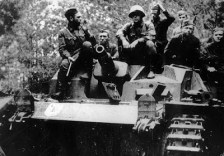 At the start of the Great Patriotic War, Soviet military intelligence and the GAU had a very approximate idea about the types and characteristics of German tanks. This deficiency led to an overestimation of the possibilities of German armour and the launch of the KV-3, 4, and 5 programs in March of 1941. Even information on real German tanks was sparse. Intelligence missed the increase of the front armour of PzIII and PzIV tanks to 50 mm and use of 50 mm guns. This lack of information had to be made up for in the most reliable way during the war: studying trophies. Among the vehicles that were glossed over by Soviet intelligence was the StuG assault gun.
 By noon of the first day of the Sandomierz-Silesian Offensive Operation, Soviet infantry penetrated the first line of German defenses and hit the second. Quickly realizing the situation, Marshall Konev, the commander of the 1st Ukrainian Front, played the ace up his sleeve: several hundred tanks and SPGs. Thanks to them, Soviet forces were ready to assault the second line by the second half of January 12th, 1945.
 The history of the Pz.Kpfw. Maus is still full of blank spots, despite the popularity of the subject. The beginning of the tank’s development from March of 1942 to 1943 is the least studied area. During this time, the project indexed Typ 205 radically changed. Essentially, the only constants were the index and the idea of using an electric transmission. Thanks to new publications and archive research, it is now possible to remove the veil of mystery from many parts of the project.
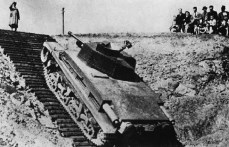 The Turán started with an acknowledgement that the Toldi light tanks (which were basically Swedish Landsverk L-60s) weren’t really suited for a general tank role on the modern battlefield. After a bit of hunting, the Hungarians ended up talking with Škoda.
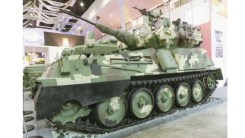 Malaysian army chief, General Raja Mohamed Affandi Raja Mohamed Noor, stated that the army plans to initiate an upgrade programme for its fleet of Alvis Vehicles Scorpion 90 light armoured fighting vehicles (AFVs) and Rheinmetall MAN Military Vehicles Condor 4×4 armoured personnel carriers (APCs) to enable them to continue operational service.
 As anti-tank threats are growing increasingly sophisticated, the Marine Corps is looking at protecting its ground vehicles with active protection and electronic warfare systems to fend off incoming rounds the same way ships and planes do today. Lt. Gen. Robert Walsh, deputy commandant for combat development and integration, said at a Senate Armed Services seapower subcommittee hearing on Wednesday that as technology proliferates, the anti-tank threat is rapidly evolving. The Navy is investing in protecting its ships and aircraft from similar threats, and Walsh said it’s time for the Marine Corps to take the same approach for its ground vehicles.
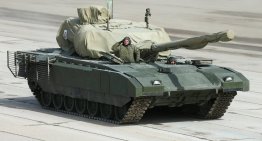 MOSCOW (Sputnik) – Russia produces 70 percent of all tanks produced worldwide, producing one tank per day, Uralvagonzavod General Director Oleg Sienko said.
 Prowling through a river, these are South Korea’s Black Panther tanks that can move effortlessly through 14ft of water thanks to a special ‘snorkel’. The £6million armoured vehicles were put though their paces in an underwater exercise across the South Han River in Yeoju, east of Seoul, today.
 Tanks are being designed with controls that look like a PlayStation gamepad in a bid to encourage video game obsessive to join the army . The new British Challenger II’s firing mechanism is based on the Sony handset in order to make it instantly recognisable to new recruits.
 is a rather substantial 400 pages and is published by Helion and Company.

 Tank and AFV News