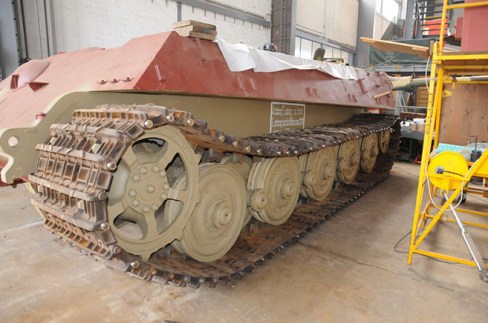
A page on facebook appeared today called Nashorn SD KFZ 164 restauration. There is little information on the page at this time other than a short description with states “ACES foundation is a group of friends who’s goal it is to restore WWII vehicles. This time we started to resore a very rare german tankdestroyer, Nashorn.”
The site contains a photo gallery of wartime photos of the Nashorn as well as a few pictures of the vehicle in it’s current state. Based on the photos, these guys have their work cut out for them! Click on the picture below to go to the gallery page.


 Winston Churchill’s saying “The tank that carries my name has more drawbacks than I do!” in regards to the Infantry Tank Mk.IV is well known. Despite this evaluation, the Churchill was the longest-living British tank, even finding itself useful in Korea. It is not know what the Prime Minister thought about the Cruiser Tank Mk.V, more known as the Covenanter, but there is one fact that says more than enough: it is the most numerous tank of the Second World War that never saw combat.
 The end of the First World War coincided with the decline of vehicles designed by William Tritton. Drastic budget cuts meant that further development of heavy tanks in Great Britain stopped. As for the first post-war medium tanks, they turned out to be too heavy, and could not repeat the success of the Mk.A Whippet. In late 1918, development of the Medium Tank Mk.D began, directed by Lieutenant Colonel Philip Johnson. The result was truly revolutionary and could reach a record of 20 mph (32 kph), but a large amount of mechanical problems brought about the end for that tank. After trials, the tank was not approved for mass production, but it did not disappear into nothingness. Later on, the Americans used it as a basis of their Medium Tank M1921. In England, the Vickers company had a go at making tanks and attained success with its first steps, creating the successful Medium Tank Mk.I.
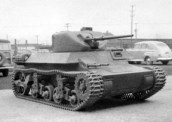 Thanks to John Walther Christie, the USA was the leader in airborne tanks before WWII, but with one caveat: not a single one of his vehicles was actually accepted into service. However, Christie’s experiments resulted in a very good understanding of what an airborne tank should be like. The idea of a tank with wings was quickly discarded in favour of a light tank that was attached under the fuselage of a heavy bomber or transport plane. This concept was used to make the Light Tank M22.
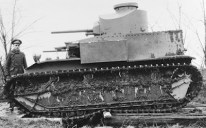 Starting with the M2 Medium Tank, American medium tanks were based on the M2 Light Tank. The method of their creation was as follows: novelties were tried out on a light tank, then the tank was proportionally scaled up in size. Of course, many changes were introduced into the design, like increasing the number of bogeys or return rollers. Overall, this method was successful. However, this was not the first attempt at using this method by American tank designers. The first time they tried it, they got something different…
 Work on heavy SPGs in the Soviet Union began in the early 1930s. By the end of the decade, development stopped, but began anew in early 1940. The Red Army needed tanks to destroy enemy pillboxes. The result of this requirement was the 212 SPG which, for various reasons, was never built. In April of 1942, the 212 project was finally closed, giving way to another no less interesting project: the KV-7 assault tank.
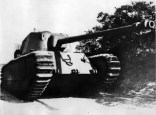 There is a misconception that the French worked only for their new masters during the occupation of 1940-1944. Indeed, most French tank manufacturing facilities ended up in the German occupation zone. Nevertheless, the resistance that so many speak of was active, and even on occupied territories, work continued. It became the foundation for French tank building that began immediately after the country was freed from occupants.
 What is Switzerland famous for? One immediately thinks of watches, banks, mountains, and cheese. Despite fighting its last war in 1848, this small country remained among the top producers of armament for decades.
 A couple weeks ago we posted about a WWII era Stuart tank that has found a new home in Berwick PA, site of the former American Car and Foundry factory. Bob Kalinowski of The Citizen’s Voice of Luzerne County has posted an article and video about the Berwick Stuart tank and Louis Kovach, a 90 year old former employee of American Car and Foundry who welded parts on many of the 15,000 Stuart tanks produced by the company.
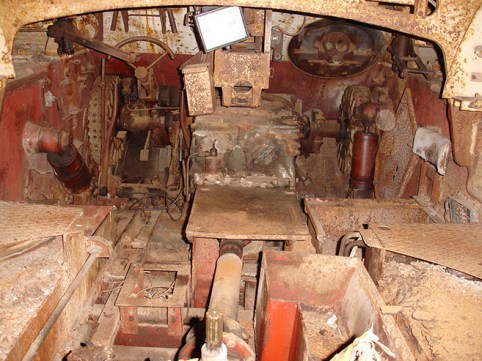



 The new book “AFV Photo Album Vol. 2: Armored Fighting Vehicles on Czechoslovakian Territory 1945” is available. This hardcover book comes in at 176 pages and is authored by Marek Solar, Petr Dolezal and Vladimir Kos. The book is published by Canfora Grafisk. Copies are available through
 Tank and AFV News