Below the Turret Ring has made a couple of new posts. As always, their posts provide a fairly lengthy description of some of the latest developments in AFV technology. These two new posts look at the Austrian Pandur wheeled AFV and the Israeli “Carmel” next generation combat vehicle. We have included an excerpt from the beginning of each post below. Click on the headline to go to the Below the Turret Ring site and read the full article.
IDF Carmel details emerge
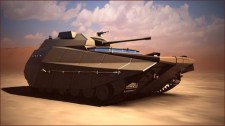 A number of 3D graphics showing the Carmel next generation combat vehicle of the Israeli Defence Force, which sometimes is also called an advanced technology demonstrator, have been posted on the internet. The images come from a presentation held by the retired Brigadier General Didi Ben-Yoash, who formerly was the Chief Armored Corps Officer of the Israeli Defence Force (IDF). The presentation was part of the Second International Ground Warfare and Logistics Conference, held on 16th and 17th of May 2017 in the Latrun Armed Corps Memorial. Based on the fact that Didi Ben-Yoash is retied and IsraeliDefense.co.il describes this as a simulation of the Carmel, it appears extremely likely that the final vehicle might appear to be very different.
Austrian Pandur projects progression
 The Austrian company GDELS Steyr, part of the General Dynamics European Land Systems (GDELS) division and formerly known as Steyr-Daimler-Puch Spezialfahrzeug GmbH (SSF), is responsible for developing a new vehicle of the Pandur family of wheeled vehicles (FoV). A few photos of an unspecified Pandur 6×6 variant, which apparently is a long wheelbase version of the Pandur II, were taken at a recent event in April. The fact that the vehicle was presented in a modern digital camouflage pattern has caused some funny commencts regarding the lack of style; however here these photos were the inspiration to take a very short look at the Pandur 1 projects in Austria and other countries. The fact that a Pandur II 6×6 is located at the Steyr plant might be a hint regarding the development of the Pandur EVO – it could be used as reference or as base model for the next iteration of the Pandur vehicle. The Pandur 1 is operated in different versions by the Austrian Army (the so called Bundesheer), the Belgian Army (as scout and ambulance vehicles), the Kuwaiti National Guard (some armed with 25 mm autocannons or 90 mm Cockerill medium calibre guns), the Slovenian Army (known as locally as “Valuk”) and the US Army’s Special Forces (fitted with applique armor, operated by the Delta Force and 75th Rangers in very small numbers).
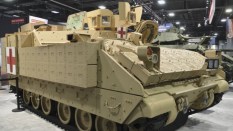 The armed forces of the United States of America are running a number of projects to modernize the land vehicle and amphibious vehicles during the next few years. The Armored Multi-Purpose Vehicle (AMPV), based on a modified Bradley chassis, will replace the obsolete M113 (not called Gavin) in the Army’s inventory. The AMPV features enhanced protection against mines and improvised explosive devices (IEDs), a total of 2,907 AMPVs will replace the M113-based vehicles as general-purpose vehicles, mission command vehicles, mortar carriers, medical evacuation and medical treatment vehicles in the US Army’s Armored Brigade Combat Teams (ABCTs). On the long run a further 1,922 AMPVs might be procured, if the M113 should be replaced at brigade level (and lower) on a one-to-one basis by the AMPV.
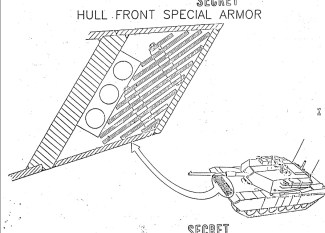 On the TankNet forums, a user with the nickname “whelm” has posted drawings from a formerly classified document on the earliest iteration of the US M1 Abrams main battle tank (MBT). He got this document from Vollketten, a user with accounts at the Sturgeon’s House forum, the WoT forum and other places. It details the armor layout of the tank, showing were the Burlington composite armor is located and how it is specifically implemented on different areas.
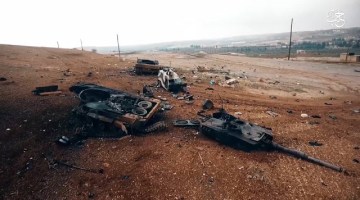 Yesterday a new video was released by ISIS terrorists showing a bunch of destroyed main battle tanks (MBTs) and armored personnel carriers (APCs) near the Syrian city of Al-Bab. This video however has proven something, that I understimated a certain weapon. Not anti-tank guided missiles (ATGMs), not improvised explosive devices (IEDs). A much older weapon: propaganda. The same weapon that turned the Tiger heavy tank – a rather mediocre design of it’s time – to a supposed super tank, that still is being worshipped by some individuals today. However the propaganda worked, invoking a Tiger-phobia on the side of the allies.
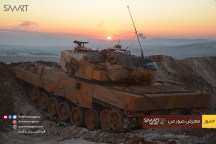 Turkish Leopard 2 tanks are actively operating in the war in Syria. The tanks have been photographed at different locations near the town of Al Bab, which is located about 35 kilometres (21.7 miles) north-eastern of Aleppo. A few photos were shared on Twitter, apparently taken by Turkish soldiers. More detailed photos and video footage was provided by the SMART news agency, which is said to have ties to Syrian rebels.
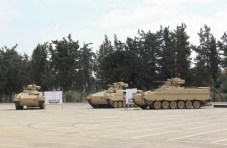 Jordan has received an initial batch of 16 ex-German Marder infantry fighting vehicles (IFVs) on the 11th December of 2016 as part of German military aid. The delivery also included 20 mm RH202 autocannons, spare parts and a Marder driver training vehicle. It must be noted that the permission for an export of 24 Marders, 28 Rh 202 autocannons and one Marder driver training vehicle to Jordan was given for 2016. The costs of this equipment is €12.8 million. This means that most likely a second batch of Marders will be shipped this year. A total of 50 Marder IFVs are being delivered to Jordan until end of 2017. Furthermore Jordan is set to receive surveillance equipment, 56 vans and 70 trucks.
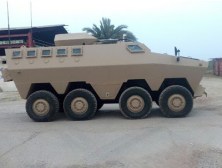 The privately-owned Pakistani company Blitzkrieg Defense Solutions – and yes, that is the actual name – has developed a new 8×8 wheeled vehicle. Supposedly it is the first 8×8 vehicle developed in Pakistan. The new vehicle is known under the name “Hamza” and was officially presented at the International Defence Exhibition and Seminar (IDEAS) in 2016. It should not be confused with the Al-Hamza, a local version of the M113 fitted with a 25 mm gun in a one-man-turret.
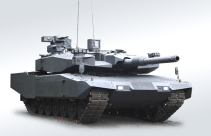 According to the Mönch Publishing Group, Chile is said to be looking for an upgrade of the Leopard 2A4 main battle tank (MBT) since 2013. Chile is operating the Leopard 2A4 since 2007, after purchasing an initial batch of 128 tanks for less than €1 million a piece – this low price is understood to be the result of political ties and separate contracts for refurbishment. Later the number of tanks has been increased to 140 and then to 172. The MBTs were modified to the Leopard 2A4CHL standard, which has a modified powerpack.
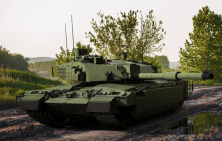 Two bidders for the life extension programme (LEP) of the British Challenger 2 main battle tank (MBT) have been shortlisted by the UK ministry of defence (MoD). The shortlisted companies will be contracted in the next few weeks for the production of two prototypes worth €25.8 million each. After a 24 month long assessment phase, the final production contract will be made with one of the downselected contenders. In case of unforseen issues, a further €7.8 million can be allocated by the British MoD. Originally the contracts were expected to be signed in October, but the project was apparently delayed, so that currently contracts are expected to be signed in December of 2016. The Challenger 2 LEP is part of the Armour (MBT) 2025 project, which is meant to ensure the Challenger 2 remaining competitive in the timeframe from 2025 to 2035.
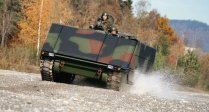 The Swiss company RUAG is offering a wider array of add-on armor types for enhancing the protection of older combat vehicles. It offers three main families of protection products: under the SidePRO brand, armor protection systems for protection the vertical aspects of a vehicle (so the front, sides and rear) are offered, while the RoofPRO brand includes protection systems for the vehicle roof. Lastly the MinePRO brand contains protection solutions for wheeled and tracked vehicles against IEDs, anti-personnel and anti-tank mines.
 The Iran is working on a new main battle tank (MBT), which has been nick-named the Karrar MBT. While most details are unknown, first footage of the new MBT has been released on state-owned TV and found it’s way onto the internet. According to the Iranian TV, the tank is supposed to be completely built and designed in Iran.
 Tank and AFV News