All we know about this Israeli vehicle is that it some sort of proof of concept vehicle dating from the period of 1999-2003. Light tanks are not a category that the IDF has traditionally been all that excited about. (source)
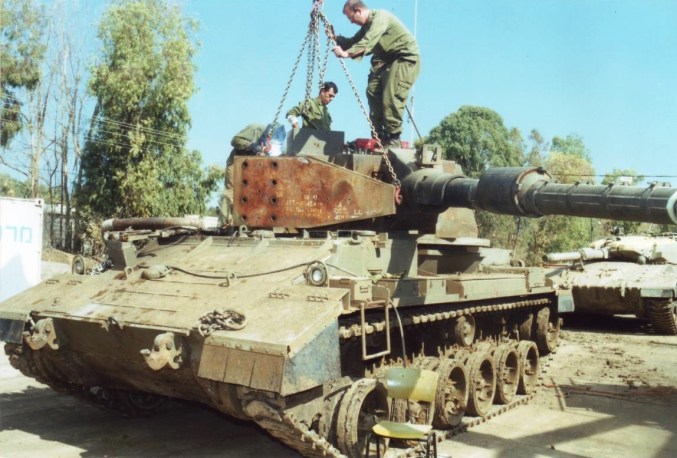
Update: A google image search led us to this post from the For the Record blog which sources the photo to this Hebrew language book.
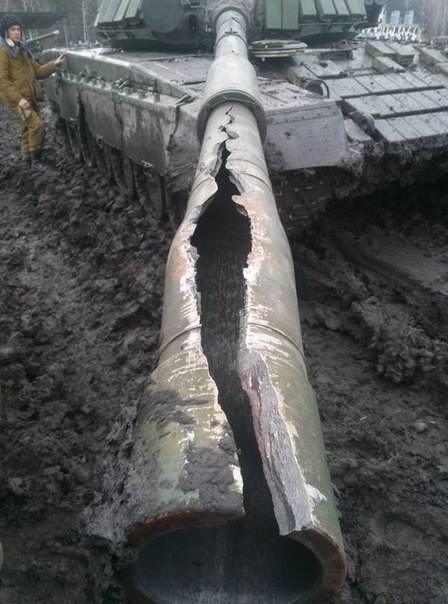
 The U.S. Army boasts a motorpool stacked to the rafters with 6,000 M1 Abrams main battle tanks — more tanks than some countries have soldiers. Yet for some crazy reason, Congress keeps buying more. Actually, the reason isn’t totally crazy. The U.S. only has one factory left that’s totally dedicated to the production of main battle tanks — General Dynamics’ (NYSE:GD) factory in Lima, Ohio. Sporadic demand from tank-buyers, however, keeps this factory always on the edge of having to shut down operations — at which point the U.S. wouldn’t be able to build tanks if it suddenly needed to. (A shutdown would also cost jobs in an important Congressional district.)
 U.S. tanks are now roughly on par with Russian tanks, according to a top general, and the American military doesn’t have the technology to recover its former advantage. “I would not say that we have the world class tank that we had for many, many years,” Lieutenant General John Murray said during a Senate Armed Services subcommittee hearing on modernizing the Army. “I’ll be the optimist and say that we’re at parity with a lot of different nations.”
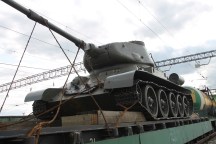 Russian authorities have slapped a three-year suspended sentence on a Moscow man for trying to smuggle a World War II-era tank into neighboring Kazakhstan, state news agency Itar-Tass reports. The man—whose name federal authorities did not divulge—obtained a Soviet Т-34-85 circa from 1945, from a Latvian citizen at the bargain price of €20,000, but planned to sell it off to a buyer in Kazakhstan for more than 10 times that amount.
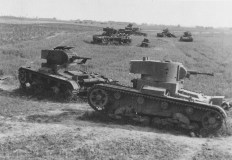 A thousand coffee table books and countless hours of popular history programs have described the Battle of Prokhorovka, part of the Third Reich’s 1943 Operation Citadel, as the largest tank battle in history. Near the city of Kursk on the Eastern Front, hundreds of Soviet tanks slammed into the 2nd SS Panzer Corps in an enormous conflagration of flesh and metal. Prokhorovka was certainly an important clash and one of the largest tank battles ever, but it might be time to retire its description as the biggest — a claim which has been seriously questioned in recent years by historians with access to Soviet archives opened since the end of the Cold War.
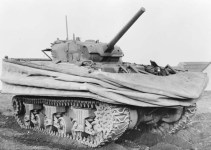 If you’ve seen the blockbuster movies The Longest Day (currently on Netflix) or Saving Private Ryan, a big part of the story is how infantry fought through the obstacles on Omaha Beach (the wisdom of sending two divisions into that meat-grinder can be debated at another time). But the lack of tank support wasn’t part of the plan. In fact, it was one hell of an instance where that notorious and unwelcome Murphy’s Law put in an appearance, costing the infantry some much-needed support. It would have been their secret weapon: the Dual-Drive, or DD, tank.
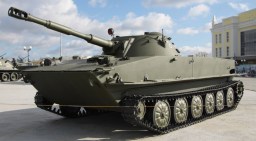 The PT-76 seems like a minor oddity of the Cold War — a Soviet amphibious light tank with thin armor and an unimpressive gun. Certainly it seemed bound for rough treatment on modern battlefields full of heavy weapons and heavier tanks. But the floating PT-76 chalked up a remarkable record, carrying knife-wielding Himalayan soldiers into battle, sinking gunboats on the Ganges Delta, dueling powerful U.S. Patton tanks in Vietnam, and launching amphibious surprise attacks on both sides of the same Middle Eastern war. The first article in this two-part series will look at the origin and characteristics of the PT-76, the nasty shock it gave U.S. forces in Vietnam, and the historic countermeasure used against it.
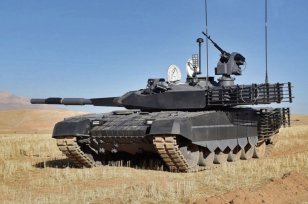 Iran has revealed to the public their new “Karrar” main battle tank. As can be expected, Iranian government sources have described the new vehicle in rather glowing terms, while releasing few details. According to
 . This book follows the same format as other New Vanguard titles, being a softcover of 48 pages. Illustrations for this book are by Felipe Rodríguez Náñez (aka Felipe Rodna).
 by Steven Zaloga takes a look at these two iconic tanks of the early WWII period. Those familiar with the Duel Series will know what to expect. This book is 80 pages with plenty of color images and black and white photos.

 Tank and AFV News