Book review of Tanks in Hell

tanks in tarawaThe Spectrum has published a review of the new book by Oscar Gilbert and Romain Cansiere, Tanks in Hell: A Marine Corps Tank Company on Tarawa.  This book was published earlier this year by Casemate.  Oscar Gilbert is the author of several books, with a focus on US Marine Corps armor.

Book Review excerpt:

Charlie Mason’s tank was inching its way toward a Japanese pillbox when incoming machine-gun fire sprayed his M4A2 Sherman, he remembered, “like hail on a tin roof.”

Mason’s tank, the CONGA, was part of Charlie Company, 1st Corps Medium Tank Battalion. Its job was to silence enemy strongpoints that acted as scythes against the lightly armed Marines invading the beaches of Tarawa.

After a bit of cat and mouse, CONGA fired and obliterated the Japanese pillbox. The victory, however, was short-lived. Later that day, CONGA was knocked out of action.

So it went for armor on Tarawa during World War II.

In the new book Tanks in Hell: A Marine Corps Tank Company on Tarawa(Casemate, $34.95), authors Oscar E. Gilbert and Romain Cansiere paint a vivid description of combat inside what was often referred to as “steel coffins.” And while writing about the fighting in the Gilbert Islands is not uncommon, focusing a book specifically on a single tank company on Tarawa is.

Read the full review here.

Book Review: T-64 Battle Tank by Zaloga

51mOjKKttzL._SX369_BO1,204,203,200_People familiar with Osprey’s New Vanguard series and with Steven Zaloga will know exactly what to expect from this title; a well written, well researched book with quality photos and illustrations. Mr. Zaloga also wrote the New Vanguard series books on the Soviet T-62, T-72 and T-80, so this volume completes the set nicely. That the T-64 is the last of the Soviet Cold War MBT’s to get its own New Vanguard book is indicative of how this vehicle has been overshadowed by its more well known stablemates. Ironically, the T-64 was perhaps the most important of the Cold War Soviet designs, setting the template for all the Soviet tanks that followed. Zaloga does a very nice job in describing the internal politics that led to the development of the T-64, a tale with more than a few characters and plot twists. It is perhaps appropriate that this book came out now, as it’s only been in the last year that the T-64 has seen combat, being used extensively in the fighting in Ukraine.

The only complaint regarding this book is the length.  As with all the Osprey New Vanguard titles, the book is only 48 pages.  Considering the number of photos and illustrations, the space available for text is rather limited and one gets the impression that Mr. Zaloga could easily fill a larger volume with his knowledge of this topic.  The “Further Reading” section at the end of the book shows that a good deal of information is available regarding the T-64, but it is almost exclusively in Russian language sources.  We can only hope that a publisher offers Mr. Zaloga a chance to write a more detailed hard cover book on Soviet post war tank development, perhaps an updated version of his classic “Soviet Tanks and Combat Vehicles: 1946 to Present” published back in 1987.  That said, this New Vanguard T-64 book is at present the best (and one of the few) volumes out there dedicated specifically to this essential battle tank of the cold war.

.

Book Review: Armored Campaign in Normandy by Stephen Napier

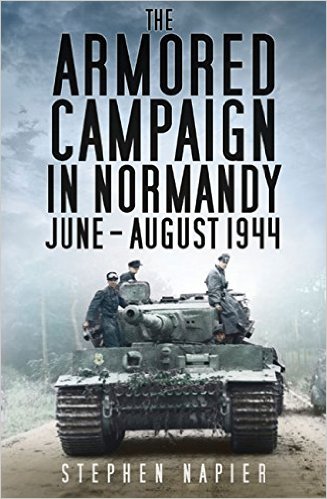
Armored Campaign in Normandy June-August 1944 by Stephen Napier

51ORzhG5PSL._SX325_BO1,204,203,200_Much ink has been spilled over the past 70 years on the Normandy Campaign of 1944 and about the tanks used in that campaign.  Author Stephen Napier decided to put his own mark on the discussion with his new book ” The Armored Campaign in Normandy.”  At over 400 pages of text, this is an impressive work,  well documented and footnoted.

Napier’s central thesis is that the performance of British Armored forces in Normandy was rather lackluster and often failed in the face of resistance from German forces, even when significantly outnumbering their opponents.  He lays the blame for this on a variety of factors, including General Montgomery, British divisional and regimental commanders, British tank doctrine and technical deficiencies of British tanks.  His analysis of the German commanders is even more harsh, noting the convoluted chain of command of the German forces in Normandy which was almost guaranteed to create indecision, confusion and defeat.

Napier approaches the subject by breaking down each of the major operations of the Normandy Campaign as a separate chapter, each chapter divided up by the combatants.  This approach means that the majority of the book focuses on the British Army and their Canadian and Polish allies.  The German and American armored forces are included, although they receive far fewer pages.  The book starts out with an examination of the use of armor on D-Day, focusing on the swimming “DD tanks” used on the beaches of Normandy by British and US forces.  He ultimately concludes that these DD tanks were not particularly effective and that Allied forces would have been just as well relying on tanks landed by LCT ships (although he notes that the US was much harsher in their judging of the DD tanks than the British.)

The next chapter is on the only one not focused on a particular battle, but rather describes the tanks and tactics used by the combatants of the Normandy Campaign.  Napier describes the armor and firepower deficiencies of the M4 Sherman and British Cromwell compared to some of their heavier German tank adversaries.  He also describes some of the daily realities that tankers faced in the Normandy Campaign, their lives spent maintaining and living inside a cramped metal box on treads.

The rest of the book is broken down into ten more chapters, each looking at a major operation.  Since most of these operations, such as Epson, Goodwood, Totalize, or Tractable, were initiated by UK forces, the focus of much of the book is on British armored units.  Napier’s descriptions of these battles is lively and he presents a good deal of detail.  Intermixed with his descriptions of the battles are quotes taken from participants of the action, both Allied and German.  These quotes add considerably to the book, helping to keep the readers interest and provide some color.  One nice touch is that Napier usually follows up these quotes with relevant information from the historical record.  This is quite useful in regards to the quotes from some of the German tank commanders who often make claim to killing a certain number of tanks.  Napier sometimes follows these quotes with unit loss figures from Allied sources, often showing that the German tankers exaggerated their kill counts by a factor of 2 or 3.

In popular accounts of the Normandy Campaign, much is often made about the technical disparities between Allied armor and the dreaded German Tiger and Panther tanks.  Napier addresses this issue, but keeps it within its proper context.  He notes that while this was factor, it was certainly not the only factor in explaining the sometimes poor performance of British Armor versus their German adversary.  If anything, the reader comes away with the impression that by 1944, the tank had lost the aura of invincibility that it had in the 1939-1941 era and that any attack by armor against a position well defended by tanks and anti-tank guns was bound to suffer heavy casualties.  This is illustrated not just by the attacks carried out by British units, but also by the counterattacks attempted by the German Panzer forces.  Despite whatever technical advantages the Panzer forces might have had, when used on the offensive in the Normandy Campaign, they almost always failed to achieve their goals.  This is well illustrated in the chapter on the ill-fated German Mortain counter-attack.

The book comes with a center section of black and white photographs.  While interesting, these pages would have been better used to include a more detailed series of maps.  The few maps included in the book are frankly a bit inadequate considering the number of battles described in the text.  That said, the book itself is well made and the paper quality good.  Personally, we feel that a picture of a British tank would have been more appropriate than the Tiger tank which adorns the front duct jacket, but we realize that nothing sells a tank book quite like the image of a Tiger tank.  That said, we highly recommend this book for those looking for an account of armor in the Normandy Campaign.

Special thanks to Casemate publishing for providing a review copy.

Books best avoided: Steel Steeds Christie

31AdPdFN25L._SL500_BO1,204,203,200_Lately I have been thinking a good deal about the role of Walter J. Christie in pre-WWII tank development.  As I have been attempting to assemble as much information concerning Christie as I can, I discovered that in the mid 1980’s, Christie’s son Edward wrote a short book about his father’s career called “Steel Steeds Christie.”  This book was published by a vanity press and is now quite rare and expensive.  Fortunately, ARMOR magazine featured a review of this book back in the Jan-Feb 1986 issue.  The review, by retired Col, Leo D. Johns, is quite negative, prompting a number of replies from both Edward Christie defending his book, and other readers posting even harsher reviews than the original one by Col, Johns.  I have reprinted the original review below as well as the various letters to the editor concerning the book.  I have provided these letters in part as a warning to anyone thinking about shelling out the dough to purchase a copy of this rare book, but primarily because I think these letters are really quite entertaining.

[Read more…]

Book Review: Armored Champion by Steven Zaloga

index“Armored Champion: The Top Tanks of World War II” is the latest installment in the “Armored” series of hardcover books written by Steven Zaloga, published by Stackpole Books.  While the first three of Zaloga’s “Armored” books focus on US armor of World War II, this latest book takes a broader look at the tanks used in that conflict, examining and declaring “the top tanks of World War II.”  The idea of declaring the top tanks of the war is a bit of a departure from the authors previous works.  At first glance it reminds one of the  innumerable “top ten” cable TV documentaries and internet forum threads dedicated to such a premise.  However, if anyone is qualified for the task of putting together such a list, Steven Zaloga must be at the top of the list due to his 40 years of research in the field and prodigious output as a writer.

It’s fair to say that this is the first book of his that seems intended to generate controversy  based on its premise and title.  One has to wonder if this book is intended as Zaloga’s response to the internet generation’s predilection with lists and rankings.  As far as this reviewer can tell, this is the first work by Zaloga in which he references online games such as “World of Tanks” and he also at one point uses the internet idiom of “Nazi fanboys” to describe admirers of SS Panzer ace Michael Wittman!

[Read more…]

Book Review: The Tank Factory by William Suttie

The Tank Factory: British Military Vehicle Development and the Chobham Establishment  by William Suttie

Publishers Description:

tank factoryDespite being the inventor of the tank and responsible for campaign-winning tactics, by the start of the Second World War the United Kingdom had fallen well behind other nations in the design and build of armoured vehicles. Here, William Suttie uncovers the history of tank design from a government perspective and the decisions and failures that led to that state of affairs, and details the formation of the Fighting Vehicles Research and Development Establishment at Chertsey. Known as the Tank Factory, the Chertsey establishment sought to ensure that the United Kingdom became world-leading in the field of military vehicle research and design, and that the British Army would never be underprotected or outgunned again. Drawing on unpublished sources and photographs, this fascinating book reveals the establishment’s history, its groundbreaking research and its inventions and designs, including first-hand insights from those who worked there.

“The Tank Factory” by William Suttie is best described as a developmental history rather than a combat history of British Armor.  Those looking for descriptions of tank battles or tales of tanker daring-do will have to look elsewhere. This book is a history of the institutions and organizations responsible for the design and production of British tanks, not their use in the field.  The focus on the developmental aspects of British armor is not surprising given the authors background as a scientist for the UK Ministry of Defense for over 30 years.  Mr. Suttie uses his knowledge and access to unpublished materials to good effect, creating a rather detailed and comprehensive study of the topic.  While his writing style is clear and understandable, the somewhat dry nature of the topic may deter some readers.  The fact that the book is prefaced with a four page glossary of acronyms is a pretty good warning that this book is not light reading!

[Read more…]

Book Review: Tanks: 100 Years of Evolution by Ogorkiewicz

tanks ogorkiewiczIn the first sentence of his new book “Tanks: 100 Years of Evolution” author Richard Ogorkiewicz states that “this book is the outcome of several years of study on the evolution of tanks.”  It’s probably fair to say that the phrase “several years” is a gross understatement.  No one has been studying and writing about tanks and armored warfare for as long as Richard Ogorkiewicz.  His first book “Armor: the Development of Armored Forces” came out in 1960.  This was followed by “Design and Development of Armored Vehicles” in 1968 and by the two volume set “Technology of Tanks” in 1991.  This new book is in some ways a combination of the three previous works, updating and condensing them into a single volume.

The book is approximately 300 pages, with the first half of the book devoted to early tank development and armored forces up through the Second World War.  The second half of the book includes a description of postwar tank development organized by country.  Russia, Germany, the USA, Britain and France get the most coverage, although other countries such as Switzerland, Sweden, Israel and the tank producing countries of Asia get attention as well.  [Read more…]

Book Review: A13 Cruiser Mk.V Covenanter A Technical History by P.M. Knight

Not much attention has been paid to the Covenanter tank other than as a footnote in the sad story of British WW2 tank design. P.M. Knight decided to change that situation, paying a great deal of attention to the Covenanter in A13 Cruiser Mk.V Covenanter A Technical History, a well researched and written book. The Covenanter never saw combat, being relegated to training duty due to issues concerning reliability. Therefore, the book is primarily concerned with the technical and developmental history of the Covenanter rather than its service history. [Read more…]
Book Review: AMX-30 by M.P. Robinson

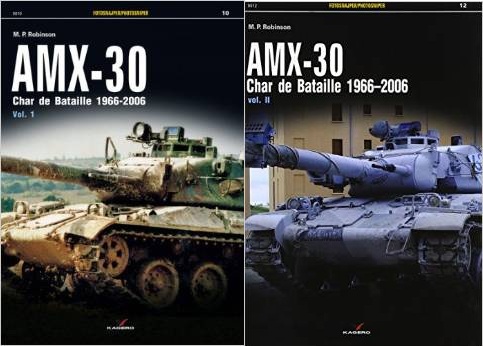
AMX 30 RobinsonIt’s fair to say that as far as cold war era tanks go, the AMX-30 has never received as much attention as vehicles like the British Centurion and Chieftain, the US Patton series, and the German Leopards.  In fact, the only thing published specifically on the AMX-30 in English (as far as we can tell) is AFV Weapons Profile #63 by R.M. Ogorkiewicz way back in the early 70’s!  Clearly, this is a vehicle that deserves better than one book in 50 years, so it was a welcome development when Polish publisher Kagero released this new two volume set on the AMX-30.  The author of the book, M.P. Robinson remains a bit of a mystery.   The book does not include an “about the author” section and a quick google search does not reveal any other books written by Mr.  Robinson.   Fortunately,  Mr. Robinson is more than up to the task given him. [Read more…]

From the Editor: Debunking Deathtraps Part 1

(Editors note: this originally appeared in my old blog – tankandavf.blogspot.com – on 2/26/2015.)traps

When it comes to the history of armored warfare in the Second World War, the US M4 Sherman tank is always sure to draw controversy and a good bit of discussion.  Invariably, when this topic is raised in an online forum, someone will bring up the book “Death Traps” by Belton Cooper.  With a forward by popular historian Stephen Ambrose and the backing of a major publisher, Death Traps has become quite well known amongst WW2 history aficionados.  Mr. Cooper has been featured in TV documentary specials as well, including the history channel series “Engineering Disasters“, which has further increased awareness of his book.

[Read more…]