

Publishers Description:
What was the ‘circle of death’? Whose Panther was found at a railway station? Can a 37mm Sturmovik cannon destroy a Panther? Which new tank round was tested by the Russians in 1945? What aircraft weapon scored the most Panzer kills in Hungary? The answers to these and other questions are to be found here in Panzerwrecks 20, with 98 rare and unpublished large format photographs from Russian archives, 49 wartime sketches and specially commissioned artwork by Felipe Rodna.
Nearly every photograph is from an album unearthed from the depths of a Russian archive, and was produced by the 17th Air Army during their evaluation of the effects of aircraft weapons on German (and Hungarian) tanks in the field. No test reports on training grounds and firing ranges here – everything is based on genuine after-action and field reports. Not only have we included the photographs and data from the captions, but many of the accompanying sketches too.

 A paperback reprint of Tanks of the Great War, 1914-1918 by
  The Panzer II was Germany’s first cannon-armed tank in the post World War I era. Designed and initially produced under the code name of 100-horsepower Farm Tractor, owing to the restrictions of the Treaty of Versailles, the Panzer II remained in production, and in the field, well after it had been surpassed by better engineered, more heavily armed and armored vehicles, and indeed played a key part in the early victories achieved by the Blitzkrieg.
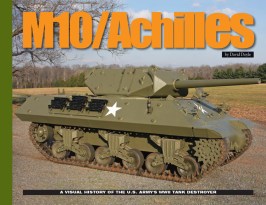 In late 1941 the concept of a separate tank destroyer force began to jell. This force would be armed with specialized weapons. While the army’s primary antitank weapons of the late 1930s were 37mm towed anti-tank guns, these were soon deemed to be inadequate against enemy armor. Accordingly, the quest for larger weapons began, as did the desire for a self-propelled antitank gun, or Gun Motor Carriage. The initial efforts, which involved adapting 3/4-ton, Dodge trucks to mount antitank weapons (the M6, née WC-55), which were intended as interim and training vehicles. In the same manner, half-tracks were fitted with cannon, yielding the M3 75mm Gun Motor Carriage. But, the quest was on to create a specialized and ideal tank destroyer, utilizing a tank chassis as the basis.
 Those interested in the development of Soviet armored and combined arms warfare doctrine in the pre-WW2 era may find this recently released book worth looking into,
  that author Richard W. Harrison has written on Isserson. At the bottom of this post we have also provided a youtube clip of author Richard Harrison giving a talk on Isserson for those interested in learning more about this important, yet relatively forgotten figure in Soviet military history.
 Sabot Publications is a relatively new publisher and
  The book is roughly magazine sized, with card stock thickness covers, a strong binding and nice quality glossy pages. Total page count is 128 pages. This book should serve as a very handy reference for model builders who decide to tackle this rather unusual vehicle. Sabot Publication is planning a second volume looking at the M60A2 which should be available relatively soon. Other Sabot titles include volumes on the M1A2 SEP Abrams and the M9ACE, and upcoming titles include those looking at the Stryker MGS, Patriot Mobile Missile Defense System, M1 ABV, and the MLRS. For more information regarding Sabot Publications, be sure to
  by Mike Guardia looks at this somewhat lopsided match-up from the 1991 Persian Gulf war. This is Mr. Guardia’s first entry in the Duel series, although he has written some other titles for Osprey, as well as books for other publishers. This new book follows the familiar format of the Duel series, being 80 pages in length and features illustrations by Alan Gilliland.
 by David Render has been released. From what we can tell, print copies of the book have been released in the UK but not yet in the US. This is a pretty substantial memoir, coming in at 320 pages. According to the Amazon listing David Render is one of the very last surviving Second World War tank troop commanders to have participated in the D-Day landing and the entirety of the subsequent fighting in the Allies campaign to liberate Europe in 1944 and 1945.
 Today we take a look at
  . As the title implies, this book examines the M1A2 SEP Abrams MBT. The book is 104 pages and features full color photos, color plates and scale diagrams. This book was followed by the recently released 126 page volume
  . As far as we know, this is the most detailed examination of the M9 Ace published to date. Ampersand Group did a nice review of the M9 ACE book which can be viewed at


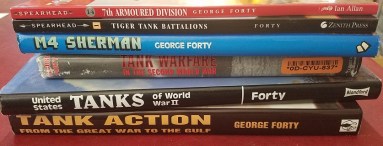 We apologize for being a month late with this news. George Forty, author and historian, British Armor veteran and former Curator of the Tank Museum at Bovington passed away on May 19, 2016 at the age of 88. Mr. Forty was instrumental in making the Tank Museum at Bovington one of the best institutions of its type in the world during his tenure in the 1980’s and early 1990’s. He was one of the most prolific writers on the topic of armored warfare and armored vehicles as well, a sampling of which can
  He left the Army in 1971 to pursue a writing career and in 1981 was appointed Director of the Tank Museum. During the next twelve years with the inspirational help of his wife Anne, who worked alongside him, he tripled the size of the museum, modernised it and turned it into one of the foremost military museums in Europe. Shortly after retiring from the museum in 1993, he was made a fellow of the Museums Association (FMA) and was awarded with an OBE in the 1994 New Year’s Honours List.
 Amazon is listing a July 8 release date for the upcoming book
  as far as an overall history of the M4, Hunnicut’s
  as far as an developmental history, or
  as far as a detailed vehicle description.
 Tank and AFV News