Book Review: Dubno 1941: The Greatest Tank Battle of the Second World War

Dubno 1941: The Greatest Tank Battle of the Second World War

By Aleksei Isaev

Helion & Company

The first thing potential readers may notice about this book is the subtitle, which proclaims the 1941 battle of Dubno to be the greatest tank battle of WWII.  To those familiar with the history of the Second World War, this might cause some confusion.  Ask the average WWII fan to name a tank battle and you will probably get replies such as Kursk, Alamein, or The Bulge.  But Dubno?  It’s probably fair to say most casual readers haven’t even heard of this battle, let alone know that it was one of the largest tank battles of the war.  Fortunately, Russian historian Aleksai Isaev tries to correct this situation in his new book, Dubno 1941: The Greatest Tank Battle of the Second World War.

Before we get into the content of the book, let’s start with a description of the book itself.  This is a 244 page hardcover volume.  The book is surprisingly heavy due to the dense, high quality paper used.  The paper texture is very smooth to the touch and provides good photo reproduction quality for the several image galleries found in the book.  The galleries consist primarily of images of tanks and also pictures of some of the commanders who play a part in the battle.  The book uses footnotes rather than endnotes and contains a rather useful series of appendices, a bibliography and an index.

This book was originally written in Russian and translated into English by Kevin Bridge.  The translation reads fairly well, although every so often a sentence will come off a bit clunky.  Whether this is due to the original text or to the translation is hard to say.  One translation error that jumped out at us was the mention of Western researcher “Thomas Yentz.”  Those well read on German armor will of course recognize this person as Thomas Jentz.  The publisher provides a disclaimer at the start of the book noting that the translation has kept partisan statements such as “our tanks” and “our aircraft” in the text.  This is a Russian book written by a Russian author and as such, it focuses much more on the Russian perspective of the battle than the German.

The text of the book is relatively straight forward, starting with a description of forces on both sides of the battle forces at the onset of Operation Barbarossa.  The chain of events from the launch of the German invasion on June 22 up to the Dubno battle a week later are explained with a good deal of detail.  A few maps are provided in the text, although readers may want to get a more detailed map of their own to prevent getting lost in the various details of unit movements and dispositions.  For those looking for individual accounts of combat or Steven Ambrose style history, this book will be quite dry and unrewarding.  For those looking for a detailed operational level description of events with analysis, this book should prove enjoyable.

The book ends with a conclusion offering an overview of the events and some analysis explaining why things turned out the way they did.  Isaev provides several reasons for why the Soviets lost this battle, primarily lack of experience and training, poor communication and poor unit organization compared to their German adversary.  One other factor that seems to crop up continuously in the description of the fighting is a lack of proper artillery support for Soviet armored units due to a lack of suitable prime movers.

Throughout the text the author regularly emphasizes certain points that he sees as important for having been misinterpreted or left out of Soviet era histories.  However, since most Western readers will not be familiar with these older histories, these points by the author may seem a bit confusing.  One thing not addressed in great detail in this book is the issue of why this battle, as large as it was, is so little known.  For the answer to that question, one needs to take a dive into the world of post war Soviet historiography.  And while this book avoids that topic, the next book in our review pile fearlessly plunges into it. (The Battle of Kursk: Controversial and Neglected Aspects by Valeriy Zamulin by Valeriy Zamulin – expect the review later next week.)

For those interested in learning more about this battle, we would easily give this book a recommendation, provided people understand this is a pretty information dense book.  Those looking for some light reading should go elsewhere.  This volume is one of several Russian language WWII histories that Helion & Company have brought over to the English reading public.  We commend them for doing so and hope the keep it up.
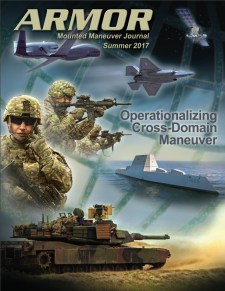
Book Alert: New Issue of ARMOR available

Armor summer 2017The Summer issue of ARMOR magazine is available for download at the eArmor website. According to the cover, the theme of this issue is “Operationalizing Cross-Domain Maneuver” (is “operationalizing” a real word?)  Anyhow, those interested in tank hardware may find the article Cordoba Cats: Ejercito de Tierra’s Leopard 2E Main Battle Tank, which looks at the Leopard 2 tanks of Spain, to be worth checking out.

Download the Summer 2017 issue of ARMOR here.

Book Alert: Patton’s Juggernaut: The Rolling 8-Ball 8th Tank Battalion of the 4th Armored Division

This month saw the release of a new book by retired general and WWII veteran Albin F Irzyk titled Patton’s Juggernaut: The Rolling 8-Ball 8th Tank Battalion of the 4th Armored Division.  Irzyk, who turned 100 years old earlier this year, is a well known figure to those interested in US Armor history.  He has appeared in numerous TV documentaries and has authored several books about his experiences as a young officer in the 4th Armored Division during WWII.

Publisher’s Description:

This is the biography, not of an individual but of a small military unit. The life span of this unit was extremely brief – less than three years. It began on September 10th, 1943 and ended on May 15th, 1946, when it ceased to exist. It is about the 8th Tank Battalion, 4th Armored Division.

Combat was the destiny of this Battalion. It was created as a Combat Battalion. It was organized primarily, fundamentally, and solely to fight the German Army in Europe. And fight it did, splendidly, spectacularly and courageously.

I feel very possessive about this Battalion. I was a major factor in training it for combat. I was in it every day the Battalion was in combat, much of it after assuming command at the age of twenty seven. I believe that there was a special bonding between my men and me.

It was a great honor and privilege to command these tankers and to witness what they accomplished. In my opinion, our nation has never fully understood or appreciated the fantastic role played by such boys and very young men.

They proved themselves on the toughest testing ground of man – the field of combat. Nothing in my long, full life could compare with the priceless opportunity that I had to command the men of the 8th Tank Battalion. This is their story.

Book Alert: Panzers East and West: The German 10th SS Panzer Division from the Eastern Front to Normandy

Those with an interest in WWII German Panzer units will be happy to know that a new book has been released from Stackpole on the history of the 10th Panzer Division.  Written by Dieter Stenger, Panzers East and West: The German 10th SS Panzer Division from the Eastern Front to Normandy is a 400 page hardcover volume.  According to the Stackpole website, Dieter Stenger is is a veteran of the U.S. Marine Corps and has worked in the museum field for two decades, including stints at the Marine Corps Air-Ground Museum, the U.S. Naval Academy Museum, the National Museum of the Marine Corps, and the U.S. Army Center of Military History, where he is senior arms curator.  We haven’t had a chance to look at this book so that’s all we can really say about it.

Publisher’s Description:

Organized and trained during 1943, the 10th SS Panzer Division saw its first action in the spring of 1944 during the attempt to relieve an encircled German army on the Eastern Front. Several months later, Hitler ordered the 10th SS west to Normandy, where by mid-June 1944 German defenses against the Allied offensive were crumbling. Here the division engaged in a series of armored attacks and counterattacks against British and American forces. The 10th SS briefly held off a few enemy thrusts but gradually had to fall back to Falaise, where the division escaped the Allied encirclement with no tanks and only a fraction of its men. The 10th SS Panzer Division next defended against the Allied parachute assault during Operation Market Garden in September 1944. Depleted and now a division in name only, the 10th SS fought in Alsace before Hitler sent it to the Eastern Front again. There, east of Berlin, the division participated in the final, futile battles against the Red Army before escaping to Czechoslovakia to surrender to the U.S. Army.

Book Alert: British Battle Tanks: British-made tanks of World War II

Osprey Publishing has released a new hardcover book by David Fletcher titled British Battle Tanks: British-made tanks of World War II.  This book is a follow-up to last years book British Battle Tanks: World War I to 1939.  For those familiar with the WWI book, this new book follows the same format, although with a slightly higher page count (280) than the previous book.  This is a well illustrated book, with photos, drawing or charts on every page accompanying the text.  These books are both published in association with the Tank Museum at Bovington.  Author David Fletcher served for many years as the Museum historian and is widely regarded as one of the most knowledgeable researchers on the topic of British armor.

Publisher’s Description:

Building on the earlier volume dealing with British armor of the First World War, this is the second of a multi-volume history of British tanks by renowned British armor expert David Fletcher MBE.

This volume traces the story of the British use of the tank through the early years of World War II, when Britain relied on its own tanks built in the late 1930s, and those designed and built with limited resources in the opening years of the war. Plagued by unreliable vehicles and poorly thought-out doctrine, these were years of struggle against an opponent well versed in the arts of armored warfare. It covers the development and use of the Matilda, Crusader, and Valentine tanks that pushed back the Axis in North Africa, the much-improved Churchill that fought with distinction from North Africa to Normandy, and the excellent Cromwell tank of 1944–45. It also looks at Britain’s super-heavy tank projects, the TOG1 and TOG2, and the Tortoise heavy assault tank, designed to battle through the toughest of battlefield conditions, but never put into production.

Book Alert: Dubno 1941: The Greatest Tank Battle of the Second World War

According to Amazon, today marks the North American release of the new book Dubno 1941: The Greatest Tank Battle of the Second World War by Aleksei Isaev.  This is a 224 page hardcover published by Helion and Company.  Mr. Isaev has written numerous books on the Eastern Front during WWII, primarily in Russian.

Publisher’s Description:

In June 1941 – during the first week of the Nazi invasion in the Soviet Union – the quiet cornfields and towns of Western Ukraine were awakened by the clanking of steel and thunder of explosions; this was the greatest tank battle of the Second World War. About 3,000 tanks from the Red Army Kiev Special Military District clashed with about 800 German tanks of Heeresgruppe South. Why did the numerically superior Soviets fail? Hundreds of heavy KV-1 and KV-2 tanks, the five-turret giant T-35 and famous T-34 failed to stop the Germans. Based on recently available archival sources, A. Isaev describes the battle from a new point of view: that in fact it’s not the tanks, but armored units, which win or lose battles. The Germans during the Blitzkrieg era had superior T&OE for their tank forces. The German Panzer Division could defeat their opponents not by using tanks, but by using artillery, which included heavy artillery, motorized infantry and engineers. The Red Army’s armored unit – the Mechanized Corps – had a lot of teething troubles, as all of them lacked accompanying infantry and artillery. In 1941 the Soviet Armored Forces had to learn the difficult science – and mostly ‘art’ – of combined warfare. Isaev traces the role of these factors in a huge battle around the small Ukrainian town of Dubno. Popular myths about impregnable KV and T-34 tanks are laid to rest. In reality, the Germans in 1941 had the necessary tools to combat them. The author also defines the real achievements on the Soviet side: the Blitzkrieg in the Ukraine had been slowed down. For the Soviet Union, the military situation in June 1941 was much worse than it was for France and Britain during the Western Campaign in 1940. The Red Army wasn’t ready to fight as a whole and the border district’s armies lacked infantry units, as they were just arriving from the internal regions of the USSR. In this case, the Red Army tanks became the ‘Iron Shield’ of the Soviet Union; they even operated as fire brigades. In many cases, the German infantry – not tanks – became the main enemy of Soviet armored units in the Dubno battle. Poorly organized, but fierce, tank-based counterattacks slowed down the German infantry – and while the Soviet tanks lost the battle, they won the war.

Book Alert: Fallen Giants: The Combat Debut of the T-35A Tank

Those interested in early WWI tank combat on the Eastern front may want to check out this new book titled Fallen Giants: The Combat Debut of the T-35A Tank.  Written by Francis Pulham, this is a 144 page softcover book.  Beyond that, we really don’t know much about this one or about the publisher, Fonthill Media.  This would appear to be the first book on tank warfare written by this author.

Publisher’s Description:

The Soviet T-35A is the only five-turreted tank in history to enter production. With a long and proud service history on Soviet parade grounds, the T-35A was forced to adapt to the modern battlefield when the Second World War broke out. Outclassed and outdated, the T-35A tried to hold its own against the German invaders to no avail. Very little is known about these strange vehicles, beyond their basic shape and photographs of them on parade grounds and battlefields. For the first time, actual battlefield photographs have been cross-referenced with maps and documents to bring about the most complete look at the T-35A in the Second World War to date. It is a grim depiction of the aftermath of the giants that were the Soviet T-35A tanks.

Edit: Sonny Butterworth posted a comment with some additional information about the author of this book.  We thought it merited posting in the main article.

The author has a Facebook page on which he regularly posts photos from his private collection. This book should be one of, if not the most, authoritative works published on the T-35, at least in English. From what I understand, Frankie Pulham has worked on identifying individual tanks by chassis numbers and their specific features in order to document their combat careers and fates. So should be a good book both for rivet counters and those interested in this tank’s operational history.  He is now working on a book documenting T-34 variants, including those produced outside of the Soviet Union.  You can also listen to Frankie talk more about the T-35 and his book on this podcast.

Book Alert: British Infantry Tanks in World War II

Kagero Press has released a new entry in their Photosniper series. This new book by Dick taylor is titled British Infantry Tanks in World War II (Photosniper). This is a softcover book of 96 pages with color photos and illustrations. While we have not gotten our copy of this book in the post yet, we have been pleased with other books of this series as well as with other books written by Dick Taylor.

Publisher’s Description:

Before the start of the Second World War, British armored doctrine was in a terrible muddle. Opinion had been divided between the proponents of the tank who saw it as the weapon of break-in, using it as an infantry support weapon, and those who saw it as the weapon of breakout, using it to restore mobility and to destroy the enemy’s forces behind the frontline. In many ways it was a division between those who saw the tank solely through the prism of the experience of the First World War, and those who saw it a decisive weapon for the future. Britain was also conscious of the continuing requirements for imperial policing, in which small tanks and armored cars had already proved their worth. As a consequence, it was decided that Britain needed three different classes of tanks: Light tanks for the policing role that could also be used for reconnaissance duties in a general war, fast and lightly armored Cruiser tanks for breakout and exploitation, and heavily armored but slow Infantry tanks for the break-in.

Book Alert: Nothing Impossible: Memoirs of a United States Cavalryman In World War 2

A new memoir of a WWII armor veteran has been released.  Nothing Impossible: Memoirs of a United States Cavalryman In World War 2 tells the story of the late Wallace Clement who served in the 804th Tank Destroyer Battalion in Italy.  This is a softcover book of 210 pages.

Publisher’s Description:

Merriam Press World War 2 Memoir Series
First Edition 2017

The late Wallace Clement served in three wars, World War II, Korea and Vietnam. A West Point Cadet, he entered the Army as a 2nd Lt. in 1940, rising to the rank of Major in 1944, serving with the 804th Tank Destroyer Battalion in Italy where late in the war he was captured and ended the war as a POW.

He served in the Korean War, as a Lt. Colonel, and in Vietnam as a Brig. General as assistant division commander of the 23rd Americal Division.

He was awarded every medal that a soldier can receive save for the Medal of Honor.

This is his story, written by him, and edited by a good friend, Sean Heuvel, who as a boy listened to Clement tell his tales of his service.

Book Review: Soviet Lend Lease Tanks of World War II

When it comes to book series about tanks and armored vehicles, Osprey Publishing’s New Vanguard series certainly holds claim to being the longest running.  The publication of Soviet Lend-Lease Tanks of World War II (New Vanguard), the 247th book in the series, is a testament to the popularity and quality of these books.  Much of the success of this series has to be attributed to the authors and illustrators that Osprey has been able to assemble, with Steven Zaloga being one of the most prolific and respected of the New Vanguard contributors.  With this new title on Soviet Lend Lease tanks he adds yet another entry into his already impressive bibliography.

For those not familiar with the format of the New Vanguard titles, these books are softcover, 48 page books, with numerous photographs, illustrations, and charts.  The earlier books in the series tended to focus on fairly well known vehicles, making them decent introductory primers on the subject.  As the series has gone on, the more obvious topic choices have been largely exhausted, opening up opportunities for less explored subjects.  One such example is Soviet Lend Lease tanks of WWII, which as far as we know has never been the sole topic of a book until now.

Having long been regarded as one of the foremost experts on Soviet armor history writing in English, Steven Zaloga is the ideal candidate to author this volume.  His writing is clear and understandable, containing a considerable density of information yet never becoming impenetrable.  The photos are well chosen and the paper quality is good, making for good photo reproduction.  The illustrations are attractive and appear to be accurate representations.  Given the relatively limited length of the book, technical specifics of the various lend lease vehicles is limited.  This is understandable since these individual armored vehicles all are described in other New Vanguard titles (as well as many other books.)  The focus of the book is on the role that these lend lease vehicles played within the Red Army and the interplay between the Soviet war planners and the Western officials in charge of Lend Lease deliveries.

One of the more interesting aspects of the story of these Lend-Lease vehicles is the Soviet interpretation of their quality and classification.  For example, while the British supplied three different types of “infantry tank” via Lend-Lease (the Matilda, the Churchill and the Valentine), the Soviets had to reclassify these vehicles according to their own system.  Hence, the Matilda and the Churchill were deemed heavy tanks while the Valentine was deemed a light tank.  Given the relatively weak armament of the Matilda and Churchill tanks compared to Soviet Heavy tanks, it’s not surprising that no more of them were asked for.  On the other end of the spectrum, the Valentine was rather well armed and armored compared to the Soviet T-60 light tank, so the Valentine was requested by Soviet forces even after it was regarded as outdated by British forces.

While British tanks made up most of the early war Lend-Lease shipments to the USSR, by the later part of the war the US was making the majority of the tanks being shipped.  Of course, the ubiquitous M4 Sherman became the primary tank sent overseas from the USA, being dubbed “Emcha” in Soviet service.  The primary variant sent was the M4A2, preferred by the Soviets due to its diesel engine.  One of the more unusual US vehicles in Soviet service was the T48 57mm motor gun carriage.  Intended as a tank destroyer, this was a US halftrack with a 57mm anti-tank gun mounted on top.  After these vehicles were rejected by the British, they were offered to the Soviets who took several hundred into service, renaming it the SU-57.  The SU-57 would become the only Lend-Lease combat vehicle used exclusively by the Red Army.

For those looking for statistics regarding Lend-Lease tanks, there are two pages of charts at the end of the book that will prove very useful.  Numbers are provided for total numbers of tanks shipped and received, broken down by vehicle type, year, and country of origin.  Also provided are numbers for Lend-Lease armored vehicles in service with the Red Army by type at the end of the war.  It is rather interesting to consider that in May of 1945 there were still 40 British Matilda tanks in Soviet service!  The book ends with a final assessment, stating that while tank shipments to the USSR were by no means insubstantial, they played a relatively small role in the Lend-Lease story compared to the large amount of trucks and raw materials that were shipped.  That said, these vehicles did play a role in filling production shortfalls experienced by the Soviets, particularly in 1942 when much Soviet heavy industry was still recovering from their rather hasty relocation eastward to avoid German occupation.

For fans of Eastern Front tank warfare history, this book will fill a niche that has not been addressed in a single volume.  For those interested in the tanks of the Western Allies, it provides an intriguing look into how these familiar vehicles were regarded by a foreign user in an environment very different from the deserts of North Africa or Western Europe.  The book retails for $18 and can be found at book stores and hobby shops as well as online.