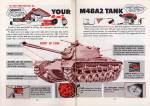
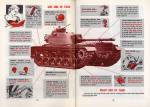
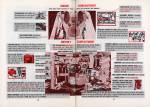
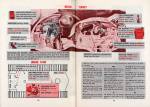
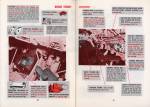
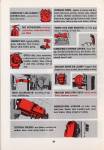
Today we present an article from issue 91 of PS Magazine 1960 series on how to inspect a M48A2 tank. The language of the article is particularly amusing, as the authors rather awkwardly make use of the slang of the day to proclaim “Yes-sir-ee, man, that M48A2 is real hip, the swingingest – ‘specially with that space-age fuel injection job.” This document should give the reader a pretty good picture of the various systems of the M48A2.


From the Vault: British Glossary of Tank terms
May 30, 2015 by Leave a Comment
Today we present an article from issue 18 of the wartime publication “Tactical and Technical Trends.” This particular article is a glossary of British terms used in relation to armor. These are all technical terms, so unfortunately this article will be of little help to those wanting to learn the slang of the average WWII British tanker. However, it may still prove of interest to those looking for a list of basic tank related terms.
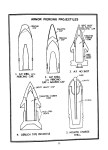
From the Vault: Caccolube
May 29, 2015 by Leave a Comment
This video from 1943 has been making the rounds the past couple years on a variety of websites. It’s a wartime training film from 1943 from the O.S.S. (Office of Strategic Services) showing a rather innovative (?) way to destroy the engine of an enemy tank or truck. Essentially, it’s a condom filled with abrasive powders and crushed walnuts that was intended to be dropped into an engine crankcase. Once this is accomplished, the caccolube goes to work, causing the enemy engine to seize up after being run “20 to 30 miles.” We will leave it to the viewer to determine how effective a weapon caccolube may have been.
From the Vault: M60 tank videos
May 20, 2015 by Leave a Comment
Today we present a series of video clips about the US M60 Main Battle Tank.
Our first video came to our attention when it was posted in a thread on Tank-Net earlier this month. It includes some rather interesting footage taken by a camera inside the turret of a Marine Corps M60A1 during a live fire exercise.
This video uploaded by TankNutDave is from the 1980’s and shows crewmen of an M60A3 explaining the turret operations of the tank.
Next up is a 1960’s era government documentary (part of “The Big Picture” series) on the development of the M60 tank. This video contains a good deal of footage of the M60 production line at the Detroit Tank Arsenal.
Finally, we finish are selection with this video of an M60 tank being used to crush a Mazda.
From the Vault: German tanks of World War I
May 11, 2015 by Leave a Comment
Today we present an article from the 1923 July-August edition of the Journal of the Army Ordnance Association on German Tanks. Authored by R. Kruger, this six page article gives a fairly detailed technical description of the tanks designed by Imperial Germany during the war. In particular, the heavy A7V is examined as well as the A7V -U and the Light LK I and LK II tanks. On the final page of the article is a short piece on “Who invented the tank?” In this piece, it is pointed out that while the British were the first to use tanks in combat, the first patent issued for a tracked fighting machine was given to Gunther Burstyn of Austria in 1912.
From the Vault: Christie Motor Carriage
May 6, 2015 by Leave a Comment
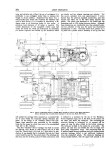
Today we present an article on “Christie Motor Carriages” from the March – April 1922 issue of Amy Ordnance magazine. Written by H. E. Pengilly, the article looks at some of the early designs created by famous tank designer Walter J. Christie. Christie is most well known for being the first designer to create armored vehicles with independently sprung suspensions, giving them very high mobility for their era. Christie was also fixated with convertible tracks, vehicles that could operate both with and without tracks. The motor carriages in this article are examples of some of his early “convertible” designs.
From the Vault: Ordnance article on Mark VIII tank
May 5, 2015 by Leave a Comment
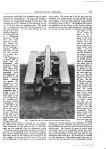
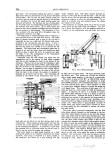
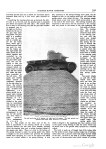
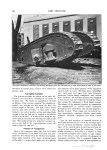
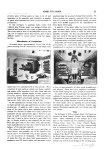
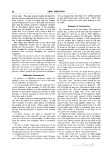
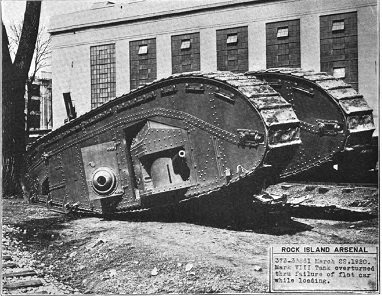 Today we present an article from The 1920 July-August issue of Ordnance magazine on the “Manufacture of Mark VIII tanks at the Rock Island Arsenal” by Harry B. Jordan. The article describes the construction of these vehicles, one of the very first tanks assembled in the United States. For those interested in the technical details of these early tanks, this article should prove illuminating. There is also a somewhat amusing photo in the article of a Mark VIII that flipped upside down during a loading accident.
From the Vault: US report on Japanese tank and antitank warfare
May 4, 2015 by Leave a Comment
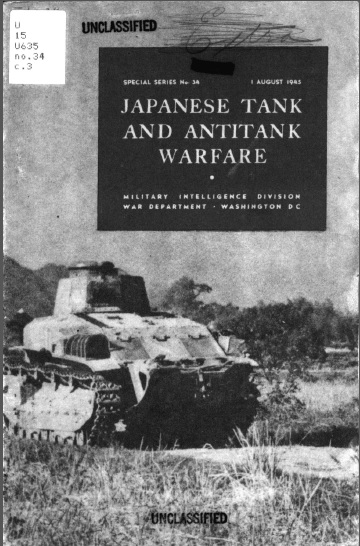 Today we present a link to a PDF of the US report “Japanese tank and antitank warfare, Special Series no. 34.” This document was released on August 1, 1945 and was intended to replace several earlier reports on Japanese tanks and antitank weapons and methods. Unfortunately the reproduction of the document is not perfect, the text is easily readable but some of the pictures are a bit hard to see. However, there is much in this report that will be of interest to those curious about Japanese armor. Vehicle descriptions are provided, as well as descriptions of all the known guns which equipped Japanese tanks. Japanese armored tactics and organization are also addressed in this report, as well as antitank equipment and tactics.
From the Vault: US description of Soviet tanks from 1942
May 1, 2015 by 1 Comment
Today we present an article from August 13, 1942, US Army publication Tactical and Technical Trends #5. The technical information is relatively accurate although the illustrations leave a bit to be desired. This article gives a good impression of how well informed the US military was concerning armor development on the Eastern Front in 1942. It is interesting to note that the longest paragraph in this report deals with aspects of the T-34 design intended to allow infantry to ride on the tank or to prevent enemy soldiers from climbing aboard.
Tank warfare has taught the Russians lessons which have influenced their tank design. The turret is located well forward to permit tank infantrymen (desyanti, see tactical and Technical Trends No. 3, page 44) to use it as a shield while riding atop the tank. Every provision has been made to prevent unwelcome riders from getting aboard. There is a lack of external fittings, tools, sharp projections, etc.: this meets the double purpose of eliminating hand grips for enemy hitch-hikers and the chance that a fire bomb or other missile could lodge on the tank. The fender of the tank is very narrow so that “tank hunters” who seek to jump aboard run the risk of being caught in the track. The newer American sponson-type tanks have no fenders as such and have solved these problems largely through basic design. As a further protective measure for the tank crew, the hatch in the top of the turret is so constructed that it cannot be opened from the outside. A special tool is required to open the hatch from the inside.



From the Vault: The External Gun Turret (ARMOR Jan-Feb 1996)
April 28, 2015 by Leave a Comment
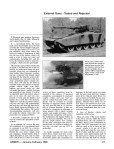
With all the attention focused on the new Russian T14 Armata tank, we thought it was appropriate to post this article from the Jan-Feb 1996 issue of ARMOR on the issues involved with an external gun turret. According to what is known so far about the Armata, it features all three crewmen seated in the hull with an unmanned turret. The article addresses some of the advantages and disadvantages of such a layout, although it is primarily critical of the idea. Of course, the article is almost 20 years old so the author’s concerns about crew visibility and situational awareness do not take into account the huge advances in miniaturized cameras and video devices in the past decade.



 Tank and AFV News