 The Firearms Blog has posted a review of the Kubinka Tank Museum outside of Moscow. This is not a particularly in-depth review, but it does include some nice photos of the museum and some of the vehicles housed there. The vehicle descriptions are not particularly detailed, something not unexpected given that this is posted on a firearms blog, not an AFV themed blog. Enjoy it for what it is.
TFB on Kubinka Tank Museum
July 11, 2017 by Leave a Comment
Audio: Steven Zaloga on War College Podcast
July 11, 2017 by Leave a Comment
 This came out in April, but we just came across it today. Noted tank expert and author Steven Zaloga discusses the history of tanks on the War College podcast. This podcast is a nice primer on the topic. War College is a weekly podcast hosted by Matthew Gault of War Is Boring and produced by Bethel Habte, podcast editor at Reuters.com.
Listen to the podcast here.
Episode description:
War nerds love tanks. The battlefield behemoths drove onto the scene in the early days of World War I, replaced the cavalry and became synonymous with war. But which one is the best?
This week on the show, author Steven Zaloga walks us through the ins and outs of armored vehicles. He explains how the French Renault doesn’t get enough credit, how the Sherman came to dominate Europe and how people always forget about the Russians.
It’s everything you ever wanted to know about tanks but were afraid to ask on War College this week. How have wire guided missiles changed the game? What’s reactive armor and why does it explode? And what, if any, is the point of tanks in low intensity warfare?
Forgotten Weapons videos on two unusual Anti-tank Rifles
July 11, 2017 by Leave a Comment
Over at the Forgotten Weapons youtube channel, host Ian McCollum takes a look at a couple unusual and rare anti-tank rifles.
The first video takes a look at the only surviving prototype of a WWI American .50 cal anti-tank rifle by Winchester.
The second video looks at the Model SS41, a Czech bullpup anti-tank rifle adopted by the Waffen SS.
Tank Chats #40 Crusader
June 30, 2017 by Leave a Comment
David Fletcher of the Tank Museum at Bovington takes a look at the British WWII era Crusader tank.
Video: Saint Chamond, Mark IV replica & A7V replica, Tankfest-2017
June 30, 2017 by Leave a Comment
This video from the recent Tankfest 2017 showing the WWI era participant vehicles comes from the youtube channel of Russian tank researcher Yuri Pasholok. The Mark IV and the A7V are replicas, so its hard to say how much they sound like the original vehicles.
Tank Fest Photo Gallery
June 30, 2017 by 1 Comment
Photographer Dave Layland was able to attend the recent Tank Fest event at the Tank Museum at Bovington and snapped some photos for us. We have posted them below in a slideshow for those that want to give them a look.
Translated Articles from TankArchives.blogspot.com (May)
June 26, 2017 by Leave a Comment
It’s been a couple months since we looked at what Russian language articles the Tank Archives (formerly Archive Awareness) has translated into English. There are quite a few, so we have divided them into two posts, one for the articles from May and one for June. Click on the article headline to go to the full version of the piece.
LT vz. 38: Bestseller from Prague
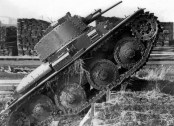 After the victory in the light tank tender for the Czechoslovakian army, CKD received a contract to build its P-II tank, adopted by the army under the index LT vz. 34. Another tender was declared soon after, which resulted in disappointment for CKD. The military did not like the light P-II-a tank. This time, Skoda celebrated victory, whose S-II tank was adopted as the LT vz. 35. However, CKD still managed to grab half of the contract for building the LT vz. 35.
Pz.Kpfw.38(t): Prize from Bohemia
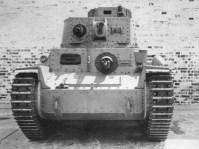 The LT vz. 38, the best Czechoslovakian inter-war tank, is more famous under another name, since it attained fame in another army. Indexed Pz.Kpfw.38(t) in the Wehrmacht, this tank became a symbol of Blitzkrieg, fighting in the advance guard of the German tank units. In the spring of 1940, tanks built in Prague smashed British and French vehicles who failed to come to Czechoslovakia’s aid two years prior.
Imagination Versus Hitler
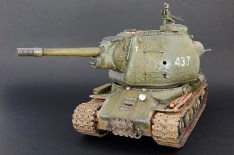 As practice shows, the temptation to make up your own tank is great. Sadly (or thankfully), few people are destined to become tank designers. Here is where limitless human imagination steps in to create more “improved” or completely fictional projects than there were real tanks made. Most of these made up tanks and SPGs belong to Germany. This is not surprising, since German dreams of Wunderwaffen firmly lodged themselves in people’s heads. However, a lot of made up tanks were “invented” for Germany’s enemies.
Steel Chimeras of the Red Army
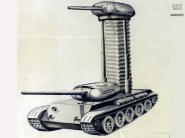 Scientific and technical progress has always been on the other side of the coin from war. Aiming to obtain instant superiority over the enemy, people who have never thought about the subject were as determined as those whose job was weapons design. In the years of the Great Patriotic War, self-taught designers earnestly believed that their tank or armoured cars can radically alter the course of the war. These designs remained on paper for obvious reasons, but accurately represent the spirit of their time.
Hellcat: Highway Tank Destroyer
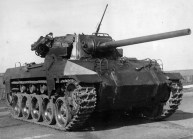 The 76 mm Gun Motor Carriage M18, more commonly known as the Hellcat, is one of the best known American wartime tank destroyers. With a powerful 76 mm gun and high mobility, the vehicle was an effective anti-tank measure. A number of sources mention that several Hellcats ended up in the USSR, but that is usually all information that is offered. This is not surprising, since, unlike the GMC M10, which was accepted into service, the M18 never made it past trials. More precisely, the USSR received the pre-production prototypes, indexed Gun Motor Carriage T70. What was the fate of these vehicles?
Light Tank M3A3: American Emigrant
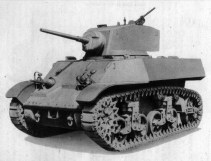 The American Light Tank M3A1 turned out to be a strange tank. On one hand, it had several superior characteristics to its predecessor, the Light Tank M3. Some elements of the design were a definite step forward. For example, the Americans began to use welding to assemble it. On the other hand, some design decisions reduced its battle worthiness. The tank became cramped and uncomfortable for the turret crew. It’s not surprising that another modernization quickly followed, which led to the most perfect form of the Light Tank M3 family: the Light Tank M3A3: a tank produced in large amounts, but almost ignored by the US Army.
Char B in German Service
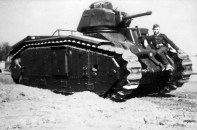 The mistake of choosing a “battle tank” (Char de bataille) as a main tank became obvious during the campaign in France in May-June of 1940. The French tank industry did not manage to shift its gears for war. As a result, by the time the German invasion began, the availability of Char B1 bis tanks was far from what was planned. In addition, some French tanks were lost to either technical problems or because of poor supplies of fuel and ammunition. Many of them fell into German hands. How did the German army use the Char B1 and vehicles on its chassis?
Renault NC: Destined for Export
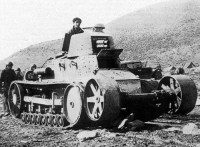 The Renault FT ended up being not only the best tank of WWI, but the most numerous one. Its production continued after the end of the war, and 3728 tanks were built by 1921. Meanwhile, the French army was no longer satisfied with the Renault FT. Even the infantry, which inherited the tank, was not thrilled with a vehicle that had a top speed of 3 kph off-road. To replace this “pensioner”, Renault designed a new tank called the Renault NC. Why were foreign armies more interested in this tank than the French?
Translated Articles from TankArchives.blogspot.com (June)
June 26, 2017 by Leave a Comment
It’s been a couple months since we looked at what Russian language articles the Tank Archives (formerly Archive Awareness) has translated into English. There are quite a few, so we have divided them into two posts, one for the articles from May and one for June. Click on the article headline to go to the full version of the piece.
Renault R 40: Incorrigible
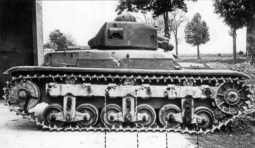 The Char leger Modele 1935 R that was accepted into service by the French army on April 25th, 1935, was a compromise. Created as a replacement for the Renault FT, it did not surpass its predecessor by much in speed, and the armament remained the same. Of course, the new tank had more powerful armour, but experience showed that you could not rely on it. The French infantry began looking at the FCM 36, an expensive tank, but one that was more suitable for the infantry tank role. The Renault R 35 could only be rescued with a modernization of its weakest link: the suspension.
Canon 25 mm S.A. Mle 1934: A “Baby” Gun for a Grown Up War
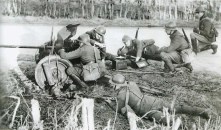 An old military saying states that “every army prepares to fight the previous war”. That is how the French generals acted when planning new anti-tank guns. Thinking about enemy tanks, they envisioned clumsy boxes, crawling across the battlefield at a pedestrian’s pace, protected with several centimeters of armour. To fight them, a small gun was needed, one that could be easily hidden on a crater-pocked field and pushed around with just the strength of the crew. The result of this line of thinking was the 25 mm anti-tank gun model 1934, Canon 25 mm S.A. Mle 1934.
Renault D1: FT on Steroids
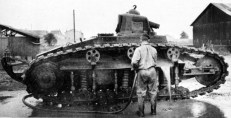 Attempts to modernize the Renault FT, the most numerous tank in WWI, gave unexpected results. Initially, only the low speed was unsatisfactory for the French military, but its tastes grew by the mid-1920s. Now, the thin armour, which was insufficient to protect the tank from high caliber machineguns, was also unsatisfactory. The result was the NC-1 tank, which was 2 tons heavier and had thicker armour, while being twice as fast.
Renault D2: De Gaulle’s Workhorse
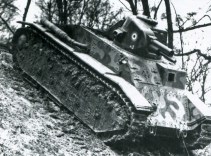 The heavy Char B1 tank became the symbol of French pre-war tank building, and General de Gaulle is frequently associated with it. The 36 ton tank might have been the best French tank was indeed the best tank that France had during the fighting of May-June of 1940. The tank’s thick armour worked well, even though the concept of the tank was obsolete. Interestingly enough, mass production of the Char B1 might never have happened, since the French military was considering a different tank for the role of their main tank in the early 1930s, with the same armament, same armour, but more than 1.5 times lighter. This was the Renault D2, the tank that Colonel De Gaulle served in.
LT vz. 35: Steel Fist of the First Czechoslovakian Republic
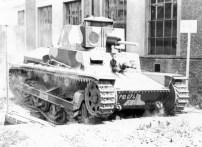 On April 19th, 1933, the Czechoslovakian army signed a contract with CKD to produce 50 light P-II tanks. This ended the 10 year long quest to build a domestic tank. The tank accepted into service on July 13th, 1935, as the LT vz. 35 was sufficiently modern. However, a year later, the Czechoslovakian military needed a better protected tank. This tank, the LT vz. 35, was destined to become the backbone of the Czechoslovakian armoured forces.
Praga LTL and Pzw 39: Tanks for Neutrals
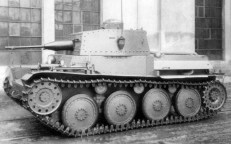 In May of 1935, an Iranian commission signed a contract with CKD for light Praga TNH tanks. At the moment, these tanks did not exist in metal, but the Iranians saw the potential in this design. A prototype was demonstrated in September of that year. The Iranian commission was so impressed that the order was increased to 50 tanks on September 10th. For this time, this was a very respectable amount of tanks for the export market. It’s not surprising that representatives from other nations came to Czechoslovakia to find inexpensive and high quality light tanks.
T-60 in Difficult Times
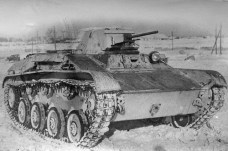 On July 20th, 1941, the State Committee of Defense (GKO) passed decree #222ss “On the production of 10 thousand light tanks”. Interestingly enough, the tank that was supposed to be built did not exist even on paper. The tank, later named T-60, was designed in a little over a week. The first tanks were built in September of that year, and full fledged mass production began in October. The Molotov Gorkiy Automotive Factory (GAZ), Kharkov Tractor Factory (HTZ), and factory #37 were tasked with producing these tanks. Meanwhile, reports coming in from the front indicated that the tank was in need of modernization.
T-60 From Stalingrad
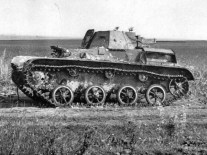 The T-34 tanks built in Stalingrad became one of the symbols for the battle there. The last tanks produced where went straight into battle from the factories, crewed by factory workers. T-60 tanks were less noticeable contributors to the breaking of the backbone of the German blitzkrieg. At the outskirts of the city, in Krasnoarmeysk, the T-60 tank remained in production at factory #264 for less than half a year. However, by volume of production, this “unplanned” factory was second only to the Molotov GAZ.
Book Alert: Soviet T-10 Heavy Tank and Variants
June 22, 2017 by Leave a Comment
A new book on the Soviet T-10 heavy tank is now available courtesy of Ospry Publishing. To those that like reading about tanks, Osprey is primarily know for their 48 page softcover New Vanguard series. This book however is an entirely different creature, being a hard cover volume of 232 pages. This book certainly has to be the most exhaustive study of the T-10 published in English. Two well established authors contributed to this book, the UK based author James Kinnear and US based author Stephen “Cookie” Sewell. As with other Osprey hardcover offerings, this is a very handsome volume with high quality paper and numerous photos and illustrations. If you are a fan of Soviet cold war armor, this title is highly recommended.
Publishers Description:
When it was introduced into service in 1953, the T-10 represented a return to the “classic” Soviet heavy tank. Although considered a major threat to NATO tank forces, it also represented the end of an era. All gun-heavy tanks like the T-10 would eventually be made effectively redundant by later models like the T-62 which had powerful next-generation armament and new ammunition types. The tank was gradually withdrawn from service in the 1970s, though the last tanks would only leave Russian service by decree of the President of the Russian Federation in 1997. As such the T-10 outlived the Soviet state that had created it.
Never exported outside of the Soviet Union and rarely used in combat, the T-10 has remained a mysterious tank, with many of its variants unknown in the West until very recently. This study, written from original Russian and Ukrainian primary source documents that have only recently been made available, uncovers the history of this enigmatic tank using 130 stunning contemporary and modern photographs of the T-10 as well as full color side-view artwork.

 When it was introduced into service in 1953, the T-10 represented a return to the “classic” Soviet heavy tank. Although considered a major threat to NATO tank forces, it also represented the end of an era. All gun-heavy tanks like the T-10 would eventually be made effectively redundant by later models like the T-62 which had powerful next-generation armament and new ammunition types. The tank was gradually withdrawn from service in the 1970s, though the last tanks would only leave Russian service by decree of the President of the Russian Federation in 1997. As such the T-10 outlived the Soviet state that had created it.
Available from Amazon at Soviet T-10 Heavy Tank and Variants
Bovington Tank Museum: Vickers Light Tank Mark IV Restoration
June 21, 2017 by 1 Comment
The Tank Museum at Bovington has released a new video documenting the restoration of a Vickers Light Tank Mark IV. It’s rather fun to see how little this tank is compared to the Leopard 1 tank behind it and Museum director David Willey standing next to it.

 Tank and AFV News