Over at the World of Tanks site, tanker and researcher Nicholas Moran has posted his thoughts regarding the first 100 years of tank history. It’s a good read, we have re-posted the start of the article below with a link to the full piece.
The Chieftain’s Hatch: 100-Year Icon
We’re now celebrating the second century of the tank, 100 years since the debut of tank combat in Flers-Courcelette (though the monument that marks the introduction of tank combat is in the nearby town of Pozières).
It’s no secret I’m kind of fond of tanks, and that I consider it quite fortunate that an object of my interest has also been my job, both in military and civilian service. But what has the tank actually become, and why is it so appealing, 100 years later?
Many moons ago, I picked up the book Tank by Patrick Wright, who took a slightly different tack than most folks in that he focused not so much on the technical or operational side of tanks, but instead more on the cultural and psychological aspects. The book received mediocre reviews because of this, but it’s worth reflecting upon its premise.
The tank is the symbol of land power. it’s usually the first image in one’s mind when thinking of modern battles. But it’s not the most important component of land power; that’s still the “poor bloody infantryman” (PBI) and his rifle. So, of all the various pieces that make up a modern army, why has the tank come out on top?

 A hundred years ago at the height of the Battle of the Somme , German troops waited at their posts to pick off the first Tommies venturing into the hell of no man’s land when the morning fog lifted. But instead of the normal glints of steel helmets, the beleaguered units, who had suffered 250,000 casualties so far, were not prepared for the First World War monster that was about to be unleashed on them. Rising from the mud, blood and gloom and brushing past the barbed wire protections like they were made of straw came the first tanks ever used in battle.
 A replica of a World War One tank has been placed in Trafalgar Square to mark the 100th anniversary of the war machine. The Mark IV tank, on which the replica is modelled, was first used in warfare in the Battle of the Somme on 15 September 1916. With 57,000 casualties on the first day it is regarded as the bloodiest day in British military history. The tank will be in position in the square until 11:00 BST. David Willey, from Dorset’s Tank Museum, which has provided the machine, said: “The British Army sent its new ‘secret weapon’ into action – and it did so in order to prevent the sort of casualties experienced on that first day of the battle.”
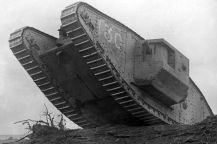 The tank, which would go on to dominate 20th Century warfare, first stormed on to the shattered battlefields of the Somme 100 years ago. Rushed into battle by desperate generals with barely any testing, its debut was a messy experiment with questionable results. A select group of young men were the first to feel its terrible influence and have their lives changed by it. William Dawson came from Boston in Lincolnshire and was the eldest of four children. His father had drowned at sea in 1898 when he was 10 years old and as soon as he left school, Dawson went to work to support the family.
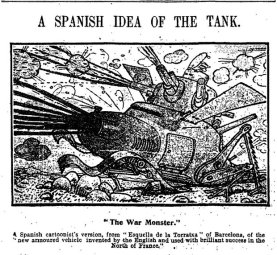 One hundred years ago the face of modern warfare changed forever when tanks were used for the first time. On the morning of 15 September 1916 the British attacked German positions at Flers-Courcelette – part of the larger Somme offensive – with 32 tanks. The results were decidedly mixed but this faltering introduction was not reflected in contemporary press reports. The Guardian and Observer enthusiastically reported on their deployment and the hope that they might break the stalemate. An initial report of ‘mystery machines’ appeared in the Observer on 17 September, containing a multitude of questions and speculations. ‘Do they attack as battering rams or as gun carriers, or both? Are we to conceive them as a sort of ironclad van…ploughing ponderously onward through hedges of wire, over holes, over trenches to the bewilderment and affright of the Hun?’
 Created by the Tank Museum at Bovington, this page includes a number of links to videos and articles on WW1 era tanks. These includes a number of profiles of some of the first “tank men.” Individual articles include:
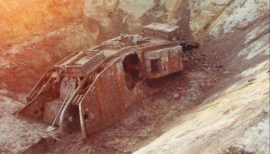 Start digging up history and you never quite know what you might unearth. Not infrequently wartime aircraft have been discovered, often with the remains of airmen still strapped inside. But only one First World War tank has been exhumed from the battlefields of northern France. With the Battle of the Somme at a stalemate, more than 340 tanks were positioned against the German forces at Cambrai in November 1917. It was an attempt to smash through enemy lines. Some 35 tanks were in D Company under the command of a Sydneysider, of which 10 were “knocked out” including one in which five of the eight crew died.
 One hundred years ago this week tanks made their first appearance on the battlefield and the face of modern warfare was changed for ever. They were large and unwieldy machines only capable of travelling at two miles per hour but as trench-crossing and barbed-wire crushing leviathans they were hailed as wonder weapons. Confirmation of the weapon’s abilities was provided by British commander-in-chief Sir Douglas Haig who immediately ordered 1000 further tanks putting the British armaments industry into overdrive with 90% of their armour plating being supplied by Scottish firms.
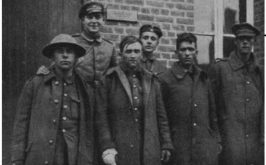 Organised amid the utmost secrecy the assault on the French village of Flesquières should have been a key element in the first mass tank attack in history. But the plan went awry when the attack was ambushed by the Germans, who managed to delay the British advance. For years historians struggled to explain why the enemy had obtained enough detail of the operation to rush reinforcements to Flesquières ahead of the planned assault Only now – nearly 100 years on – can it be revealed that the German high command was given notice of the attack by a group of captured British soldiers.
 A team of British and Australian war veterans will lead an archaeological expedition in France next year in what will be the first major dig of the Battle of Bullecourt in almost 100 years. The move aims to solve the mystery of the fate of a dozen British tanks that were deployed to support the 1917 assault of the German line by the Australian 4th Division but disappeared – leading to the slaughter of the Diggers in one of the biggest defeats of the Great War. News Corp Australia has learned the French government has granted the British Ministry of Defence an extraordinary permit to conduct an exploratory survey next month of the ill-fated battlefield in northern France. Further access will be sought for a full dig to take place in early 2017, coinciding with the centenary of the battle.
 Historian Richard Pullen, 44, from North Scarle, has discovered that Thomas Keightley fought in the battle on board a tank.
 Tank and AFV News