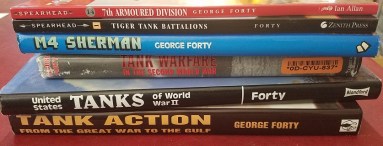
 We apologize for being a month late with this news. George Forty, author and historian, British Armor veteran and former Curator of the Tank Museum at Bovington passed away on May 19, 2016 at the age of 88. Mr. Forty was instrumental in making the Tank Museum at Bovington one of the best institutions of its type in the world during his tenure in the 1980’s and early 1990’s. He was one of the most prolific writers on the topic of armored warfare and armored vehicles as well, a sampling of which can be seen here. He also served as editor of the RTR (Royal Tank Regiment) Tank Magazine for many years.
From the Tank Museum website:
Lt. Col. George Forty served as Museum Director, than known as Curator, for twelve years from 1981.
Lieutenant Colonel George Forty, OBE, FMA, was a well-known military author specialising in Armoured warfare. He was born on 10 Sep 1927 in London, and was educated at Ashville College, Harrogate and The Queen’s College Oxford University.
He joined the Army in 1945, was commissioned from the RMA Sandhurst in July 1948 – the first intake to pass out after the war. He joined 1st Royal Tank Regiment (RTR) in the British Army of the Rhine (BAOR) and thereafter served for 32 years, seeing active service first in Korea, where he was wounded during the Hook battle in May 1953, whilst commanding a troop of Centurion tanks in support of the Duke of Wellington’s Regiment.
Later, he commanded an armoured reconnaissance squadron on operations in Aden, the Persian Gulf and Borneo. He attended the Staff College in 1959 and his staff appointments have included GSO 2 at the Army Air Corps Centre, GSO 2 (Author) and commander (GSO I) of the RAC Tactical School. His last appointment was as GSOI of the RAC Gunnery School. In total he served with 1 RTR (twice), 2 RTR (twice), 4 RTR (twice), 7 RTR (once) and 42 RTR (TA) (once), also at the RAC Signals, Tactical and Gunnery Schools.
He left the Army in 1971 to pursue a writing career and in 1981 was appointed Director of the Tank Museum. During the next twelve years with the inspirational help of his wife Anne, who worked alongside him, he tripled the size of the museum, modernised it and turned it into one of the foremost military museums in Europe. Shortly after retiring from the museum in 1993, he was made a fellow of the Museums Association (FMA) and was awarded with an OBE in the 1994 New Year’s Honours List.
As an author he wrote over 70 books which sold worldwide and were translated into many languages including German, French and Japanese. This included the History of the Royal Tank regiment. He also was the editor of the RTR Tank Magazine for many years.
Lt Col Forty was a gentle and happy family man who is always spoken of with affection and respect by all those that he served or worked with. He leaves behind his wife Anne and four sons Simon, Jonathan, Adam and Jason, nine grandchildren and one great grandchild.
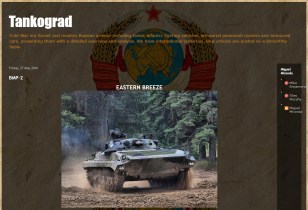 This iteration of the BMP family is technically excellent in the application of available technologies and the number of features it has, but if there is one thing that nearly all BMP-2 crewmembers know, it is that it is a rather unpolished product, if a brilliant one for its time. To the untrained eye, it might seem that the BMP-2 is simply a marginally more impactful rehash of the old and obsolete BMP-1 design, and while that is true, the sentiment and the connotations behind such an accusation point to an incorrect mindset. The BMP-2 is a product improved BMP-1, but it is not quite the same thing as its predecessor. Far from it. It is so heavily modified that the only similarities are in the general layout, and the powertrain, which was retained as is. Everything else was changed to some extent, the most obvious being, of course, the new turret, now bristling with gadgets appropriate with its era.
 Tank and AFV News