Wargaming Europe’s Richard “The Challenger” Cutland takes a look at the Soviet T-54/T-55 tank in the latest of his “Inside the Tanks” video series.
Chieftain’s Hatch: How Suitable was T29, Part 2
October 27, 2015 by Leave a Comment
 At the World of Tanks forum, Nicholas “The Chieftain” Moran has posted part two of his article on US post-WW2 heavy tanks. This installment of the article looks specifically at concerns expressed by the Armored Board in a report regarding the the T-29 and T-30 heavy tanks. The Armored Board seemed to have a more than a few concerns regarding heavy tanks, particularly one the topics of logistical support and transportation, as well as gun performance and armor.
Excerpt:
The US Army wanted a tank which I’m not sure even they believed was entirely possible with the level of technology then available. There was also a level of contradiction: They wanted a gun which was capable of defeating all likely armor possible of being placed onto a tank while, at the same time, wanting sufficient armor to be proof against any gun. The armor team and the gun team must have had some interesting discussions. More importantly, note the amount of emphasis placed on strategic and operational mobility. Getting a tank to move about the battlefield doesn’t seem to have placed anywhere near as many restrictions on the design, or taken as many processing cycles, as being able to get it to the battlefield in the first place. Granted, it was not wartime, but six weeks to collect enough railway rolling stock to move a battalion of medium tanks is a significant amount of time. Getting the rarer heavy capacity flatcars would have taken even longer. There is little surprise that Transportation and Engineering corps usually placed objections to heavy tanks when they came up.
It is interesting to note the comparative value of the T29 to the T30. T30 provided no particular improvement in anti-armor lethality, which seems to have been the driving force behind the heavy-tank criterion, and did better at dealing with bunkers and infantry at the cost of a very reduced rate of fire and ammunition capacity. Did the merits of the one bigger bang outweigh the overall weight-of-shell per minute that the two types of tank could fire? Perhaps T34 would prove to be the compromise blend. After all, when the US finally did decide to build a heavy tank in the M103, they went with the 120mm.
Tank chats #10 Crossley Chevrolet Armored Car
October 19, 2015 by Leave a Comment
The Tank Museum presents another installment in their series of Tank Chat videos starring David Fletcher. This episode takes a look at the Crossley Chevrolet Armored Car.
Armoured cars had proved so successful in India during the First World War, that shortly after its end the Indian Government ordered 16 Rolls-Royce cars. However, these proved so expensive that subsequent orders were placed with Crossley Motors in Manchester who made a tough but cheap 50hp IAG1 chassis. Substantial numbers of these cars were supplied between 1923 and 1925.
The car shown in this film was presented to The Tank Museum by the Government of Pakistan in 1951.
“Grizzly” tank sells for $155,000
October 19, 2015 by Leave a Comment
 According to several articles circulating the internet, a Canadian “Grizzly” M4 tank recently sold at auction for $155,000. Known as the M4A5, the Grizzly was a Canadian variant of the US M4 Sherman tank. Production of the Grizzly only proceeded to 188 copies before it was realized that US manufacturing capacity would suffice for US and Commonwealth needs. Grizzly production lines were then switched over to specialized vehicles based on the Grizzly hull such as the Sexton SPG.
According to an article from livescience.com:
The recent sale of the Canadian tank took place online via the New York-based auction platform Bidsquare. The tank was sold Wednesday (Oct. 14) by H&H Classics, an auction house that specializes in the sale of cars and motorcycles. Other Sherman tanks have been auctioned off in the U.S. in recent years. In 2014, several different variants of the Sherman tank were sold at auction. The largest of these, an M4A3E2 “Jumbo” Sherman assault tank, sold for more than $1 million.
The Grizzly, which sold for much less than the oversized assault tank, needs a bit of work to its electrical system and hydraulic cables to get it up and running, according to Bidsquare. In other words, a Canadian army tank could soon be rolling toward a town near you.
An article from the Ottawa Citizen provides more detail and photos of this particular Grizzly tank:
Reportedly used for training on both sides of the Atlantic rather than frontline combat, it is nonetheless thought that a few were deployed to Italy. Better preserved than their US contemporaries, some fifty-odd Grizzlies were sold to Portugal during the 1950s as part of the NATO military assistance programme. Demobbed three decades later several were brought back to the UK and have formed part of private and museum collections ever since.
Notable as the very first of the 188 made, CT160194 has been in the current ownership since 1984. Understood to have been used for training purposes during World War Two, the Grizzly I later saw service with the Portuguese Army. Despite reputedly participating in the Angolan War of Independence, the Sherman’s remarkable state of preservation suggests that it has never come under heavy fire. Loaned to various museums over the past thirty-one years including its present circa two decade stint at IWM Duxford, the tank is said to require minor recommissioning prior to use.
Noting that work is needed to various electric and hydraulic cables, the vendor variously rates the Grizzly as ‘excellent’ (engine, manual transmission, body), ‘excellent / good’ (paintwork) or ‘good / fair’ (interior). More complete and original than many of the Shermans that have come to market in recent years, CT160194 – a.k.a. Grizzly No.1 – has its own place in history.
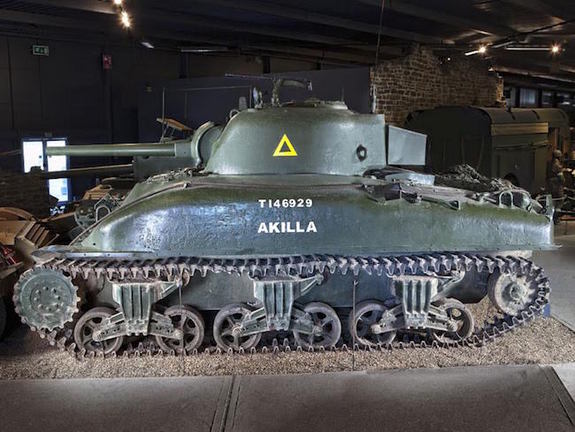 One thing not mentioned in the article is that the vehicle shown in the photographs has been given a paint job which includes the name “Akilla” and the number T146929 on the side of the hull. These markings are identical to those of a Sherman tank belonging to WWII British Tank Ace George Dring. Why someone chose to put those markings on a Grizzly tanks is not entirely clear. The tank has spent the last two decades at the Imperial War Museum at Duxford.
WW2 Era German half-tracks recovered from Polish river
October 19, 2015 by Leave a Comment
Two German WW2 era half-tracks have been recovered from the Pilica river in Poland by the historic military vehicle preservation group “Panzer Farm.” The two vehicles recovered consist of a Sd.Kfz. 250 light armored halftrack and a Sd. Kfz.7 medium towing vehicle. A photo-gallery of the Sd.Kfz. 250 recovery process can be seen on the Panzer Farm facebook page here.
This video is in Polish, but the footage should prove interesting to fans of German WW2 vehicles.
More information on this story available in this thread over at the AFV News Discussion Board.
Inside the Tanks: The M47 Patton
October 12, 2015 by 1 Comment
World of Tanks Europe has posted a new addition to their “Inside the Tanks” video series hosted by Richard Cutland. This episode takes a look at the US M47 Patton tank of hte 1950’s.
Tank wreck videos
October 8, 2015 by Leave a Comment
A new youtube channel called Wartime Wrecks has posted a couple videos in the past couple days of tank wrecks. These videos are really collections of still images set to trippy music.
Chieftain’s Hatch: How Suitable was T29? Pt.1
October 5, 2015 by Leave a Comment
Tank researcher Nicholas Moran has posted a new article in his “Chieftain’s Hatch” web forum. The post is a description of an Armored Board report from 1948 concerning future requirements of the heavy tank program.
Excerpt:
After the war, the US heavy tank program was in full swing. However, there was still some debate as to just what the heavy tanks would look like, or even what it is they were going to do. As a result, though it was accepted that the T28 and T29 series tanks were dead ends, they still provided some kernels for thought on the matter. Armored Board decided to put a more detailed writing down as to where the heavy tank program should go, if at all. Specifically, “to secure sufficient information on the employment of heavy tanks to form an intelligent basis on which future requirements for heavy tanks in the US Army may be determined.” The report was dated 30th June 1948.
This is a fairly long report, so I’m going to split it up into two parts. One the more philosophical outlook as to just what heavy tanks were supposed to be doing and the second, next week, will be on the practical matters relating to tanks of the T29 class in particular. Extract follows:
Background:
By current definition the term Heavy Tank includes those from 56 to 85 tons. The United States first developed a tank (Heavy Tank, M6) in this weight class in 1942; however, it failed to meet service requirements and was not produced. The German Mark VI (Tiger) appeared in 1943 followed by the Mark V (Panther) and a heavier more powerfully armed version of the Mark VI (The Royal Tiger). The Russian 50-ton KV, new in 1941, was succeeded by the Josef Stalin series in 1944. The Josef Stalin -3, a vastly improved fighting vehicle of the heavy tank class, weighs approximately 60 tons, is armed with a 122mm gun and as early as the summer of 1945 had been produced in considerable numbers.
Read the full post here.
Drive a Tank article
October 1, 2015 by Leave a Comment
It seems that every few months, some media outlet feels the need to send a reporter to crush a car in a tank. This time it’s the NY Daily News who features one of their writers crushing a car at Drive a Tank in Kasota MN. The article has a few nice photos of the interior and exterior of the M4A2 kept at the Drive a Tank facility. Here is a video of the article author crushing a car.
VMMV Open House Oct 3rd and 4th
September 26, 2015 by Leave a Comment
The Virginia Museum of Military Vehicles (VMMV) will be holding their 2015 Open House on October 3rd and 4th. VMMV is an organization dedicated to preserving military history and historic artifacts. They have in their collection a number of WW2 era armored vehicles, including quite a few US, British and Soviet tanks (view collection here.)
Event details:
The Museum’s 2015 Open House will be held on Saturday and Sunday, October 3 and 4, at the “Tank Farm,” 13906 Aden Road in Nokesville, Virginia. The event will be open from 10 a.m. to 4 p.m. each day.
Click here to register. Your registration helps us plan parking, food and other accommodations.
As always, educational and entertaining activities will highlight the stories of American veterans as well as the future Americans in Wartime Museum. Activities include:
Dozens of operational military vehicles
Tactical demonstrations by the U.S. Marine Corps Historical CompanyLiving history units in action
Helicopter fly-in and display
Voices of Freedom – our mobile oral history studio
Veterans’ roundtable
Kid-friendly activities
Much more!Children attend for free and we suggest a $10 donation per adult.
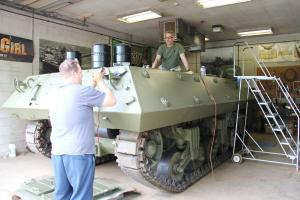
A newly restored M10 tank destroyer will be making it’s first public appearance at the open house this year. Pictures of the restoration process can be viewed here.

 Tank and AFV News